
As the sewing machine hums, Hafsatu Hamman focuses on the fabric in front of her, carefully guiding it through the machine to keep the stitches in line.
This is a typical day at Hamman’s tin shack, where she sews clothes for residents of the Wassa displacement camp in the Nigerian capital, Abuja, for an average of ₦300 ($0.3) a set – akin to the price of a small loaf of bread. Before the end of the month, she is expected to make her contribution of ₦4,000 to her Adashe group.
“We have a group of about 15 women. Everyone contributes ₦1,000 a week, but if that amount is too much, you can contribute what you can afford,” Hamman explained, speaking in the Hausa language that is commonly used in West Africa. “We understand that not everyone has the same means.”
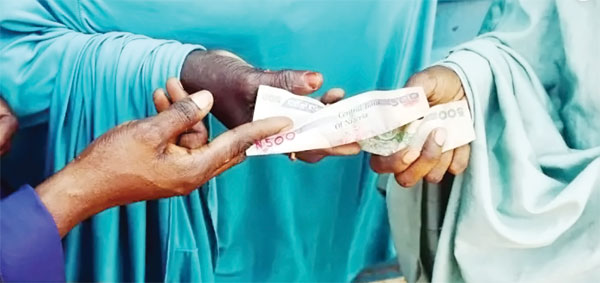
Adashe is the Hausa word for a traditional form of association whereby people contribute a certain amount of money that is then pooled and shared among the group’s members. The practice is believed to have originated in Nigeria before spreading across West and Central Africa, as far as the Caribbean, although similar money clubs are common all over the world. The pooled earnings can be a lifeline during emergencies, as well as a way to grow savings.
Hamman, 40, is one of 31,000* displaced people living in 18 camps around Abuja. Like most, she ended up there after escaping the Boko Haram conflict in the northeastern states of Borno, Adamawa, and Yobe. Since the insurgency intensified in 2014, over 35,000 people have been killed in a conflict marked by high civilian casualties, abductions, and a scorched earth military campaign that has deepened the humanitarian crisis in the region.
‘We came here without knowing anyone’
Hamman, who fled the Gwoza area of Borno in 2014 due to a wave of attacks by Boko Haram militants, recalled the moment she was forced to leave her village – and her sewing machine – behind.
Her journey from Gwoza to Abuja was long and difficult. She was forced to move from place to place in search of safety before finally settling in Wassa, the largest displacement camp in Abuja. It houses nearly 6,000 people – most are from northeastern Nigeria, and around 70% are women or children.
“We came here without knowing anyone or anything,” she told The New Humanitarian. “For the first year, we all just waited and hoped that we would soon be able to go back home. We didn’t think about doing something to help ourselves because we didn’t believe that we would be here for long.”
Even though they were physically far from the areas of violence, the conflict still affected them in profound ways. “It left us without access to basic necessities: no shelter, no clean water, no food, no clinics,” Hamman said.
‘I can help my family now’
Before it became a shelter for displaced people, Wassa was a low-cost housing estate. However, as the numbers of displaced people coming to Abuja increased, many were relocated there. Each bungalow houses several families. While some local NGOs had previously set up a primary school and a mobile clinic in the camp, these services are no longer operating. Camp residents say they receive food and medical aid once a year, and it’s not enough to meet their needs.
“Back home, I was a tailor, so I went looking for someone in the community who had a sewing machine that I could borrow. With it, I would sit by the roadside and would patch up clothes, ₦20 or ₦50 each. Sometimes, someone would give me up to 200 naira and I would be so happy,” Hamman said. “I wouldn’t spend all the money I made on food. I would put half of it aside to put into Adashe.”
Little by little, Hamman was able to save up enough money to buy her own sewing machine, and eventually she was able to build a tin shack to create a more permanent workspace.
“I can help my family now more than I could before,” she said, explaining how she can now afford to pay her children’s school fees – since the free camp school closed. “Aid [from local NGOs] still comes once in a while, but it is never enough,” Hamman added. “There are thousands of us here, but that does not matter to them. They give us what they can and it’s up to us to share it how we can.”
A sense of belonging
The Adashe system provides a safety net for displaced families living in the camp, allowing the women to save money in a collective fund, which can be used for school fees, medical care, farming supplies, and other family needs.
But in addition to providing financial assistance, Adashe clubs also offer a sense of emotional and mental support.
For women in particular, being part of such a group provides a sense of belonging and community, which can be especially important during times of adversity and uncertainty. Adashe also offers women a way to take charge of their own lives and make decisions about how the collective funds are used in their households.
‘Adashe is for people who have extra’
But not everyone can afford to participate in Adashe. As the cost of living has skyrocketed due to rising inflation, many people in the camps have struggled to make ends meet with the little they have.
Bintu Ali sells roasted nuts for a living in the Durumi camp, which is sandwiched into a middle-class area of Abuja and houses over 3,000 people. She doesn’t make enough money to save. “All the money I make goes towards [paying for household items],” she explained. “Adashe is for people who have extra.”
People who are unable to join Adashe groups can feel a sense of exclusion.
While it may be difficult for displaced women to participate in such groups on their own, cash transfers from aid organisations can help them gain access to these support systems. A World Bank study in Niger found that cash transfers led to an increase in women’s participation in Tontine, a type of local savings group similar to Adashe.
One of the main challenges with Adashe systems is the lack of regulation. Because they’re often based on mutual trust between members, they lack formal structures to ensure all members contribute fairly or receive their fair share of the savings when it’s their turn.
While this flexibility can be advantageous, especially for women in displaced settings, it can also lead to problems if members aren’t honest or responsible.
In 2022, a local NGO, Stand with a Girl Child, gave 20 women funds to boost their small businesses. Instead, the women decided to invest it in an Adashe group. Hamman said some members stopped contributing when they received their share of the money, causing most of the women to lose their savings.
“Sometimes people will take their share of the money and stop contributing,” said 50-year-old Liyatu Ayuba, who lives in Durumi. “Others may have an urgent need for money and, rather than being honest and asking the next person on the rotation if they can swap places, they may lie to the leader of the group. This can cause a lot of confusion and mistrust, which can damage the sense of community.”
‘We decided to just settle where we found others like us’
Ayuba’s journey to Abuja was filled with grief and loss. She and her family had been living in Imo State in the southeast, but in 2014 her husband, a soldier, was called to serve in Bama, a town that has repeatedly been attacked by Boko Haram insurgents.
“They said all soldiers from Borno should go back for peacekeeping, and they took my husband to Bama. From there, my husband died in active service, shot by the Boko Haram boys,” she said.
After her husband’s death, Ayuba embarked on a 1,200-kilometre journey to Maiduguri, Borno’s capital, in search of a fresh start, but tragedy struck again when her son Daniel was seriously wounded in a Boko Haram bombing. After several hospital transfers, the pair moved to Abuja hoping it would help him recover.
“Many people died in that explosion, but not Daniel. He was badly injured and had surgery after surgery but was not healing,” Ayuba explained. “Most of our money was gone in hospital bills, so we decided to just settle where we found others like us.”
Ayuba said there were fewer problems during the first two years: “We had the attention of the government, and so we had better chances of being heard. We got food, soap, clothes, mosquito nets on a regular basis.” Now, almost a decade later, she said the camp has become increasingly overcrowded, putting a strain on resources. The food, water, and other relief materials provided have become insufficient.
In Ayuba’s Adashe group, five women contribute ₦500 each day to the collective fund, which then totals ₦75,000 by the end of each month. This money is then split between two members on rotation, giving each a sum of over ₦35,000. This is more than the minimum wage in Nigeria, and has helped Ayuba to support herself and her family.
‘I know the importance of school’
Ayuba is viewed as a maternal figure by many of the young people in the camp, particularly those who lost their parents during the conflict. She has 12 children directly under her care.
As well as providing emotional support and guidance, Ayuba helps pay their school fees and other essential needs, which Adashe allows her to save for. “I know the importance of school for these children, and I am doing everything to help,” she said.
“Sometimes the [Adashe] money is not enough for all of us to get everything we need, but it allows us to get by. Some of my teenage girls joined a group too recently, and they are due to get their share before Christmas. They tell me they will buy their Christmas clothes, so at least I can take that off my hands,” Ayuba said, smiling.
While Adashe and other money clubs may not be exclusively for women, in Abuja’s displacement camps they are often organised by and for women. This is because many of the displaced women are widows, while others lack the same work opportunities that the men have.
The women are also better connected to the community. This allows them to navigate the complex dynamics of the groups and ensure their contributions are safe and used effectively.
How aid groups can help
Some women who are not yet part of any Adashe group (like Kaltume Ali, who is knitting a cap in the Wassa camp above) told The New Humanitarian they would be keen to join if they could get financial help to do so – even instead of food rations if it would help them more over the long term.
Tijjani Babakura, a humanitarian and development programming specialist based in Nigeria, said that strengthening systems like Adashe was key to empowerment. “When organisations try to support and empower people, they often go about it the wrong way and identify the wrong people to support,” he said.
WATCH TOP VIDEOS FROM NIGERIAN TRIBUNE TV
- Relationship Hangout: Public vs Private Proposals – Which Truly Wins in Love?
- “No” Is a Complete Sentence: Why You Should Stop Feeling Guilty
- Relationship Hangout: Friendship Talk 2025 – How to Be a Good Friend & Big Questions on Friendship
- Police Overpower Armed Robbers in Ibadan After Fierce Struggle


