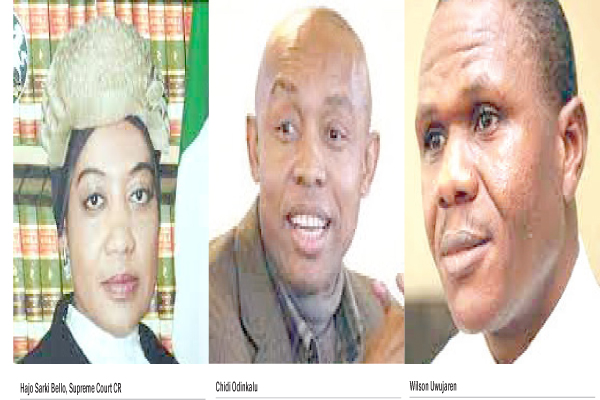
YEJIDE GBENGA-OGUNDARE examines the law setting EFCC up and its current application which is causing constitutional ripples.
Last week, the Media Office of the former Governor of Kogi State, Yahaya Bello, accused the Economic and Financial Crimes Commission (EFCC) of abusing its prosecutorial powers following a botched attempt to get the ex-governor arrested and arraigned, describing the EFCC’s activities as “nothing but a desperate political witch-hunt”.
“Looking at the curious and endless scenarios of duplicated charges, cross-charges, counter and frivolous charges by the EFCC against former Governor Yahaya Bello, it has become crystal clear that the whole onslaught is nothing but a desperate political witch-hunt of the immediate past Governor of Kogi State,” it alleged.
Bello would not be the first former governor to challenge the constitutionality of the power being wielded over state helmsmen, by the Commission, a creation of the federal government, considering that Nigeria is a federal set-up and the State House of Assembly is responsible for the fund allocation to the executive at the state level.
From Lagos to Abia, from Rivers to Ondo and states in the North, the prosecutorial powers of the Commission and the extent of application, have been queried multiple times, albeit, without success.
Under now-late Governor Adebayo Adefarati, Ondo State, was the first, to use the federal structure of the country, to strike down the federal body, but was saved by the Judiciary. States like Lagos and Abia went ahead to create own anti-corruption bodies, with little or no success in applicability and operation.
The numerous successes of the Commission in the judicial battles to determine the boundary of its prosecutorial powers have not stopped critics from pointing out alleged trespass by the anti-graft body whenever they think so.
A recent instance is the prosecution of two prominent Nigerians; controversial crossdresser, Idris Okuneye, popularly known as Bobrisky, and Pachal Okechukwu, popularly known as Cubana Chief Priest, for alleged naira abuse.
The anti-graft agency has dragged both Bobrisky and Cubana Chief Priest to the Federal High Court in Lagos for prosecution for the said offence, following their arrest
Bobrisky, who was arrested by the EFCC at Pinnock Estate in Lagos State was docked before Justice Abimbola Awogboro on a six-count charge of allegedly laundering N180 million through his company BOB EXPRESS and tampering with N490,000, by spraying.
While the first four counts of the charge signed by EFCC counsel, Rotimi Oyedepo (SAN), alleged that the defendant abused the naira, the last two counts bordered on alleged money laundering.
The offence allegedly committed on March 24, 2024, was said to be contrary to, and punishable under Section 21(1) of the Central Bank Act 2007. Upon the reading of the charge, Bobrisky owned up to the offence of naira abuse. However, prior to the reading of the charge, EFCC’s lawyer had asked the court to strike out counts five and six.
He said: “We have an agreement with the defendant which will lead us to withdraw counts 5 and 6. In the circumstance, we’re humbly urging the court to strike out counts 5 and 6, leaving counts 1 to 4 alive.”
The EFCC again on April 17, 2024, arraigned Pascal Okechukwu, a.k.a Cubana Chief Priest, on a three-count charge bordering on abuse of naira before Justice Kehinde Ogundare of a Federal High Court in Lagos.
Lacking jurisdiction?
There is an argument that naira abuse as set out under the Act of the Central Bank of Nigeria (CBN) does not constitute economic or financial crime under which the anti-graft agency is empowered to prosecute. There were also arguments that spraying of naira does not constitute economic and financial crime, and as such does not fall within the prosecutorial mandate of the EFCC.
Critics of the Commission argued it has no powers, locus standi and competence to prosecute people for naira abuse.
The condemnation was led by a former Chairman of the National Human Rights Commission (NHRC), Chidi Odinkalu, a professor of law, who said EFCC lacks the powers to prosecute people for naira abuse, adding that spraying of naira, does not fall within the commission’s prosecutorial purview.
“The law that establishes the EFCC defines ‘economic and financial crimes’ to mean ‘non-violent criminal and illicit activity committed with the objectives of earning wealth illegally either individually or in a group or organised manner thereby violating existing legislation governing the economic activities of government and its administration,” he said.
Responding, EFCC, in a statement, signed by Dele Oyewale, its Head of Media and Publicity on April 5, described the comments as reckless, adding that “the commission views such commentaries from Odinkalu as unbecoming of a former head of a major government agency”.
Portions of the statement further read, “Okuneye was arrested and arraigned by the commission on the basis of clear cases of abuse of the Naira to which he has pleaded guilty. Odinkalu has a right to free speech as a Nigerian but such a right should be exercised with decorum and responsibility. The Commission would not hesitate to take appropriate legal actions against such uncouth commentaries against its lawful mandate by anyone. Odinkalu is warned and advised to ventilate his rascally opinions more responsibly in future situations.”
But other senior lawyers have supported Odinkalu’s assertions. Chief Solo Akuma (SAN), said abuse of naira as set out under the CBN Act does not constitute economic crime or financial crime under which the EFCC is empowered in Section 46 of the EFCC Act to prosecute, adding that such prosecutorial power lies with the police or CBN, a statutory body that can be sued and can also sue. He described the EFCC as a meddlesome interloper and a busybody when it comes to prosecuting people for naira abuse.
Also, a former President of the Nigerian Bar Association (NBA), Dr Olisa Agbakoba (SAN), said the Supreme Court has decided that the scope of powers available to the EFCC is very limited in the case of Nwobike Vs EFCC, adding “I very much doubt the power of the EFCC”.
He further said, “EFCC was created for a purpose; it is created for grave economic and financial crimes. The EFCC has no powers at all to do what is doing when it comes to naira abuse. It should focus on the bigger issues and stop wasting the nation’s resources.”
While there seems to be a consensus among senior lawyers that naira abuse or mutilation; naira spraying or sprinkling, is outlawed under the CBN Act, the EFCC was set up to prosecute economic and financial crimes and the Commission is believed to be lacking in full powers, to prosecute the offence of naira abuse.
A legal practitioner, Tony Oruah, said the answer to the question is simple if the Act that set up the Commission is x-rayed.
He said, “the prevalent question is not whether spraying of naira is a crime but whether it falls within the purview of economic and financial crimes or an offence that should be pursued by primary law enforcement institutions. To determine whether EFCC is going beyond its mandate by prosecuting offences bordering on naira abuse, we must look at the law that set up the agency.”
Mandate
In every society, it is a priority to promote and protect integrity, accountability and due process in institutions so that they will not be undermined.
This accountability quest, according to the government of Olusegun Obasanjo, was what gave birth to the EFCC with the primary focus of upholding sanctity in the business of government, incorporated entities and even private dealings of individuals.
It was established by an Act of the National Assembly in 2004 to investigate, prosecute and prevent economic and financial crimes in all parts of the federation; and despite being a federal government agency, their jurisdiction is not limited to public office holders or appointed officials across federal government parastatals, but also extend to other levels of government, the private sector and down to individual citizens.
While the extent of EFCC’s powers has caused arguments and contradictory views, the functions and power are clearly stated in Section 6, 7(1) and 13(2) of the Act. Section 6 provides that the Commission shall see to the enforcement and the due administration of the provisions of this Act; investigation of all financial crimes including advance fee fraud, money laundering, counterfeiting, charge transfers, futures market fraud, fraudulent encashment of negotiable instruments, computer credit card fraud and contract scam among others; coordination and enforcement of all economic and financial crimes laws and enforcement functions conferred on any other person or authority.
Also, it is saddled with the adoption of measures to identify, trace, freeze, confiscate or seize proceeds derived from terrorist activities, economic and financial crimes-related offences or the properties the value of which corresponds to such proceeds.
It can also adopt measures to eradicate the commission of economic and financial crimes.
The Commission is also empowered to adopt measures which include coordinated preventive and regulatory actions, introduction and maintenance of investigative and control techniques on the prevention of economic and financial related crimes.
It can also facilitate rapid exchange of scientific and technical information and the conduct of joint operations geared towards the eradication of economic and financial crimes.
It is equally into examination and investigation of all reported cases of economic and financial crimes with a view to identifying individuals, corporate bodies or groups involved as well as determination of the extant of financial loss and such other losses by government, private individuals or organizations while collaborating with government bodies both within and outside Nigeria.
The investigative powers of the commission are vast in nature as set in Paragraphs 6(b), (d), (e), (f), (g), (h), (i), (j), (m) and (n) which explicitly give the commission the powers to investigate all variations of economic and financial crimes, including identifying masterminds, whether corporate body, or individuals, and determining the extent of financial loss, while taking practical steps to recover loot and restore same, to victims.
Oruah complained that “Sections 7 and 13 will draw the conclusion that the powers are vested without any limitations as its provisions are vast but the investigative and prosecutorial powers of the Commission will always be put to test.”
Judicial pronouncements
In ruling on the prosecutorial powers of the EFCC in previous matters, the apex court held in the case of NYAME v. FRN (2010) 7 NWLR (PT.1093) 344 at 429, PARAS E-G, inter alia that “It is not a defense known to law that an accused person cannot be prosecuted by the authority with prosecutorial powers on the ground that the prosecutor is not the owner of the stolen items.
“Criminal offence is an offence against the state. A prosecutor need not have an interest in the subject matter of the complaint before he can prosecute an accused person.
“He is protecting the state and its citizens and every prosecutor or authority or agency vested with the powers to prosecute should be encouraged to carry out their duties, provided that the due process is maintained and followed.”
A legal practitioner, Goke Aina, stated that” while the court has in a myriad of judicial pronouncements, held that the power to prosecute the commission of an offence is not limited by the ownership of the property being alleged to have been stolen, there has been no major pronouncements on money mutilation and until there is a pronouncements, every opinion is based on interpretation which may be coloured by individual perspectives.
“So, there is a need for such to be decided by the courts so that there will be a pronouncement of law on the law in order to put an end to contradictory views.
“Statutorily, EFCC has the mandate to investigate and prosecute any allegation of economic or financial crime by any person in Nigeria, notwithstanding the person in whom the ownership of the property is vested. The statutory and judicial authorities have created no derogations to the powers of the Commission to investigate and prosecute economic and financial crimes in Nigeria,” he added.
However, a social commentator, Olumide Ajofoyinbo, stated that “the powers of investigation and prosecution of crimes granted to the Economic and Financial Crimes Commission under the Act are not at extensive as presumed; they are actually restricted and exercisable in relation to financial crimes as exhibited in the money laundering and other similar acts.
“But, today, the EFCC is used to settle contract disagreement, recover debts and other civil issues including crimes bordering on bribe-taking by public officers which should not be in its purview. They are exercising powers that are exercisable only by the Nigeria Police.
“This must be the reason that Court of Appeal ruled that the EFCC has no powers to investigate and prosecute a serving High Court judge for bribe-taking in the course of performing his official duty. I think it is time for the commission focus on its mandate despite the powers and immunities conferred on the EFCC in Section 41 of the EFCC Establishment Act, 2004. The EFCC has apparently turned itself into a political tool and this has to stop.”
ALSO READ: One feared killed, two others injured in LAUTECH students’ clash
WATCH TOP VIDEOS FROM NIGERIAN TRIBUNE TV
- Relationship Hangout: Public vs Private Proposals – Which Truly Wins in Love?
- “No” Is a Complete Sentence: Why You Should Stop Feeling Guilty
- Relationship Hangout: Friendship Talk 2025 – How to Be a Good Friend & Big Questions on Friendship
- Police Overpower Armed Robbers in Ibadan After Fierce Struggle