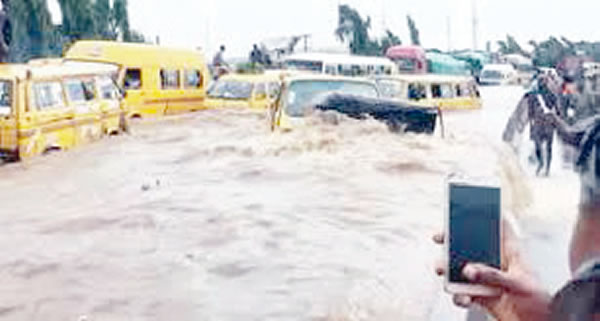
Insurance is a pivotal instrument to reduce flood risk but the extent to which insurers can help the society depends very much on how flood insurance coverage is arranged and this varies from countries, writes JOSEPH INOKOTONG.
Insurance can be an important mechanism to stimulate flood risk reduction and thus decrease losses. However, there is a gap between the theoretical potential and the actual engagement of insurers.
The purchase of insurance policies like flood insurance can help protect one’s property and belongings from damage caused by flooding. Homeowners and renters’ insurance policies typically cover water damage caused by broken pipes, but may not cover damage caused by flooding, therefore, policyholders should consider adding water damage coverage to their policies. Increased deductibles can lower premiums and help save money on insurance.
Flood insurance and water damage coverage are available in many countries, but availability and coverage can vary depending on the country and the specific insurance provider. Some countries have government-sponsored flood insurance programmes while others rely on private insurers.
Those concerned about their assets being protected from flooding should research the options available and speak with an insurance agent to find the best coverage for their needs.
In countries where flood insurance or water damage coverage is not available, there are steps to take to protect assets from flooding. Mitigation entails taking steps to reduce the risk of flooding, such as elevating a home above the base flood elevation or installing flood barriers.
Emergency preparedness is necessary to create an emergency plan and stockpile supplies to help mitigate the effects of flooding. Government assistance can provide temporary succor as some governments provide financial assistance to people affected by floods.
Flood insurance and water damage coverage may cover some or all of the structural damage to the property and belongings. Loss of use, which covers additional living expenses if the insured property is uninhabitable due to flooding; personal property damage, including furniture, appliances and other belongings and vehicles that are damaged or destroyed by flooding. Loss of life may be covered by life insurance or through government assistance programmes.
Flood insurance policies often have a waiting period before coverage takes effect. This waiting period can vary from a few days to 30 days and flood insurance premiums can vary depending on many factors, including the location and elevation of the property. Policies typically exclude coverage for damage caused by sewage backup, surface water, or water from an adjacent body of water.
Insurers are engaged either directly, through co-financing risk reduction, or indirectly by giving incentives to policyholders or governmental actors to adopt risk reduction measures. Risk reduction measures like awareness-raising campaigns targeting citizens are often quite common across several countries.
The use of risk-based pricing as an incentive for the adoption of risk reduction measures as suggested by some experts is difficult in practice, due to barriers such as information gaps on the effectiveness of property-level protection measures and requirements concerning the affordability of insurance. New approaches to overcome these shortfalls include organised data collection on property-level protection measures or the insurance of high-risks for affordable premiums in public-private partnership arrangements with the government.
Economic losses from weather-related hazards are already high and are expected to increase in the future. Mainly socioeconomic developments, but also climate change, can largely be held accountable for rising loss trends, with valuable assets increasingly exposed to flood risks. The negative impacts of rising flood losses challenge governments, the public sector and the private sector to develop sustainable flood risk management mechanisms aimed at reducing those losses.
Acknowledging the slow progress and limited success of climate change mitigation in reducing greenhouse gases, sustainable adaptation is seen as one necessary management strategy to reduce and manage the risks of climate change. Adaptation is defined as an adjustment to actual or future implications of climate change aiming to avoid harm or to exploit benefits. It should be noted that in natural hazard research, the terms “adaptation” and “mitigation” are often used synonymously in the sense of reducing impacts or losses.
Flood risk is generally determined by the hazard itself, the population, assets and values at risk from being flooded and the vulnerability of society, their capacity or ability to cope with flood events. Thus, flood risk reduction measures can be classified according to which of the flood risk determinants they influence.
Another important aspect is that different flood reduction measures address floods of different strength and return periods, while emergency management and adaptation measures are best suited to avoid or reduce losses from minor flood events with a high return period, successful land-use planning has the potential to avoid not only losses from minor events but also from more seldom extreme events. Risk knowledge and warnings are considered to be preconditions that facilitate or enable the implementation of other risk reduction measures.
Insurance has a special role in this context, as it is not primarily meant to avoid or reduce losses, but to compensate for losses after seldom severe events and thus facilitate recovery. Flood risk management today relies on a mix of structural and nonstructural measures.
Flood risk management is often framed as a cyclical process starting with a flood event. As a direct response to the flood event, already during the flooding, emergency measures can be taken to limit negative impacts and the destruction of valuable items. In the recovery stage, when the flood is over, damage is repaired and affected societies will try to return to “normal life” or pre-flood conditions.
In the “risk assessment” phase, the flood risk is assessed systematically to inform the planning of risk reduction measures in the “risk reduction” phase. In reality, these phases are often linked with each other; risk reduction measures can be implemented while damage is repaired.
Experts say that over 90 percent of all deaths from natural disasters are water-related, and 99 percent of deaths from floods from 1975 to 2001 were from low-income groups. In richer countries, total disaster losses are generally less than two percent of the Gross Domestic Product (GDP), while in poorer countries the figure is nearly 14 percent.
Architects have an important role to play in helping society to become more resilient but so do insurance companies. Some of the leading insurance companies have considered climate change adaptation very seriously. Dry seasons will generally be drier with drought and subsidence problems, but there will still be extreme rainfall leading to flooding as was demonstrated in some jurisdictions. There is a growing realisation that civil engineering solutions are not enough. For flood management to be sustainable other, more natural flood management is needed. The insurance industry will have an increasingly important role in helping society to adapt and become more resilient.
Some ways in which insurers can help are assistance with identifying areas at risk, catastrophe modeling, economic incentives to discourage construction in the flood plain, collection of data on the costs of flood damage to feed into benefit-cost appraisals for flood management schemes, promotion of resilient reinstatement techniques and promotion of temporary defence solutions.
The extent to which insurers can help society depends very much on how flood insurance cover is arranged and this varies depending on the country. It also depends on how sophisticated the country›s insurers are in mapping flood risks and how much the insurers are regulated by the government. The more the regulation, the less the insurers can use market forces to manage the risk.
There are many different approaches to insurance in different countries around the world. Where private flood insurance cover is available (and it is not available in all countries) such different approaches can be categorised into just two basic types, what Crichton calls the “option” system and the “bundle” system.
Under the option system, insurers agree to extend their policy to include flood on payment of an additional premium. There are some problems with the optional cover. Apart from the problems of defining what “a flood” means so it can be excluded, the biggest problem is adverse selection. Adverse selection means that insurers tend to select against customers by only making the cover available in areas they consider to be safe, while customers select against insurers by only buying it in areas they deem to be risky. The result is that cover, when it is available at all, is expensive and has very low market penetration. Such insurance is unlikely to be sustainable because a big enough “book” of business cannot be achieved. In countries where the government will step in to compensate flood victims, this further reduces the effective demand for insurance.
In the bundle system, flood cover is only available if it is “bundled” with other perils, such as fire, storm, theft, earthquake, etc. With the bundle system, insurers have the freedom to charge differential rates, but excessive rate increases can be mitigated because the risk is not only spread over time, but across perils, and rating areas. People living in areas safe from flood still have to buy flood cover if they want to get earthquake cover and vice versa. This system is characterised by much higher market penetration because everyone is paying for flood insurance whether they think they need it or not, this reduces the opportunities for adverse selection by customers.
Drains and sewers in towns and cities could be particularly affected by climate change and increased flooding. Short-duration rainfall events will become more severe, resulting in more flooding from drains and sewers.
ALSO READ: Atiku blames govt’s failure for journalists, others’ kidnapping
WATCH TOP VIDEOS FROM NIGERIAN TRIBUNE TV
- Relationship Hangout: Public vs Private Proposals – Which Truly Wins in Love?
- “No” Is a Complete Sentence: Why You Should Stop Feeling Guilty
- Relationship Hangout: Friendship Talk 2025 – How to Be a Good Friend & Big Questions on Friendship
- Police Overpower Armed Robbers in Ibadan After Fierce Struggle