
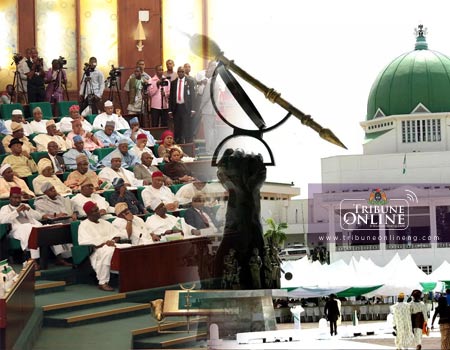
Chairman of the Movement for Credible Election, Usman Bugaje, has declared that the National Assembly has “lost credibility” over the passage of the 2026 Electoral Act, insisting that what lawmakers approved departed from the clear demands of Nigerians.
Bugaje made the remarks on Sunday night’s Politics Today, on Channels Television, anchored by Seun Okinbaloye, where the controversy surrounding the new Electoral Act took centre stage.
The conversation was triggered by comments of the Senate Leader, Opeyemi Bamidele, who had earlier maintained that broad consultations were held with civil society groups, the National Assembly, the Independent National Electoral Commission (INEC), and other stakeholders, and that the Electoral Act 2026 reflects the majority wishes of Nigerians.
ALSO READ: Police arrest six suspected car thieves, recover three vehicles in Kano
But Bugaje strongly disagreed.
“I don’t agree with the position of the Senate Leader, Senate Opeyemi Bamidele. And I don’t think Nigerians agree with his position,” he said.
“It is very sad that someone of his standing would speak in this manner. Is he assuming that Nigerians do not know what happened in the Senate? His own colleagues came out chanting ‘APC ole.’ The cameras were there. Nigerians saw it. You cannot insult our intelligence by pretending otherwise.”
He accused the Senate of deliberately resisting mandatory real-time electronic transmission of results and introducing ambiguity instead of clarity. “The Senate resisted mandatory real-time electronic transmission of results. When pressure mounted, they introduced ambiguity instead of clarity. These things happened in full public view,” he stated.
Bugaje argued that prior controversies had already eroded public trust in the legislature.
“Before this, there was the issue of the tax law, the version signed was reportedly different from what was passed. A committee was set up. Till today, Nigerians have heard nothing about that committee,” he said.
“So when the National Assembly has already lost credibility, what reason do we have to simply believe verbal assurances?”
At the heart of his criticism was the absence of what he described as a clear, mandatory provision for real-time electronic transmission of results.
“Nigerians have consistently demanded mandatory real-time electronic transmission of results. Eight years ago, institutions responsible for communications infrastructure confirmed 93 percent network coverage and that was during the era of 3G and 4G. Today, we have 5G,” Bugaje argued.
“Bandits in remote forests upload videos on TikTok. So what infrastructure excuse are we talking about? INEC itself said during public hearings that it is ready for real-time electronic transmission. So what exactly is the problem? Unless the intention is to rig.”
He dismissed other reforms cited by the Senate as insufficient in the absence of what he called the “core transparency mechanism.”
“All these other provisions are cosmetic if the core transparency mechanism is weakened. If you truly want credible elections, insert clear mandatory real-time electronic transmission. That is the real reform,” he said.
Also speaking on the programme, the Executive Director of YIAGA Africa, Samson Itodo, insisted that the final law diverged from what was agreed during consultations.
“Absolutely not,” Itodo said when asked whether civil society’s demands were reflected in the 2026 Act.
“Yes, there may be progressive provisions in the 2026 Act. But the central issues affecting election integrity were ignored or distorted.”
He pointed to Section 63, which provides for electronic transmission of results but retains Form EC8A as the primary legal document for collation and declaration.
“It states there shall be electronic transmission of results. However, it also says that Form EC8A remains the primary legal document for collation and declaration. What does that mean? It means that electronically transmitted results have no superior legal effect. They are secondary. Historically, Form EC8A has been the instrument used for manipulation,” he said.
“Nigerians are saying: if EC8A remains supreme, then falsification at that level overrides whatever is transmitted electronically. That is the core problem.”
Itodo further argued that the legislative outcome did not reflect public sentiment.
“The voting pattern in the National Assembly did not reflect the will of the people. Public hearings and consultations clearly showed Nigerians wanted stronger guarantees,” he said.
“Representation is not symbolic; it requires listening. Town halls were held. Public submissions were made. Even within the National Assembly, several lawmakers opposed these contentious provisions. Yet what was passed departed from what was discussed.”
He warned that changes affecting INEC’s funding timeline could weaken its independence.
WATCH TOP VIDEOS FROM NIGERIAN TRIBUNE TV
- Relationship Hangout: Public vs Private Proposals – Which Truly Wins in Love?
- “No” Is a Complete Sentence: Why You Should Stop Feeling Guilty
- Relationship Hangout: Friendship Talk 2025 – How to Be a Good Friend & Big Questions on Friendship
- Police Overpower Armed Robbers in Ibadan After Fierce Struggle


