
By: Chinyere Chukwudi-Okeh
Long before Emmanuel Otozi Ekuma ever held a flute or touched a drum, the Igbo people had already composed the story of what he would become.
The legend of Ojadili is one of the most enduring in Igbo oral tradition. Ojadili was a wrestler of supernatural ability, undefeated in the mortal world and eventually so consumed by his own legend that he danced his way into Ala Mmuo, the Land of the Spirits, and wrestled the most fearsome multi-headed beings of the underworld into submission. He did not do this alone. Beside him, every step of the way, was his personal Ofu Ọ́jà, a flute player whose music fuelled him, filling his body with what the Igbo call igba ume, the superhuman adrenaline that ancestral praise can unlock. The ọ̀jà called out Ojadili’s lineage, his titles, his greatness, and he grew invincible on the sound of it.
Then came the moment the flute changed its tune. Drunk on glory and still hearing the roar of his own praise music, Ojadili demanded to wrestle one opponent more, his own Chi, his personal guardian god. His terrified flute player shifted immediately from a victory song to a weeping rhythm, playing Ngororo ngoro didi ngoro, pleading with his champion to bow down and retreat. Ojadili could not hear the warning through his own pride. His Chi lifted him with one hand and smashed him to the earth.
Igbo elders tell this story to explain something that goes beyond wrestling. The ọ̀jà is spiritually potent enough to make a man perform miraculous feats. But it also carries warnings, and a man who does not listen to those warnings will meet his downfall precisely because of the music that once made him great. The flute, in other words, is always saying something. The question is whether the person hearing it has the wisdom to understand.
Emmanuel Otozi Ekuma grew up in Ebonyi State in southeastern Nigeria, understanding this at a level that precedes explanation. “Growing up in Ebonyi State, Nigeria, culture was my classroom,” he says. “Igbo festivals, drumbeats, and traditional dance surrounded my childhood. Elders playing the flute at dusk moved something deep within me.” That movement, he told us, was part of what defined his becoming. The ọ̀jà in particular is an instrument with a technical quality that sets it apart from almost any other: it mimics the tonal sounds of the Igbo language, meaning that a skilled Ogbu-Oja, a master flutist, plays in a way that is simultaneously musical and linguistic. The high and low pitches of spoken words are reproduced through thumb pressure on the flute’s side holes. A master flutist can call out a person’s full name and lineage through the instrument without uttering a single spoken word. This is ancestral communication, and it is the tradition Emmanuel absorbed before he ever formalised his practice as a performer.
The drum carries a different and equally serious weight in Igbo cosmology. Ancient instruments like the Ikoro, the great stationary slit drum, were reserved exclusively for moments of communal extremity: the death of a king, the outbreak of war, a calamity that required every member of the village to stop whatever they were doing and attend to something larger than themselves. To hear the Ikoro was to know that history was being made. The Udu, invented by Igbo women as clay water-carrying vessels, served a parallel spiritual function, maintaining the community’s heartbeat in ceremonies where the larger sacred drums were out of reach. Emmanuel came to drumming within this understanding. “At my core,” he says, “I am a storyteller and a custodian of culture. I believe rhythm is the heartbeat of every civilisation. From my first touch of a drum, I understood that music is communication, history, and identity wrapped in sound.”
The moment his path became clear to him arrived, as such moments often do, through witnessing rather than deciding. “Watching an elder drummer perform at a village ceremony, I felt an overwhelming sense of belonging,” he recalls. “That rhythm spoke directly to my soul. In that single moment, everything became clear. This was not a hobby or a pastime. This was my calling, my purpose, and the truest expression of who I am.” That sense of calling was not romantic in the way the word is sometimes used to mean vague and impractical. It was rooted in a specific cultural responsibility, one that Emmanuel would spend the following years translating from the village square to international stages.
He arrived in Wales by a route that does not immediately suggest performing arts. Emmanuel holds a Master of Science in Biomedical Science from Swansea University and is registered with the Health and Care Professions Council. He works in clinical healthcare, bringing the same attentiveness and precision to patients in their most vulnerable moments that he brings to every performance. Viewed from the outside, the two lives might appear to occupy entirely different registers of experience. Viewed from the inside, they share the same fundamental architecture: careful, disciplined service to other people, and the conviction that what one does for another carries lasting consequence. “Through these art forms,” he says, “I bridge the ancient and the contemporary, preserving what our forefathers created for the generations yet to come.” The scientist and the custodian of culture are the same person, shaped by the same Ebonyi upbringing, guided by the same sense of responsibility.
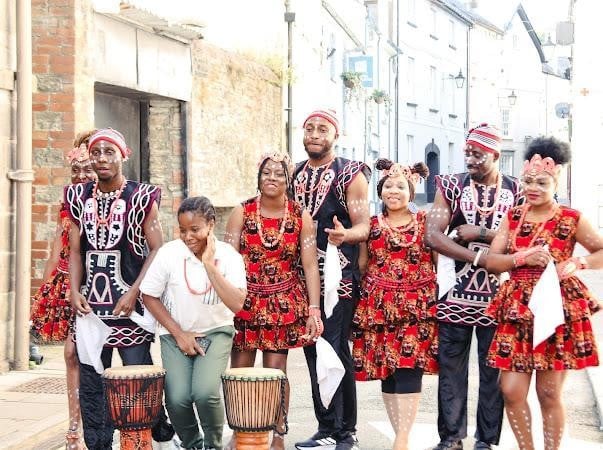
As a member of Nganga Performing Arts and Mobile Theatre, Emmanuel has carried Igbo cultural performance to stages and streets across Wales and the United Kingdom. At the Brecon Jazz Festival, one of the country’s most respected music gatherings, he drummed and danced and played the traditional flute simultaneously before an audience that arrived with no particular cultural preparation for what they were about to experience. They did not need any. “The local community at Brecon did not just watch,” he says. “They embraced it. I witnessed something beautiful unfold in real time. People from an entirely different cultural background connecting deeply with rhythms and melodies born thousands of miles away in southeastern Nigeria.” Several people stood afterwards with tears in their eyes. “That connection confirmed something I have always believed: that authentic cultural expression needs no translation. When art is genuinely rooted in truth and identity, it speaks universally.”
The tradition he carries has also found new expression beyond the traditional stage. In recent years, Ogbu-Oja artists have fused the spiritual registers of the ancient Igbo flute with the South African Amapiano beat structure to produce a genre now known globally as Ojapiano, an entirely new musical language assembled from the oldest Igbo foundations.
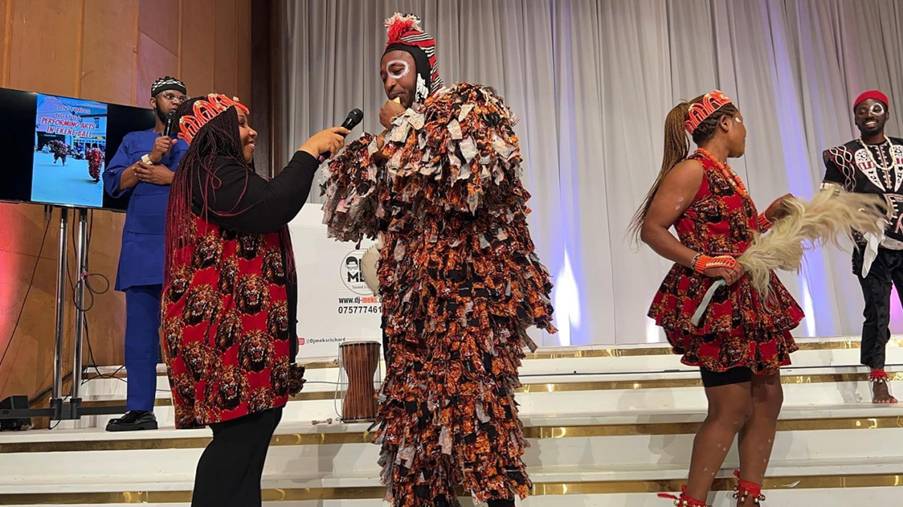
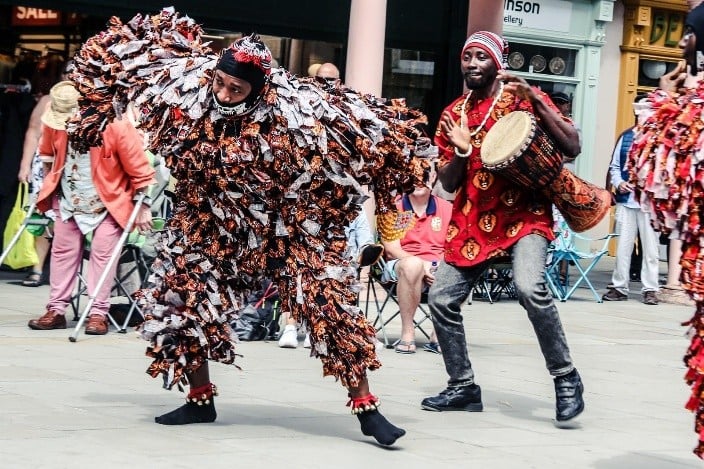
The Nganga company embodies the igwe bu ike principle that Igbo culture has always understood as the foundation of meaningful work: unity is strength. Traditional Igbo performance was never designed for a solitary practitioner. The masquerade requires witnesses. The drum calls the community to gather. The dance is answered by the crowd. Photographs of the ensemble moving through the streets of Brecon in full Igbo ceremonial costume, with white-painted markings on the skin, drums at the hip, and the layered mmanwu costume announcing the ancestral presence, carry an authority that no individual performance can produce.
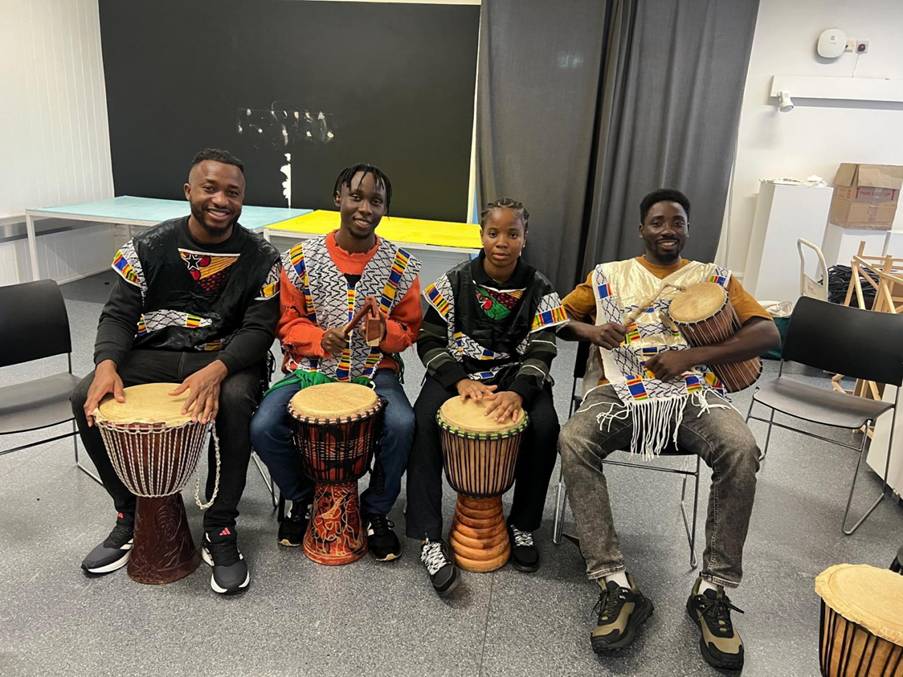
At the Windrush Celebration, Emmanuel extended his work beyond performance into teaching. He sat with young students and walked them through the history of what they were holding, the drum’s cultural function, its spiritual significance, and the discipline required to play it properly. “Watching young people connect with that knowledge confirmed that every challenge I faced was worth it,” he says. For him, it was about ensuring things are properly passed on, through presence, through patience, through the particular care of someone who knows exactly what they are sharing and why it matters.
Emmanuel has spoken directly about the misconceptions that persist around traditional Igbo performance. The most stubborn of them is the assumption that such forms are technically simpler than classical Western ones, that they belong to village settings rather than international stages, and that cultural distance makes genuine emotional connection across audiences impossible. Every stage he has stood on has refuted each of those assumptions without argument. The coordination required to play the flute, drum, and dance simultaneously is a physical and intellectual achievement that few artists in any tradition attempt. That Emmanuel executes it in a way that appears fluid is the mark of someone for whom the years of practice have become so deeply internalised that the work no longer shows its own effort. His discipline is invisible precisely because it is total.
The Ojadili legend ends in a fall, but Igbo elders tell it not as a tragedy but as a teaching. The flute player who shifted from praise to warning was doing the most important thing a musician can do: telling the truth. Emmanuel Otozi Ekuma plays in that tradition. “I am most drawn to stories of identity, belonging, and resilience,” he says. “The emotions that move me deepest are those that live at the intersection of joy and longing, the bittersweet feeling of celebrating a culture while simultaneously fighting to preserve it.”
The strong man gives way when the flute plays. The drum speaks before the war begins. The masquerade arrives and the circle forms.
Emmanuel Otozi Ekuma has been listening to all of it his entire life. Now, he makes sure others can hear it too.
Chinyere Chukwudi-Okeh is a writer-critic and reviewer of arts, culture, and literary artists and productions.
WATCH TOP VIDEOS FROM NIGERIAN TRIBUNE TV
- Relationship Hangout: Public vs Private Proposals – Which Truly Wins in Love?
- “No” Is a Complete Sentence: Why You Should Stop Feeling Guilty
- Relationship Hangout: Friendship Talk 2025 – How to Be a Good Friend & Big Questions on Friendship
- Police Overpower Armed Robbers in Ibadan After Fierce Struggle


