
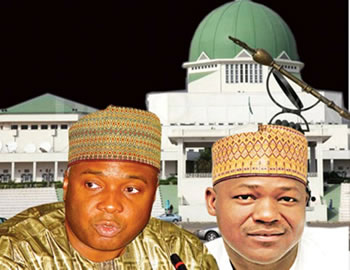
ON resumption from a three-week Sallah break (the rest of the nation was harassed by religious balancers for taking a three-day break for the same Sallah), our legislators took three issues all about themselves. Immunity for their leaders (House of Reps); protection of their leaders from criminal charge of forgery (Senate) and bid to ensure that their constituency project is funded (Senate). It is incredible that the legislators are so unaware of the picture they cut as being a self-centered lot. Or they just do not care about what we think of them.
This write up is about the constituency projects. These are projects inserted into the national budget by the legislators to, as they claim, bring something home to their constituencies. There is no evidence that any relevance/ feasibility studies are done for such projects. The aim is that each legislator has a project in his/her constituency. If we take the figure for this year as stated during the agitation of the senators of N60 billion and we have 109 Senators and 340 House of Rep members, on average, the project/constituency will amount to N134 billion. Of course, they may have a rotational agreement that may allow a higher amount per constituency. The work done by BudgiT published in The Nation, on Sunday of July 17, puts the range of the project cost at between N4.5 and N300 million. The mode of deciding the content of the projects is opaque. Overall the projects cannot be earth shaking big. But as we all know, the project is not the target of the legislators, money in the pocket of the legislators is!
The concept of constituency projects is not peculiar to Nigeria. Most legislators around the world angle for such projects such that they can appeal to the voters in their constituents since they seek votes just as the executive does. In most politico lingo, it is known as pork-barrel politics. As Wikipedia explained it, it is a process used to obtain funding from a central government to finance projects benefiting the legislators’ local constituents. The benefits of such projects do not extend beyond a legislator’s constituency even though the funding was obtained through taxation of the larger geographic region. It is also known as earmarking in some nations. There is opposition to pork barrel projects all over the world as they usually involve corrupt power wielding and negotiations; and sleaze; and there have been agitations that they be scrapped. An example of constituency project at its most licentious can be found in the Philippines where funds are allocated to members of the House of Reps and Senate to spend as they see fit. It can be used for ‘hard’ projects such as buildings and roads, or as ‘soft’ projects like scholarships and medical expenses. In that country, the practice was so replete with corruption that there were massive public protests against it in 2013 and the Supreme Court abolished it as unconstitutional in the same year.
In Nigeria, information gathered for this write up shows that the distribution of project fund goes through many channels in a way that it actually results in wealth distribution. Post budget approval, the first beneficiary is the bureaucrat. He is ‘facilitated’ to ensure cash backing and release of fund for the project. Then the legislator takes the lion share of the money. He gives some money to the contractor whose name/company had been used as front and who will process the papers back to the bureaucrat. The bureaucrat takes a second helping in certifying the project completed. Where some circumscribed work had been done (in quite a number, nothing at all is done), the community leader ( Emir, Oba,Chief, ward leader, etc) are facilitated to attend the launching. The Press is also co-opted into the gravy train to favourably report on the project ‘execution’.
At the end of the day, the legislator who takes the lion share has enough money to give as largesse o his penurious constituents, stash away some for the next election and record a handsome profit on his investment of contesting to the legislature. Of course, this scenario will be disputed by the legislators but there is a way to resolve the issue. The Senate and the House of Representatives should publish a year by year record of constituency projects. The details should contain the project name, the location and the cost. We will then require two levels of certification as to the existence, completion and durability of the projects from their constituents and anti-corruption Civil Society Organisations. The BudgiT Organisation has done some work in this respect. Their effort should be complemented and the CSO should popularise the report using it as a basis of nationwide campaign.
Constituency projects have the following wealth distributing effects. The politician, who benefits most from the fund of the project, is able to give some cash/material gifts to his penurious and dehumanised constituents, sustains young men on his pay as thugs, acquires properties and is able to stash away some money to prosecute the next election. We have been told umpteenth time that politics in Nigeria is an investment. Clearly, one of the profit lines is the constituency project. There are more. The bureaucrat, who earns say N150,000 per month, is able to make the equivalent of 6 months’ salary from one constituency project. He can leave a more handsome feeding allowance, send her/his children to that rarefied school he would not otherwise be able to afford. He has loose cash to satisfy his friends, girlfriends included. She could buy a little more jewelry. With a consistent flow of constituency projects, he/she could start that housing project which he would otherwise be not able to afford in his entire 35 year career. The contractor makes a few million Naira for just being close to the legislators and serving as a front. A number of young boys (graduates who cannot find jobs) specialise in this role. The community leader makes a cool earning from the launching. He smacks his lips and may just acquire a new wife (they are mostly males).
On the contra side, however, the constituency projects are debilitating to societal development in fundamental ways. First, the society gains virtually nothing. The projects are perfunctory, irrelevant. For example one type that I have seen is the borehole. Apart from the fact that a large number of them do not function from day one, most of them pack up in a short while. Worse, the conception is insulting to the constituents and stifles genuine development. The Constituents are expected to fetch water from the bore holes to their homes. The limited vision of the legislator does not envisage citizens with pipe -borne water in their homes. He does not think of rehabilitating the huge water works in his constituency. He does not think he should lobby to get the Local/ State/Federal government to provide pipe borne water. What he wants is immediate ephemeral notice through the sign board he erects on his puny bore hole. Second, the communities are denied the location of projects in their communities since projects that were not delivered would have been placed in the books as done.
Third, there is a culture of conspiracy between the legislator, the contractor front, the bureaucrat and the community leader to defraud society. Corruption is entrenched as an acceptable means of earning a living by key players in society. Fourth, the only ‘start up’ business idea of a large number of our youth have is being around politicians to be used as fronts. The work ethic is destroyed and our youths are indoctrinated into the culture of wealth without work being honourable. Fifth, the contractor/front gains no experience since he hasn’t in most cases built anything. And sixth, this fraud is a ruling elite consensus about corruption as a principle of governance since there clearly is agreement by all legislators irrespective of their political party, ethnicity or religion on pork barrel projects.
Constituency projects destroy the soul of the nation in ways deeper than we seem to want to acknowledge. It should be discontinued. Our civil society organisations should include mobilisation against constituency projects in their campaigns for a more just and prosperous nation.
Professor Akinyanju is of the Department of Microbiology, University of Ilorin.
WATCH TOP VIDEOS FROM NIGERIAN TRIBUNE TV
- Relationship Hangout: Public vs Private Proposals – Which Truly Wins in Love?
- “No” Is a Complete Sentence: Why You Should Stop Feeling Guilty
- Relationship Hangout: Friendship Talk 2025 – How to Be a Good Friend & Big Questions on Friendship
- Police Overpower Armed Robbers in Ibadan After Fierce Struggle


