
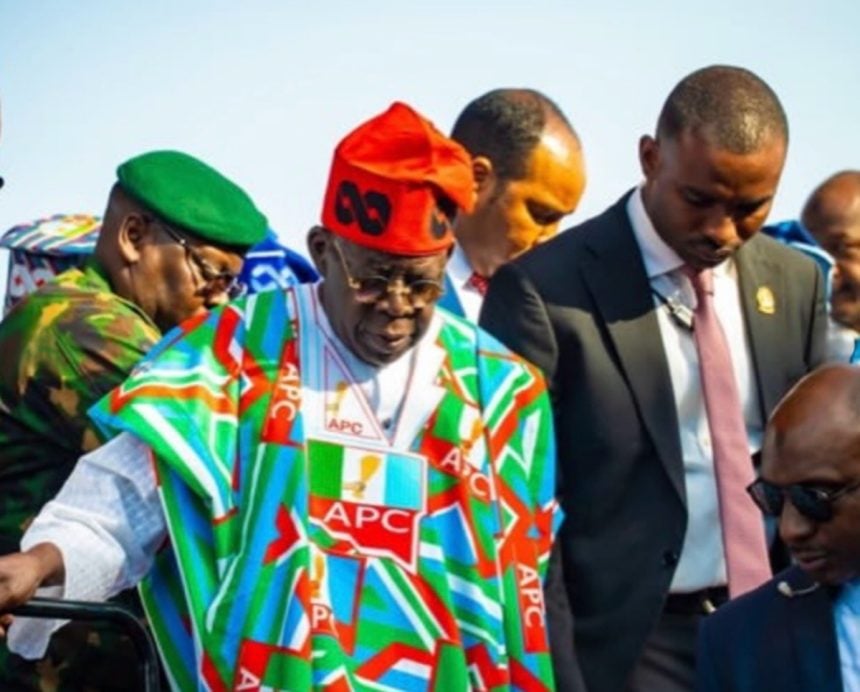
The 2027 presidential campaigns, which kicked off on August 19, have started gathering momentum in recent weeks with unique twists here and there. Muideen Olaniyi presents the emerging picture of the multi-colour campaigns, the rainbow coalition, with a peep at the previous campaigns in the earlier part of the Fourth Republic.
On Wednesday October 14, President Bola Ahmed Tinubu inaugurated the All Progressives Congress Presidential campaign Council (APCPCC)at the Banquet Hall, Presidential Villa, Abuja.
What dominated the inauguration was not the regular list of APC coalition stalwarts but an aglomeration of political forces, something that is becoming institutionalised in the latter part of the current Republic.
In the build-up to the 2023 election, five governors of the Peoples Democratic Party (PDP) differed with their party and campaigned for then Senator Bola Tinubu, the candidate of the APC. A similar trend had played out earlier in 2014 when five governor of the PDP decided to pull out of their party to join the emerging APC coalition and eventually defeated the then incumbent President Goodluck Jonathan.
It, however, looks as if the 2026 scenario is taking the game a notch higher as President Tinubu announced a PCC, which included leaders of the PDP, Accord, and the All Progressives Grand Alliance (APGA).
The revised APCPCC list signed by the party’s National Secretary, Sen. Ajibola Basiru, included opposition figures in Tinubu’s machinery. It is being called the Rainbow Coalition – a cross-party alliance inside an APC campaign.
The expanded list came barely a month after APC governors rejected alliances which they said were capable of weakening the party.
Key on the list are Minister of the Federal Capital Territory, Nyesom Wike, Osun Governor Ademola Adeleke and Anambra Governor Chukwuma Soludo.
Under the arrangement, Wike was appointed coordinator for Rivers and the FCT, Soludo for Anambra, and Adeleke for Osun. Wike is a member of the Peoples Democratic Party (PDP), Soludo was re-elected in November 2025 on the platform of the All Progressives Grand Alliance (APGA), while Adeleke won his re-election on August 16 under Accord.
The party had initially released the council on August 22, with former Zamfara Governor Abdulaziz Yari as director-general, while Senate President Godswill Akpabio, Speaker Tajudeen Abbas and Yobe Governor Mai Mala Buni were deputy director-generals.
In the revised list, Akpabio, Abbas and Kwara Governor AbdulRahman AbdulRazaq are now deputy vice-chairmen I, II and III respectively. Buni becomes deputy DG I for the North. Deputy Senate President Barau Jibrin moves from deputy DG III North to deputy DG II North. Senate Leader Opeyemi Bamidele and Deputy Speaker Benjamin Kalu are deputy DGs I and II for the South.
All 32 APC governors are now coordinators for their states. For non-APC states, candidates were appointed: Sharafadeen Alli for Oyo, Mohammed Abubakar for Bauchi, and Chijioke Chukwu for Abia.
ALSO READ: Again, Tinubu seeks approval to borrow $20.5bn, €1.04bn loans, writes Senate
The new list also has 14 advisers, including Bisi Akande, Segun Osoba, George Akume, Secretary to the Government of the Federation, Florence Ita-Giwa, Ibikunle Amosun, Iyiola Omisore and Wale Edun.
Virtually all speakers at the inauguration endorsed the rainbow coalition, though some analysts see it as official approval of anti-party activities. This followed an exchange between Wike and Chairman of the Progressive Governors Forum, Imo Governor Hope Uzodimma.
Speaking at the event, APC National Chairman Nentawe Yilwatda said: “No political party in Nigeria has our structure. We have over 261,000 party executives, from the national to the ward levels.” He added that the party has 31 governors, plus two supporting “wingers” from the South-West and South-East from Accord and APGA respectively.
Earlier on the floor of the Senate, Bamidele described the inclusion of Wike, Soludo and Adeleke as evidence that a “rainbow coalition” is taking shape.
Senate President Akpabio called it historic: “This has never happened in the history of our democracy since 1999, that a sitting president will constitute his presidential campaign council with almost all the parties in Nigeria, inclusive. Even what we are going to do today is evidence of the fact that his second term is going to be a unity government, just like his campaign council, is a unity campaign council.”
President Tinubu, who will face former Vice President Atiku Abubakar of the African Democratic Congress (ADC) and Peter Obi of the Nigeria Democratic Congress (NDC) among others, declared the party ready and united.
“As I stand before you with a heart full of gratitude and spirit full of resolve, it is my honour to inaugurate the presidential campaign council of the APC for the 2027 general election. I thank all of you for the last election, but no one gets credit for an incomplete assignment until you deliver the next election, until you deliver your electoral wards, until you deliver the votes,” Tinubu said. He urged members to conduct activities responsibly and highlight the Renewed Hope Agenda.
How Obasanjo did it – 1999 and 2003
As parties prepare for a crowded 2027, multi-colour campaigns – rallies, town halls, door-to-door and distinct party colours across 36 states and FCT – are staging a comeback.
The 1999 election was Nigeria’s first after 16 years of military rule. It was short and elite-driven.
Obasanjo was released from prison in June 1998 after Sani Abacha’s death and adopted by retired generals as the “safe” candidate. The campaign lasted less than three months between PDP formation in August 1998, Jos Convention on February 14, 1999 where he beat Alex Ekwueme, and election on February 27, 1999.
Since the timetable was short, posters, billboards and mobilisers dominated the Jos convention. After nomination, the campaign relied on establishment backing, zonal structures, and targeted rallies rather than a full 36-state marathon.
Apparently because of the limited campaign period, Obasanjo did not comprehensively tour 36 states and FCT in 1999. In 13 days between nomination and election, it was impossible. He made selective zonal stops – Lagos, Kano, Enugu, Port Harcourt, Kaduna, Jos and Abuja – meeting traditional rulers, retired generals and business leaders. Messaging was simple: reconciliation and healing the wounds of June 12.
During that period, Chief Tony Anenih described himself as National Campaign Director. He organised the famous dinner for 100 top politicians at Lake Chad Crescent and created contact, finance, publicity and mobilisation committees. In his memoir, he said Obasanjo told him “make me president but it’s not my business how you do it.” Dr. John Dara served as campaign manager for operations.
The 2003 scenario
It was the first modern incumbent re-election campaign of the Republic and Obasanjo was seeking re-election. He was reputed to have done a near-complete tour of the states with advantages of incumbency – commissioning projects, and using governors as field commanders. It was formalised as Obasanjo/Atiku Campaign Organisation with jingles in Hausa, Yoruba, Igbo and Pidgin.
He also reached out to the Pan-Yoruba Socio-Political Organisation, Afenifere, which guaranteed him huge support from the South West.
Former Plateau Governor Fidelis Tapgun served as DG between 2002 and 2003. Vice President Atiku Abubakar also served as DG for the South-West, where PDP won five of six states.
However, Obasanjo’s way of implementing the rainbow colition was different. He included leaders of the All Peoppes Party (APP) and the Alliance for Democracy (AD) in his administration and through such appointments, the administration got the opposition weakened.
How Jonathan ran – 2011 and 2015
The template of 37-stop tours became standard after 2003. Jonathan did 36 states in 37 days in 2011.
In the 2011 election, Jonatha’s first full campaign after Yar’Adua’s death, he appointed zonal coordinators, governors as anchors, and over 1,000 support groups. Message was Fresh Air and Transformation Agenda with 91 pledges on power, agriculture, rail, Second Niger Bridge and Almajiri schools. Flagged off in Lafia, Nasarawa on February 7, 2011, the campaign had covered 36 states in about six weeks, sometimes three states per day, ending in Dutse, Jigawa State. The Grand finale was held at the Eagle Square, Abuja on March 26, 2011. Along the line the president’s wife, Patience Jonathan ran a parallel women’s tour.
The DG was Senator Dalhatu Sarki Tafida, Nigeria’s High Commissioner to the UK and former Senate Majority Leader, with Elder Godsday Orubebe as deputy. Ima Niboro, who served as the spokesman confirmed the completion of the 36-state tour.
The 2015 election cycle
In 2015, the PDP ran a defensive campaign against the coalition party , the APC, which fielded General Muhammadu Buhari as candidate. The Style was big city mega rallies, live concerts, Ward Volunteer Scheme and aggressive TV ads. A larger council of elders was assembled to counter the Buhari wave amid low oil prices, Boko Haram and northern sentiment.
The DG was Dr. Ahmadu Ali, former PDP national chairman, appointed January 2015. Team included Tony Anenih as adviser, Prof. Tunde Adeniran as deputy head office, Kabiru Turaki as deputy North, Peter Obi as deputy South, and Femi Fani-Kayode for media. Jonathan toured all zones but relied more on zonal mega rallies in Kano, Lagos, Port Harcourt, Enugu and Abuja.
How Buhari ran – 2015 and 2019
After three defeats (2003, 2007, 2011), Buhari was repackaged from being a localised northern northern candidate to run on a pan-Nigerian alliance. The APC merger included CPC, ACN, ANPP, a faction of APGA and nPDP – gave him colours everywhere. Unlike elite dinners, it relied on state-by-state mass rallies, youth town halls and crowd-funding. Message was threefold: fight corruption, tackle insecurity, fix economy.
The DG was Rotimi Amaechi, then governor of Rivers and Chairman of Nigeria Governors Forum. Buhari toured all 36 states and FCT between December 2014 and March 2015, often two states per day. Mammoth crowds in Kano, Lagos and Port Harcourt created momentum that defeated an incumbent.
In 2019, as incumbent, Buhsri’s campaign looked more subdued. He reappointed Amaechi to lead “Next Level” campaign focusing on rail, rice, TraderMoni and N-Power. Structure was larger: Chairman Buhari, Co-Chairman Bola Tinubu, Deputy Chairmen VP Yemi Osinbajo and APC Chairman Adams Oshiomhole.
He toured 36 states plus FCT in lighter form, flagging off in Akwa Ibom on December 28, 2018 and doing zonal rallies in Kaduna, Kano, Bauchi, Lagos, Kwara and Delta, delegating more to Osinbajo and Tinubu.
How Tinubu ran – 2023
It looked like the most structured campaign since 1999. Running as both insider and outsider of the APC, amid fuel scarcity and naira redesign, and facing Atiku and Peter Obi, Tinubu combined multi-colour rallies with digital war.
The DG was Governor Simon Bako Lalong of Plateau, Chairman of Northern Governors Forum, chosen to balance the Muslim-Muslim ticket with Kashim Shettima. Chairman of Council was President Buhari, Deputy Chairman I Tinubu, Deputy Chairman II Abdullahi Adamu, Deputy DG Operations Adams Oshiomhole, Vice Chairman Femi Gbajabiamila, Secretary James Faleke and Assistant Secretary Christopher Tarka.
He linked up with aggrieved members of the PDP named G5 governors who eventually broke the back of their party’s candidate to vote Tinubu in their states.
The former Lagos governor flagged off the campaign in Jos on November 15, 2022 – symbolic for North-Central/Christian inclusion – and toured all 36 states and FCT between November 2022 and February 2023, some twice. Lagos homecoming was on November 26, Kano mega rally, and Rivers visit hosted by Wike despite being a member of the PDP membership. The final rally was held at Teslim Balogun Stadium, Lagos on February 21, 2023.
Tinubu’s 2023 model is what APC is now rebranding as Rainbow Coalition. In 2023 he needed to prove he could win without Buhari’s full backing, using Lalong as DG but governors as foot soldiers. In 2027 as incumbent, pundits say he does not need a 37-day tour as much as Jonathan did in 2011. But APC is reviving multi-colour campaigns with opposition governors as coordinators to show national spread, just as Tinubu did by touring opposition states in 2023.
WATCH TOP VIDEOS FROM NIGERIAN TRIBUNE TV
- Relationship Hangout: Public vs Private Proposals – Which Truly Wins in Love?
- “No” Is a Complete Sentence: Why You Should Stop Feeling Guilty
- Relationship Hangout: Friendship Talk 2025 – How to Be a Good Friend & Big Questions on Friendship
- Police Overpower Armed Robbers in Ibadan After Fierce Struggle


