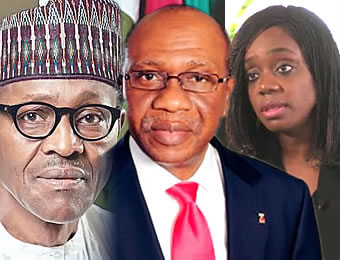
 Many Nigerians will readily agree that the economy experienced some turbulence in 2017. Sanya Adejokun looks at business and economic events that shaped Nigeria in the year.
In terms of the economy, the most important issues that dominated Nigeria’s landscape in 2017 will be the exit from recession, refund of over-deductions of Paris Club debt repayments by Federal Government to states, inflation, foreign exchange regime, unrelenting unemployment, budgets, farmers’/cattle herders’ clashes and the prolonged absence of President Muhammadu Buhari from Nigeria due to ill health.
Exit from recession
Nigeria entered its worst recession in recent history in April 2015 and though it was declared as merely a “technical recession by Finance Minister, Mrs. Kemi Adeosun, the country would continue to revel in economic downturn for the next fifteen months. However, in its Second Quarter 2017 GDP report, National Bureau of Statistics (NBS) announced that the country had finally also technically exited the conundrum.
This however, did not translate into a buoyant economy even till the end of the year. Statistician General and Head of NBS, Yemi Kale had said in an interview following the release of Q2 GDP results that “Gross domestic product is an accumulation of 46 different economic activities in Nigeria. And the overall number, whether positive or negative will determine whether you are in recession or out of recession. Within those 46 activities, some sectors will do very well and be positive while some will do badly, some will grow worse, or stay the same way they are. Depending on who you are in society, what is published as economic growth of 0.55 in the second quarter of 2017 is the aggregate total of everybody for those that did well and those that did not do well. So even in that same report, you will see 21 sectors still remained negative. Anybody operating in those sectors will still be in recession because all their economic activities are still negative.
“But there are other sectors that are positive and those ones will not say the same thing. And so I can understand people saying that recession is still here. When you look at trade, in which most Nigerians fall into, the woman on the street is involved in trade. She buys and sells. That is where she feels the impact. That same report suggests that the man on the street is still struggling because trading activities was still negative. We have to look at the report and see where things are going positively and otherwise. When you take the overall figure, which is an average of everything, it tends to mislead individuals. You have to look at your own particular situation. Publishing for instance is part of what is calculated as economic activity. It grew over two percent but in the first quarter it was negative. If many people are losing jobs in publishing, you are likely to also say that recession is still biting. The reality is that if you are a trade, you are still in recession because your growth was negative. That overall figure does not apply to your own particular activity.
“If you are in agriculture and you can go and talk to farmers, they will tell you how happy they are. And if you look at the numbers, agric was positive. There two main economic activities that threw Nigeria out of recession and they are agric and crude production. Does crude production stop flowing because anyone lost his job? No! That crude is an economic activity and it is part of GDP. Niger Delta militants have not been destroying pipelines and oil wells recently. When you are comparing a period in 2016 when vandals were destroying oil wells and oil output collapsed and another period this year when nothing like that happened of course, it is going to be an improvement. In agriculture there is improvement. Agriculture is largely subsistence farming even corporate agriculture is rising. The subsistence farmer does not do demand/supply studies in deciding how much of his land to be used- he maximizes his land every year. Because of that agriculture is likely going to continue to grow. A farmer will go to his farm and plant. He is not going to base his activities on the fact that state government workers have not been paid salaries and that is part of the reason why agriculture will continue to grow even in a recession.
“There were instances of herdsmen attack on farmers, there were instances of flooding and there were also instances of great growth. As rice production was expanding. The report says that agriculture grew at three percent, which is the lowest growth by the sector in the last two years. And this is because of those factors. In 2014, agriculture grew at four percent but issues of pest invasion, herdsmen attack and flooding affected agricultural output. At the end of the day, we are adding total production in rice, tomato, yam etc and the balance was positive. If you check fish production figures, it dropped significantly because of high cost of feeds because you are netting your costs against output. Note that GDP is output minus intermediate consumption costs. So your GDP can go up if your output increases or if your cost go down. Your output can be constant but if you are able to pull down your costs, you will increase your GDP. GDP can also tell if you have become more effective in cost structure.”
Refund of Paris Club debt excess deductions
Shortly before he embarked upon his second trip to the United Kingdom While addressing a meeting of National Economic Council (NEC) in Abuja, in March, President Muhammadu Buhari directed Minister of Finance, Kemi Adeosun and Governor of the Central Bank of Nigeria (CBN), Godwin Emefiele immediately commence the process of releasing the second tranche of the London-Paris Club refunds to the states. While giving his approval for the refund, the President, who made a strong case for the settlement of unpaid salaries and pension liabilities of workers, said the move was to ease the people’s financial hardship. However, the refund was not effected months after due to his absence.
Eventually on July, a statement from Director of Information at the Federal Ministry of Information, Salisu Na’Inna confirmed the President’s directive was made formal on May 4, 2017, “in partial settlement of long-standing claims by state governments relating to over-deductions from their Federation Account Allocation Committee (FAAC) allocation for external debt service arising between 1995 and 2002. The debt service deductions were in respect of the Paris Club, London Club and Multilateral debts of the FG and States.
“While Nigeria reached a final agreement for debt relief with the Paris Club in October 2005, some States had already been overcharged. The funds were released to State Governments as part of the wider efforts to stimulate the economy and were specifically designed to support states in meeting salary and other obligations, thereby alleviating the challenges faced by workers. The releases were conditional upon a minimum of 75 per cent being applied to the payment of workers’ salaries and pensions for States that owe salaries and pension. By the second week of December, 27 states had already received their final payment. Nonetheless, workers in many states were still being owed many months’ salary arrears.
Unemployment
Throughout 2017, unemployment continued to be a big economic issue with more Nigerians joining the employment market.
The economically active or working age population (15 – 64 years of age) increased from 110.3 million in Q2 2017 to 111.1 million in Q3 2017. The labour force population increased from 83.9 million in Q2 2017 to 85.1 million in Q3 2017. The number of people within the labour force who are unemployed or underemployed increased from 13.6 million and 17.7 million respectively in Q2 2017, to 15.9 million and 18.0 million in Q3 2017.

Total unemployment and underemployment combined increased from 37.2% in the previous quarter to 40.0% in Q3 2017.According to official statistics, 67.3 percent of young people aged 15-24 years were either underemployed (engaged in work for less than 20 hours a week or low skilled work not commensurate with their skills and qualifications) or unemployed (have no work at all but willing and actively seeking to work), compared to 64.6 percent in the previous quarter. The unemployment rate increased from 14.2 percent in Q4 2016 to 16.2 percent in Q2 2017 and 18.8 percent in Q3 2017. Number of people within the labour force who are unemployed or underemployed increased from 13.6 million and 17.7 million respectively in Q2 2017, to 15.9 million and 18.0 million in Q3 2017.
Total unemployment and underemployment combined increased from 37.2 percent in the previous quarter to 40.0 percent in Q3 2017. During the quarter Q3 2017, 21.2 percent of women within the labour force (aged 15-64 and willing, able, and actively seeking work) were unemployed, compared with 16.5 percent of men within the same period. In Q3 2017, 16.4 percent of rural and 23.4 percent of urban dwellers within the labour force were unemployed and unemployment is increasing at a slightly faster rate for urban dwellers than it is for their rural counterparts.
Inflation
With inflation at 15.90 percent at the end of November and unemployment also soaring, Nigeria’s misery index maintained its upward movement in the year. The misery index has been calculated by different economists to be anywhere between 60 and 80 percent depending on the employment indicator used. Generally, the rate is around 60 percent but among the youth population, the misery is much higher. The misery index is an economic indicator, which helps to determine how the average citizen is doing economically and calculated by adding seasonally adjusted unemployment rate to the annual inflation rate.
Economic recovery and Growth Plan (ERPG)
On April 5, 2017, President Muhammadu Buhari launched the Economic Recovery and Growth Plan (ERGP), which is his development blueprint. ERGP seeks to achieve a seven per cent economic growth by 2020. In addition to diversification of the economy, ease of doing business, increased oil production, reduction of inflation, effective collaboration between the public and private sector, as well as between the federal and state governments, ERPG hopes to leverage science, technology and innovation and building of a knowledge-based economy.
Ease of Doing Business
In October World Bank reported that Nigeria had moved up by 24 points in the ‘Ease of Doing Business Index’ to 145. This was a significant leap from its position 2016 position of 170th
In the year ending June 1, 2017, 119 economies implemented 264 total reforms across the di erent areas measured by Doing
According to the World Bank, Nigeria has since 2008 made executed reforms in many areas including Starting a Business; Dealing with Construction Permits; Registering Property; Getting Credit; Paying Taxes; and Starting a Business.
Buhari’s medical vacation
President Muhammadu Buhari spent a total 103 days in a London hospital observing medical vacation. He left the country on May 7, and returned on August 19. This was after he had been away from January 19 to March 10, 2017.
Senate rejects Magu
For the second time, Senate rejected the nomination of Mr. Ibrahim MAgu as Chairman of Economic and Financial Crimes Commission (EFCC), hinging the decision on a report from the Directorate of State Security (DSS) that lacked integrity. The presidency had in January resubmitted Magu’s name after he was rejected earlier.
Saraki’s Code of Conduct Tribunal saga
Senate President, Bukola Saraki, was in and out of the Code of Conduct Tribunal (CCT) in Abuja where he was defending charges of alleged false and anticipatory declaration of assets filed against him by the Code of Conduct Bureau since September 2015. The tribunal acquitted him in June, 2017.
However, on December 12, the Court of Appeal in Abuja ordered the senate president back to the tribunal to face the same charges. The court ruled that Saraki did not answer three of the charges adequately. His media office reacted immediately and said the senate president would appeal.
Farmers’/herdsmen clashes
On November 1, Benue State became the second state to outlaw open grazing through a law. The passing into law of the anti-grazing bill. The law banned open grazing while leaving cattle farmers with the option of ranching. By the end of the year, over 50 cattle had been confiscated from herders who contravened the law.
Fuel scarcity
The year 2017 ended with the furious return of scarcity of premium motor spirit. The scarcity, which was noticed in the early weeks of December lasted till the end of the year with motorists buying from between N200 and N500 per litre in the black market.
WATCH TOP VIDEOS FROM NIGERIAN TRIBUNE TV
- Relationship Hangout: Public vs Private Proposals – Which Truly Wins in Love?
- “No” Is a Complete Sentence: Why You Should Stop Feeling Guilty
- Relationship Hangout: Friendship Talk 2025 – How to Be a Good Friend & Big Questions on Friendship
- Police Overpower Armed Robbers in Ibadan After Fierce Struggle