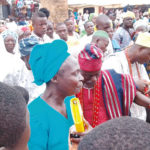
For a while, core Yoruba historians have argued that Yoruba names are going into extinction but people argued that the assertion is a fallacy. Today however, they have divided Yoruba names into clear categories to prove that the names many believe to be Yoruba names are religious names given in Yoruba language. YEJIDE GBENGA-OGUNDARE reports
Alade Opo
Opomulero moja alekan
Opo roso, opo gbaja
O kan dudu labe aso
This particular greeting is one of the reasons Tomisin Adiamo, a Communication Arts undergraduate, dislikes visiting her grandparents who have refused to call any of their grandchildren and their parents the name they prefer but those that they find repulsive and embarrassing.
His grandfather will call his son Ayinla, his daughter-in-law, Ajoke, their only granddaughter, Abeni and Tomisin’s elder brother, Ige. Though their parents just smile and tell them to humour their grandparents because they are old, the children now find it more of a burden.
This is due to the fact that their grandparents now live with them and what used to be an occasional name has now become a main name and their parents have also taken up the habit of calling them those names.
The belief of the Adiamo children is one of the major reasons that many Yoruba children don’t bear indigenous Yoruba names again. What is special in a name that makes the Yoruba people pay special attention to giving their children names?
According to Yoruba culture and belief, names are more than simple identification tags as it is seen by many today. There is a reason and history behind each name; family background and pedigree, physical characteristics and circumstances surrounding the birth of a child, season of birth, religious belief or parents’ profession and that of the lineage as well as cultural background.
Historians classify indigenous Yoruba names into five categories while they argue that many Yoruba names that parents give to their children today are not really Yoruba names as they are not indigenous names but religious names translated into Yoruba language.
Chief Ladipo Babalola, a retired librarian was adamant that there are few people bearing Yoruba names now. “What you now call Yoruba names are not traditional Yoruba names but religious names translated to Yoruba language. I see no difference in someone that names his child I Iyinoluwa and the one that names his child praise or grateful. It is the same name in different languages. And those are not our traditional names,” he told Nigerian Tribune.
Historians and experts in Yoruba culture have classified traditional Yoruba names into five categories; panegyrics, destiny names, acquired names, divinity names and profession names.
Panegyrics, known as oriki are names used to celebrate or praise a child in a chant like manner; it includes names like Ajoke, Asabi, Akanmu, Ajin-un, and Aremu amongst many others. Oriki varies in length based on the purpose for which it is given to a child, is it to describe the future portents of the life or a recital of the accomplishments of the child’s clan?
In Yoruba land, the oriki is invoked not only to praise a child for bringing pride to the parents but also to evoke virtuous character traits that are believed to be innate in a person by pedigree. And there are destiny names, known as Oruko Amutorunwa; names that naturally go to a child because of the circumstances surrounding birth. They include Ige, Aina, Taiwo, Kehinde, Ojo and Oke among many others. Another class of this is the Abiku names which are given to children that are believed to die and reincarnate to the same mother more than twice, they include Malomo, Ikukoyi, Kokumo, Durojaye and Omotunde amongst others.
Another class is the acquired names which have to do with lineage and prestige or pedigree of the family. Such names are used to show status and examples are Ibilola, Adeyipo, Olawumi, Oyelola. These names may signify the position of the family in the society while there is a class of name that shows the traditional vocation of the child’s lineage and there are many of such.
For a child from a masquerade clan, the names start with Oje; Ojewale, Ojewumi, Ojefunke. A child from a lineage of hunters will have a name that starts from Ode; Odetunde, Odejayi, Odeponle while a child from a lineage of drummers will bear names like Ayanlaja, Ayanwumi, Opabunmi among such others.
The class of traditional names that people shy away from and do not move near again is those that have to do with divination. These have a link with traditional religion and worship and is seen by many today as idolatry. These has to do with name of deities like Orunmila, Osun, Ogun, Obatala, Sango and even Esu
This is where names like Osungbemi, Ifatade, Efunyela, Sangotade, Ogunsola and Esubiyi come up. Names from these five categories are the indigenous traditional names that were acceptable to the Yoruba people in times past.
In times past, when a Yoruba child mentions his name, people around automatically recognises where the child comes from and possibly the profession that the people in his lineage take as their vocation. Even people from other communities can easily decipher this especially when the name mentioned is the oriki that is linked to his ancestral background.
This is however not the case in today’s Yoruba society and it is continuously argued by core Yoruba people that people especially the elites and religious people no longer give their children Yoruba names. The argument focuses on the names of today as religious names given in Yoruba language, which in no way relates to the way names are given in times past.
This school of thought believes that most names today are Christian names which modern Christians derive from traditional names.
Olumilua Aina stated that the parents of today simply merge traditional names with their belief to form names for their children. “What they do is to simply use traditional names in a way it will work with their faith. They just remove the prefix from the Yoruba names and substitute it with Oluwa or Olorun or Jesu. We have people that are Ogungbayi that changed their name to Jesugbayi and from Awolowo to Jesulowo.
“Are you telling me those names are Yoruba names? Definitely they are not. Those names are a reflection of the Christian belief and doctrine which replaces the prefix of names to reflect the Christian concept of God and Jesus Christ. And for our brothers of Islamic faith, they just give Arabic names. So, the truth is that Yoruba names rarely exist among us now though the white people that brought Christianity to us love those names we abhor.
“I have a white friend that goes by the name Ojo and anytime we talk on phone, until I recite his panegyrics Ojo o si nile, omo adie dagba, to ba wa nile, a ti paya e je, he won’t be happy. So what is our own problem? Why do we throw our culture down for others to respect and repackage for us?” he queried.
WATCH TOP VIDEOS FROM NIGERIAN TRIBUNE TV
- Relationship Hangout: Public vs Private Proposals – Which Truly Wins in Love?
- “No” Is a Complete Sentence: Why You Should Stop Feeling Guilty
- Relationship Hangout: Friendship Talk 2025 – How to Be a Good Friend & Big Questions on Friendship
- Police Overpower Armed Robbers in Ibadan After Fierce Struggle