
You know the feeling when you spot a remote DevOps or Full-Stack job based in London or New York. The salary is in US Dollars or British Pounds, the perks look amazing, and you match the requirements perfectly.
Then you spend an hour tweaking your CV, hit apply, and then… nothing. Or worse, an automated email drops into your inbox at 2:00 AM saying, “We’ve reviewed your application, but unfortunately…”
It hurts deeply, but the truth is that a human recruiter probably never even saw your application.
International tech firms have thousands of applications for every single remote role. To manage the volume, they use Applicant Tracking Systems (ATS), a software designed to scan, filter, and rank your CV before a human ever lays eyes on it. If your document doesn’t play by the software’s rules, you are out of the game before it even begins.
How can you ensure that your Nigerian CV passes ATS software 2026 updates? Because it requires moving away from old-school layouts and adopting clear formatting habits that global recruitment bots love.
How do Modern Parsers Read Your CV?
Let’s debunk a myth first. ATS software isn’t some super-intelligent AI that judges your worth as an engineer or data scientist. It is pretty much a text parser. It strips away all the visual layout, converts your beautiful document into a plain-text file, and scans it for specific keywords and structures.
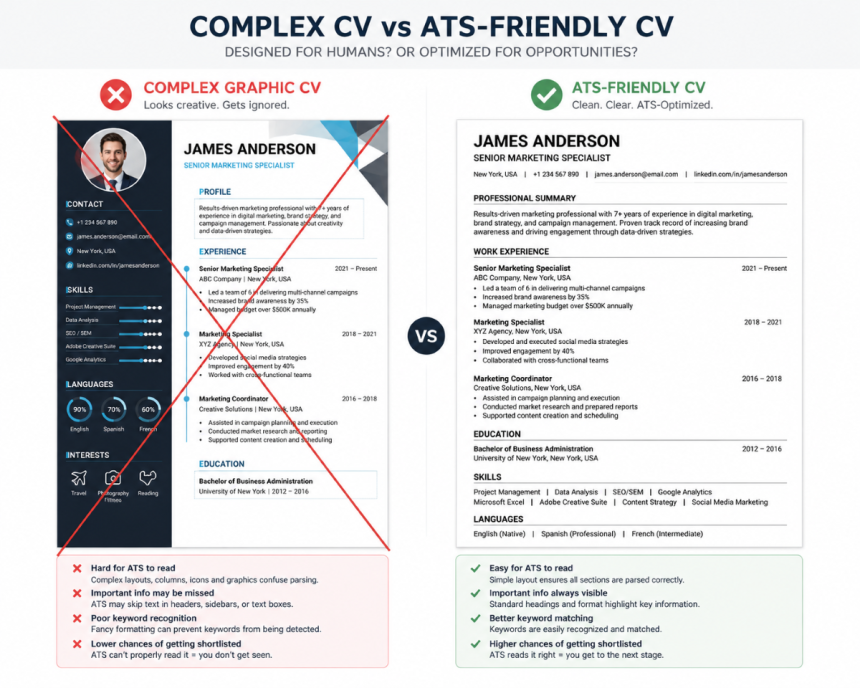
The software can get really confused, looking at a heavily styled document.
When a modern parser processes your application, it follows a very strict set of rules. Understanding this template explains why creative designs usually fail:
- The Format Strip: The software strips out images, icons, and non-standard fonts, converting your file into a raw text string.
- The Left-to-Right Scan: It reads text exactly from left to right, top to bottom. If you use columns, it often reads across them, mixing unrelated sentences.
- Heading Mapping: It looks for universal phrases like “Work Experience” or “Education” to categorise your life. If you name a section “Where I’ve excelled,” it won’t understand what that means.
- Keyword Matching: It cross-references your text against the tech stack and core skills the hiring manager typed into the system (e.g., “Kubernetes,” “TypeScript,” “Agile”).
If the parser encounters a multi-column layout from a Canva template, it reads right across the columns. Your job titles get smashed together with your home address, creating a scrambled mess. To the system, you look unqualified, and your CV is instantly filed away into the digital rejection bin.
3 Formatting Rules You Should Never Ignore
According to guidelines from the Chartered Institute of Personnel Management (CIPM), structural clarity is the absolute baseline for compliance in corporate hiring pipelines. To bypass the digital gatekeepers at international companies, you need to do away with the noise.
The Single-Column Rule
Kindly do away with the two-column layouts. Your CV must read from top to bottom in a single, clean column. Avoid using text boxes to highlight your contact info or skills. Most ATS tools treat text boxes as blank spaces or skip them entirely. If your phone number, GitHub link, or core programming languages are trapped inside a box, they might as well not exist.
Complex Graphics, Logos, and Skill Bars
You know those little progress bars that show you are “85% proficient in Python”? ATS doesn’t like them. Software cannot read graphics; in other words, your proficiency level shows up as zero.
Use standard text instead. Also, do not include company logos, decorative lines, or your profile picture. In regions like the UK and the US, international tech firms actively discard CVs with photos to comply with strict anti-discrimination and data privacy laws.
Stick to Standard Fonts and Formats
Keep it boring. Stick to universally accepted fonts like Arial, Calibri, or Helvetica. When it comes to saving your document, save and upload your CV as a standard PDF file, unless the job portal explicitly asks for a Microsoft Word (.docx) format. Modern systems can parse clean PDFs easily, and it ensures your margins won’t shift when a human recruiter finally opens it.
Tailoring Local Experience for a Global Audience
Passing the software filter is only half the battle; your content still needs to make sense to a foreign recruiter once they see it. This is where many remote job seekers from Nigeria fall short.
“Your CV is your global passport. If it doesn’t meet international standards, your applications risk being invisible—even if you’re the best candidate.”
— Shireen Vogel, Global Executive Branding Specialist & Career Strategist
When listing your work history, do not just list your daily responsibilities. Move away from generic phrases like “Responsible for maintaining the backend database.” Instead, use data and quantify your impact. Show them the scale of your work:
- Instead of: “Managed a team of developers to build a payment app.”
- Use: “Led a 6-man engineering team to deploy a microservices-based payment gateway handling over ₦50M (£25,000) in daily transactions.”
By giving the financial context or conversion, you immediately prove your ability to work on high-scale systems.
Handling Local Acronyms
Don’t assume a recruiter in Canada knows what an acronym like NYSC or ICAN means. If you just write “NYSC,” the tracking software might completely miss the fact that you completed a full year of mandatory national service and professional project management work. Always spell it out completely first: National Youth Service Corps (NYSC).
The same applies to your education and local tech communities. Spell out institutional names completely so the software catches the keywords.
ALSO READ: The assault on NIPSS
The Keyword Matching Strategy
You cannot use one generic CV to apply for twenty different remote roles. If an international job description lists “React, Next.js, TypeScript, and AWS” as mandatory requirements, those exact terms must appear in your skills section and your bullet points.
Don’t try to cheat the system by stuffing keywords into the footer using white text. Modern software immediately flags that trick and can blacklist your name from future applications. Instead, add those technical skills naturally to your project achievements.
Once you have optimised your technical layout, you can use your strong positioning to set yourself up for long-term career growth.
Frequently Asked Questions
Should I list my exact location in Nigeria on an international remote CV?
Yes, but keep it simple. You don’t need to write your full street address in Ikeja or Abuja. Just list “Lagos, Nigeria” alongside your phone number (include the +234 country code) and your LinkedIn profile. Many international firms hire specifically within certain time zones (like WAT/GMT), so showing you are in Nigeria helps them see you fit their regional remote hiring pool.
Does using AI to write my CV trigger automatic rejections from recruitment bots?
No. ATS software does not automatically reject CVs just because they contain AI-generated text. However, AI tools tend to use incredibly repetitive, fluffy phrases like “dynamic go-getter” or “proven track record of driving synergy.” Recruiters spot these lifeless phrases instantly. Use AI to help structure your thoughts, but rewrite the bullet points in your own voice to reflect your genuine experience.
What is the maximum page length recommended for an executive tech resume?
For mid-level to executive tech roles, two pages is good. If you have over ten years of deep engineering experience, a two-page layout gives you enough room to showcase your technical stack and quantified achievements without overwhelming the parser or the human reader. Avoid going to three pages unless you have an extensive list of published technical research or global patents.
WATCH TOP VIDEOS FROM NIGERIAN TRIBUNE TV
- Relationship Hangout: Public vs Private Proposals – Which Truly Wins in Love?
- “No” Is a Complete Sentence: Why You Should Stop Feeling Guilty
- Relationship Hangout: Friendship Talk 2025 – How to Be a Good Friend & Big Questions on Friendship
- Police Overpower Armed Robbers in Ibadan After Fierce Struggle


