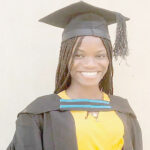
There is ability in disability. That typifies Mrs Rosaline Oniyide, a teacher at Monatan High School, Ibadan, Oyo State. She has been teaching senior secondary school students commerce as a subject since 2021. Despite her inability to see, she surmounts all odds and, through her ingenuity, prepares her teaching notes, takes her class, and marks her students’ scripts.
Mrs Oniyide was not born blind. Her mother, a teacher, and her father, a policeman, are not blind; neither are the siblings blind. She became blind after developing glaucoma in both eyes and a detachment of the retina in her eyes.
The human eye has many parts, including the retina, cornea, pupils, lens, and more; they all work together to help you see clearly. The retina is the light-sensitive layer at the back of the eyes that detects light, turns it into electrical signals, and communicates with the brain so that one can see.
Retinal detachment is a painless but serious condition that affects the vision and can lead to blindness if not treated. Its treatment is through surgery.
“About 14 years ago, I was in the first semester of my 400-level business administration course at the Ekiti State University of Ado Ekiti when I noticed my vision was foggy. Initially, I assumed it was harmattan, although my roommate said there was nothing of such,” recounted Mrs. Oniyide.
On the third day, the persistence of the problem and the fear that it could affect her writing her final examination and final year project thesis made Oniyide to seek the help of eye doctors at the University College Hospital.
Since age 6, Oniyide has been going to the UCH, Ibadan, because of poor eyesight due to what the doctors told her was a “dislocation of eye lenses.” She had to wear high-powered glasses to compensate for her poor ability to see. Also, she also sat as close to the chalkboard as possible, even in Primary 1.
“On getting to the UCH, they told me that there was nothing they could do. So I went back to school, thinking that with time, the haziness would wipe off. But nothing happened; it became so serious that I could not go out of my house to school to attend lectures.”
The intervention of the wife of a pastor at Redeemed Christian Church and a nurse at the Ado Ekiti State Hospital in Ekiti State eventually helped to resolve the riddle of the hazy eyesight.
They diagnosed high pressures in the eye, what is medically termed glaucoma, and a retina that is about to fully detach from its normal position in both eyes. She was then referred for treatment at the Eye Foundation Hospital in Lagos.
At the Eye Foundation Hospital, she was billed N1 million to operate each eye. She was told it required an emergency to ensure that she did not go blind. Also, the pressure in her eyes needed to be kept low with eye drops to prevent blindness, too.
“At Eye Foundation Hospital, they said I should go and bring over a million naira to operate each of the eyes. Where does a poor girl like me, whose mother is a teacher, get such a big amount of money for treatment? Moreover, I didn’t grow up with my father; he was a policeman,” she added.
Fortunately, her lecturers, concerned by her plight and inability to afford the surgery, tried to call attention to her need for money for the surgery.
“Dr Ajayi, one of my lecturers, had the opportunity to go on TV, and the Commissioner for Health, who had been interviewed, escalated my case to him. Afterward, the Ekiti State governor, Engineer Segun Oni, took up my case and sponsored the surgery. Back in 2010, the whole of Ekiti State was aware of the case.
“After the surgery, the right one after the surgery was averagely okay. The left eye did not respond very well because it took another 2 to 3 months before the surgery was done.
“They now said I should be on eye drops. The eye drops were to treat glaucoma. It cost N5000. At a point in time, I couldn’t afford to buy them because, after my graduation, there was no job. Even feeding then was a challenge. So, the eye deteriorated so much that, for more than a year, I couldn’t buy the recommended eye drops. Eventually, the eye was unable to see.
“My mother, who was also supporting me, was in a sick bed. And all my sisters were also running around to support her, saying it was my challenge, which made her health fail because she was always worried. So, I kept off everybody.
“I went for several job interviews, but once they saw that I had an eye challenge, they refused to consider me despite my brilliant performance in the written tests.
“Sometimes, I would scale through the written examination, but when it came to the computer examination, I would be locked out because I did not have any understanding of how to use the computer as a blind person.”
But it was not all bad news for Oniyide. She got married in 2015, and her marriage is blessed with a child.
“I met my husband in 2014; we belong to the youth forum in my church. Back then, I still managed to navigate my way, although slowly and without a white cane. He said that this was not a problem, so we got married and had a child.
“After that, I became completely blind. Still, I was not working and had no earnings. We relied on the little work that my husband was doing for upkeep, and so he couldn’t also afford to buy the eye drugs for me.”
For Mrs Oniyide, learning to accept being blind was difficult, particularly when she was not born blind and had hope for a miracle to happen.
“To accept that I am actually blind was so difficult. I had hoped that God would heal me. Anytime Pastor Enoch Adeboye asked us to ask for something special during Christmas from God, my request was always that God should heal my eyes. I saw that this was not forthcoming. So I picked up the guide cane to train how to live as a blind girl. Mr Tope Ayeni trained me to use the guide cane.”
No doubt, the independence that comes with the guidecane made her request for a teaching appointment with the Oyo State government possible after graduating over 10 years from the university.
She declared, “My prayer all throughout that campaign year that brought Engineer Seyi Makinde in as the new governor was that God should make the incoming government consider persons with disabilities for jobs. We can also work if given the opportunity.
“Governor Makinde suddenly became the father of disability when he took 150 teachers with disabilities. I met with the association of the blind, and then I took up the form, unaware that it would work out. We did the interview and got the job. Since 2021, I have been gainfully employed at Monatan High School, a regular school,” Onijide said.
Born to a teacher and her tenacity to prove that there is ability in disability, she pleaded to be allowed to teach in a school with students without disability. Even at that Monatan High School, other teachers and students were perturbed that she wouldn’t be able to carry out her role as a teacher.
The 39-year-old teachers declared: “The school I was posted to teach was under Zone 4; it had no special schools. The zonal coordinator then was saying that, as all special teachers, we wouldn’t be able to cope and we would become a problem.
“I stood up and pleaded that I be sent to a regular school since I was not blind from birth, I didn’t learn braille, and I cannot work on braille. I know that is when I will be redundant because I will not be able to teach them. I asked that I try for 2 weeks to see if I will cope or not.
“On getting there, everybody was asking how I was going to cope, but they told me not to worry and that they would be helping me.”
Her transformation from supporting another teacher, Mrs Olusola, to take a commerce lesson to senior secondary school students to fully being in charge of a class took some time.
“Because my mother is a teacher, I also had a passion for teaching. One day, I told the teacher to allow me to take the class for a few minutes. I told her to just write a note on what is to be taught on the chalkboard; someone should read what is on the board to me paragraph by paragraph, and I will then explain it to the students. I wanted to show other people that it was possible that we can do it.
“I didn’t know that as I was teaching, all the other teachers had already surrounded the classroom. There was perfect decorum in the class; the students were listening because immediately I started, I told them that for them to enjoy the teaching, they had to keep quiet to get my teaching.
“So, by the time I finished taking that class, I just heard applause and our head of department coming into the class, hugging and commending me for good teaching and good class control. That was how I was given the whole of the SS1 class to teach commerce. A promise of a lesson note for teaching was also made.”
Still not satisfied as a teacher, Mrs Oniyide fashioned a way to prepare a lesson note to teach each topic and devised a means to also assess her teaching of the subject.
According to her, “I used my salary for the first 3 months to buy a computer system and then began to type the lesson notes by myself and print them out every week to show my head of department what I wanted to teach. I did not mind the cost because I wanted to prove that I could teach despite my disability.
Now, how has she been able to mark script?
“I am the one that taught them; I know what they are supposed to write, and I am supposed to be the one to mark it as well, to examine them. How can someone be marking for me? So, I decided I would find a way.
“By my first and second or third grades, I already knew the brilliant ones among them as they responded to my questions. I will ask someone who can read very well to read the scripts to me, and then I score them. That is how I mark.
“Anyone that does very well, I will ask for their name, so when I get to the class, I ask for the students to align with the way the person responds in class to the score given. If there is someone who is very quiet and who is good by the time I interrogate, I will know whether he has cheated or if it was his work.”
However, she declared that she is unable to record the marks into the school’s broad mark sheets and marks book and still relies on other teachers to get this done.
Moreover, Mrs. Oniyide, the general secretary of the Oyo State of the Joint National Association of Persons with Disabilities and deputy national women leader in the Nigerian Association of the Blind, says persons with disabilities shouldn’t surrender themselves to despair and depression.
“We can all make something good out of our lives; it is a wrong notion that a person with a disability cannot make the best out of that disability. I also felt the same way, but God helped me. That is why I can come out and speak. The moment I start to speak, I begin to cry. Imagine you standing on the road and you want to cross, and nobody is willing to help because they think that you are lying about being blind since they can see your eyes opened. Some people will just ignore you, thinking that you are a kidnapper.
“Gradually, I began to get out of that fear. But one thing is for sure: if you don’t make up your mind and don’t accept that this is what happened to you, you will not be able to move on. Now that I live correctly with it, I seek help, training, and everything else that will make it possible for me to live comfortably.
“I don’t sit at home as a person with disability; I run an NGO to train people with visual impairments; it is called Light Up for the Blind Empowerment Foundation. It has been running for over three years, and we also do rehabilitation.”
WATCH TOP VIDEOS FROM NIGERIAN TRIBUNE TV
- Relationship Hangout: Public vs Private Proposals – Which Truly Wins in Love?
- “No” Is a Complete Sentence: Why You Should Stop Feeling Guilty
- Relationship Hangout: Friendship Talk 2025 – How to Be a Good Friend & Big Questions on Friendship
- Police Overpower Armed Robbers in Ibadan After Fierce Struggle