
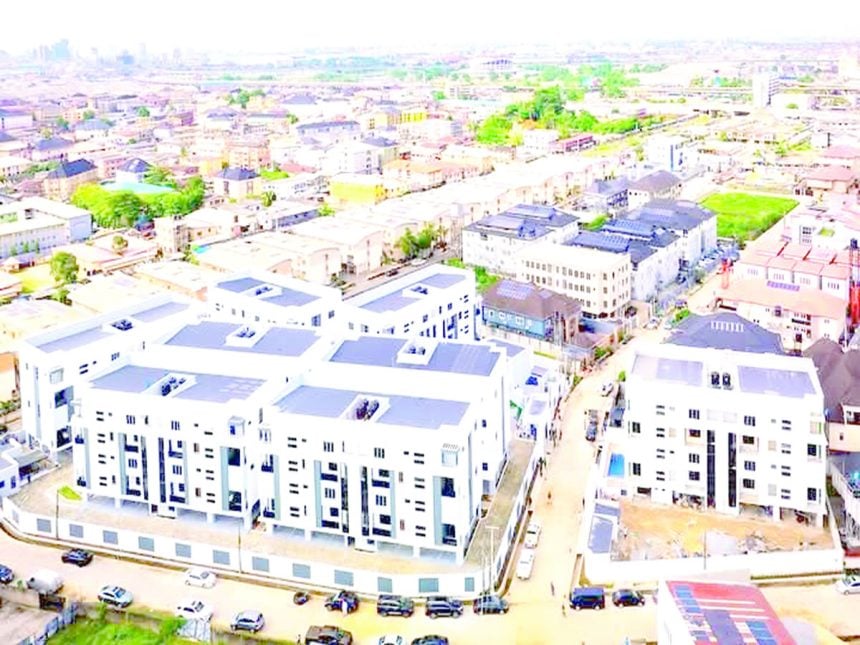
Nigeria’s housing crisis is worsening as rental costs continue to surge across major cities, with experts attributing the trend to deep-rooted structural and macroeconomic challenges rather than arbitrary decisions by landlords.
Recent data indicate that rents have risen by between 50 and 200 percent in the past two years, with some locations in Lagos, Abuja and Ogun State recording spikes of up to 300–400 percent. The development has pushed Nigeria’s rent-to-income ratio to about 70 percent, far above the United Nations’ recommended 30 percent threshold.
Executive Secretary and Chief Executive Officer of the Mortgage Banking Association of Nigeria, Ajadi Adedeji, argued that inflation and the time value of money are key drivers of rent increases. According to him, landlords who fail to adjust rents in line with inflation effectively incur losses in real terms.
“A landlord who collected ₦1 million two years ago and maintains the same rent today has effectively lost value due to inflation, which I estimate at about 40 percent depreciation,” he said at the Capital Markets Academics of Nigeria (CMAN) platform, noting that the issue reflects broader macroeconomic pressures.
Economist, Professor Sheriffdeen Tella, said while demand and supply dynamics remain central, deeper structural factors are accelerating the crisis. He identified insecurity-induced migration, weak infrastructure, and limited housing supply as major triggers of rising demand in urban centres.
“When supply meets barely 0.18 per cent of demand, prices will naturally rise,” Tella stated, adding that displacement from rural communities and the concentration of economic opportunities in cities have intensified pressure on housing.
READ ALSO: Growing hostilities in Middle East may worsen Nigeria’s housing crisis — Expert
He further highlighted systemic issues such as what he described as the “landlord income trap,” infrastructure deficits, and coordination failures in housing policy. According to him, government housing delivery—estimated at between 5,000 and 7,000 units annually—falls significantly short of the roughly 550,000 units needed each year, contributing to a national housing deficit of about 14.9 million units.
Tella warned that rising rents should be treated as a macroeconomic risk rather than merely a social concern, as they erode household income, reduce consumption, and undermine economic stability.
“Housing inflation acts like a regressive tax on urban households,” he said, calling for coordinated intervention involving fiscal and monetary authorities, as well as stakeholders across the housing value chain.
On policy responses, experts expressed scepticism over rent control measures implemented by some state governments, including Lagos and Enugu, citing weak enforcement and structural misalignment.
Housing analyst Omoke Philip maintained that rent control policies have historically failed to address the root causes of housing shortages. He pointed instead to rising fuel prices, exchange rate depreciation, and mass displacement caused by insecurity as key drivers of urban population growth and housing demand.
“The economic law of demand and supply remains the dominant force. The solution is to build more houses to meet growing urban demand,” he said.
Philip added that housing remains a critical indicator of economic performance, influencing employment, investment, and consumer confidence. He noted that increased housing investment can stimulate broader economic activity through demand for construction materials, labour, and financial services.
Analysts also linked rising rents to escalating construction costs, driven by inflation, currency depreciation, and high interest rates, which have made property development more expensive and homeownership less attainable.
A recent report by Fortren & Company ranked Lagos among Africa’s most expensive rental markets, with annual rents for luxury two-bedroom apartments in prime locations such as Ikoyi, Banana Island, and Victoria Island averaging about $19,379 (approximately ₦26.8 million).
As affordability worsens, experts are calling for a shift in housing policy, including increased government intervention in land provision, access to low-cost financing, and income-based housing models.
They warned that without urgent and coordinated reforms, Nigeria’s housing crisis could deepen poverty levels and threaten the sustainability of broader economic reforms.
WATCH TOP VIDEOS FROM NIGERIAN TRIBUNE TV
- Relationship Hangout: Public vs Private Proposals – Which Truly Wins in Love?
- “No” Is a Complete Sentence: Why You Should Stop Feeling Guilty
- Relationship Hangout: Friendship Talk 2025 – How to Be a Good Friend & Big Questions on Friendship
- Police Overpower Armed Robbers in Ibadan After Fierce Struggle


