
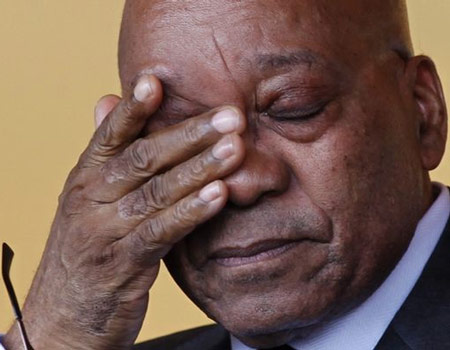
ON Valentine’s Day, February 14, 2018, Jacob Zuma resigned as the president of South Africa. The resignation occurred less than 24 hours before his party, the African National Congress (ANC), was scheduled to debate a no-confidence vote on him by the parliament. He had been asked by the party a week earlier to resign or be removed.
The road to Zuma’s exit was paved by repeated cases of corruption and scandals involving allegations that he allowed the Gupta brothers, business associates of his son Duduzane Zuma, to influence cabinet appointments and the award of government contracts. In March 2016, South Africa’s top court found that he had violated the constitution by failing to pay back $542,000 of public funds spent on his private rural estate. Earlier, in April 2016, the High Court in Pretoria ruled that there was no basis to drop the 18 charges relating to 783 counts of corruption, fraud, racketeering and money laundering brought against him in 2009. The Supreme Court subsequently upheld the High Court’s decision in 2017.
These scandals provoked public opprobrium, which was expressed in the media, in litigations and street demonstrations by civil society groups. But Zuma tried to subvert the independence of key state institutions. For instance, he abused his powers by handpicking judges heading commissions of inquiry and hiring and firing the operational heads of the police and national prosecuting authorities. He also long employed a strategy of fighting judgments through the courts. As the leader of the majority party, he was able to subvert several no-confidence votes in the parliament. He virtually turned parliament into a rubber stamp, in spite of the persistent cries of opposition voices like Julius Malema of the Economic Freedom Fighters party.
Meanwhile, Zuma’s presidency had been devastating for the ANC. Disillusionment with corruption led to hundreds of thousands of ANC voters abstaining during the 2016 municipal elections. The party list (proportional representation) electoral system enabled opposition parties to win seats in Cape Town and Tshwane, in the biggest city, Johannesburg, and in the former ANC heartland, Nelson Mandela Bay. Thus, in the December 2017 elective conference of the party, Cyril Ramaphosa won the day after Zuma’s faction antagonised other members in an attempt to rig the vote through gatekeeping. Since then, resentment against Zuma within the party had deepened. Thus, the ANC leadership perceived victory in the forthcoming election to be clearly threatened by Zuma’s remaining at the helm. He had to go.
The recall of Zuma owes to the party’s view of all government officials, including the president of the country, as “deployees” of the party who are required to follow party orders. Thus, when the party leaders considered that Zuma’s unpopularity had become a threat to the ANC’s electoral victory, they recalled him. Even so, it took the threat of certain defeat in a no-confidence vote in parliament, to be brought by an opposition party, to force him to resign. Given the institutionalisation of the party and the clear and direct threat to its victory in the forthcoming election, Zuma had to resign. Before the party’s move, he had resisted Constitutional Court orders, surmounted the vocal opposition Economic Freedom Fighters (EFF), ignored the media, and disregarded the protest by South Africa’s citizens and civil society groups in order to remain in power.
Although the parliamentary and proportional representation electoral system contributed to the centrality of the party and party discipline in delivering the eventual positive outcome, it is the collective force of these groups that prevailed on the party to put an end to Zuma’s calamitous and corrupt reign. Active citizens, persistent and courageous opposition parties, determined civil society groups, independent courts and the media united against corruption and irresponsible governance and forced the party’s hand. In Nigeria, parties have remained fragile and uninstitutionalised. Disagreement over matters of propriety and national values often end in schism within the parties. This is because such disagreements are quickly undermined by religious and ethnic cleavages.
The elite have not been able to uphold the morality, propriety and national values enshrined in the constitution as foundation for democratic governance. A president quickly rises above the party. Factional leaders and sections hold sway as the quest for power fails to reckon with the aspirations of citizens. These negative behaviours must be corrected for party discipline and party institutionalisation to occur. Upholding the values of integrity, discipline, social justice and rule of law, values that are enshrined in the 1999 Constitution, is essential to strengthening governance institutions for democratic advancement and economic prosperity.
WATCH TOP VIDEOS FROM NIGERIAN TRIBUNE TV
- Relationship Hangout: Public vs Private Proposals – Which Truly Wins in Love?
- “No” Is a Complete Sentence: Why You Should Stop Feeling Guilty
- Relationship Hangout: Friendship Talk 2025 – How to Be a Good Friend & Big Questions on Friendship
- Police Overpower Armed Robbers in Ibadan After Fierce Struggle


