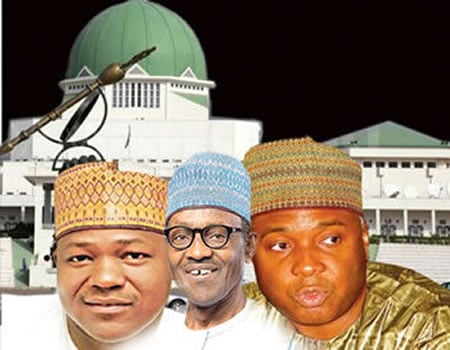
 Contrary to widely held indications that the contention between the National Assembly and the Presidency is the order of elections bill, the National Assembly is actually working on the 2018 Electoral Act, which has 42 other amendments outside the section seeking to re-order elections.
The introduction of Section 25(1) to the 2010 Electoral Act Amendment Bill in January by the House of Representatives raised some dust which has refused to calm down ever since.
No one appeared to see it coming, especially as the Senate had as far back as March 2017 passed the Electoral Act amendment bill 2017, which was a combination of two bills; SB 231 and 234.
But the House, which worked on House Bills 165,174, 220, 429, 468, 484,809 and 966 shocked the nation in January when it announced the passage of the amendment seeking to reorder the elections.
Since that passage, the order of elections bill has become the domineering factor. Lawyers and public commentators have shouted themselves hoarse arguing on different sides about the propriety of the action taken by the National Assembly.
Some have said that the amendment was targeted at President Muhammadu Buhari such that he would be denied the bandwagon effect of general elections.
Others have argued that the lawmakers have powers to amendment the laws of the land as far as they follow prescribed channels.
Contrary to indications in the polity, however, the Electoral Act Amendment Bill 2018, which is seeking to amend the Act no. 6, 2010, (Electoral Act 2010) contains 43 amendments which are targeted at cleaning the election up the election Aegean’s table.
Amendments to Electoral Acts have always been dogged by controversies since 2002, when the political system of the Fourth Republic started reshaping the legacy bequeathed to it by the military. That year, the tango over the propriety of the Electoral bill was dragged to the front doors of the Judiciary, which resolved the quest by the lawmakers to fix dates for elections.
Ever since, the subsequent elections have witnessed the amendment to Electoral Acts just before the elections. There was the 2006 Electoral Act passed just before the 2007 elections, the 2010 Electoral Act passed just before the 2011 elections. That Act has so far survived two elections: 2011 and 2015 elections. It is the subject matter of the controversy currently ravaging the relationships between the National Assembly and the presidency ahead of the 2019 elections.
Some of the key inputs the 2018 Electoral Act Amendment bill seek to bring on board includes the official recognition of the Card Reader and electronic contents in election processes; attempts to standardise Area Council and local government elections conducted by the State Independent Electoral Commissions (SIECs) and ensure free and fair contests; introduction of Electronic Register of voters which can be accessed by interested persons on payment of a fee; provisions for punishments for staff of INEC who fails to display voters register as contained in Section 19(1a) and (4) ; provision of the order of elections as contained in Section 25(1) of the bill; imposition of ban and a fine of N1 million on any political party which fields an ineligible candidate for elections.
The bill is also seeking to stop the spate of court cases that arise from claims of omission of party logo and names of candidates by introducing Section 34(2) which gives the opportunity to parties and candidates who notice that their names or logo were omitted to submit such claims in writing to INEC not later than 21 days to the election.
Section 34(3) indicates that where a candidate or the party fails to give such notification, he shall be deemed to have waived his right The contentious electoral bill is also seeking to correct the type of logjam that was witnessed in Kogi state in 2015 following the death of the candidate of the All Progressives Congress (APC) Alhaji Abubakar Audu, who was poised to win the election. With the introduction of Section 36 (3) ( A,B,C) to cure the logjam.
According to the new bill, if a leading candidate in an election dies before the returns are made, the Electoral Commission shall suspend the election for a period not exceeding 21 days and allow the party whose candidate died to within 14 days conduct a fresh primary to replace the dead candidate.
Buhari, NASS leaders strike deal on 2018 budget
The bill also introduces a new Section in 38(2) which provides that party agents can make video recordings of the election materials submitted by INEC officials to each polling station. Any Presiding officer who violates the processes highlighted in Sections 38 (3),(4), (4a) and (5) which deals with election process shall be guilty of offence including a punishment of one year imprisonment or a fine of N1million or both. In the new bill, a political party that does not object to errors in its name or logo cannot validly pursue a case of exclusion in court or tribunal.
Section 49 (2) recognises the use of the Card Reader or any other electronic device introduced by INEC from time to time to authenticate or confirm the identity of the voters.
In section 52(2) the new bill empowers INEC to adopt electronic voting in all elections or any other method as may be determined by the commission.
In Section 53(2) the National Assembly modified the existing law by indicating that where the votes cast in a polling unit exceeds the accredited number of voters, the commission shall cancel the result and fix another date for the conduct of the elections where the result is seen to be capable of affecting the overall result in the constituency.
Also in Section 63(1) the National Assembly indicated that the Presiding officer shall after counting the votes in a polling unit shall enter the votes into a form prescribed by the commission and “electronically transmit same.” That amendment made clear reference to electronic transmission of votes. The same section, at 63(4) indicates that the Presiding officer shall announce the result at the polling unit.
In Section 65(A), the new bill seeks to empower INEC to operate a National Electronic Register of Election Results, a database of results from pooling units across the country, which can be accessed by interested parties.
Section 76(2) also indicates that a Presiding Officer who intentionally announces or signs election results in violation of the provisions of the Electoral Act shall be guilty of an offence punishable by one year imprisonment or N1 million fin or both.
Section 87(1) of the new bill further empowers INEC to not only monitor party primaries but to also endorse or certify party primaries to all elections it shall conduct.
Section 87((3), (i),(ii),(iii),(iv),(V),(VI),VII), stipulates the nomination fees for the various offices to be contested under the bill as including the sum of N150,000 for Councillorship seats in the FCT,N250,000 for Area Council Chairman in the FCT, N500,000 for House of Assembly seat, N1,000,000 for House of Representatives seat, N2 million for Senate seat, N5 million for Governorship seat and N10 million for Presidential seat.
2019 election sequence, NASS and executive veto
In further seeking to empower INEC and possibly subdue the shenanigans of political godfathers, the new bill indicates in Section 87(9) that if a political party alters the results of a primary conducted and certified by INEC the Electoral Commission shall overrule the party and uphold the primaries.
Section 87 (9) (A) also stipulates a sequence of primaries for political parties in this order; National Assembly, State Houses of Assembly; Governorship and Presidential election.
The dates for the primaries according to 87(9) B) shall not be earlier than 90 days and not later than 60 days before the date of elections to the offices.
The new bill also stipulates the delegates to each of the primaries to be monitored by INEC.
Section 91(1-10) stipulate the amounts permissible to be spent in prosecution of the different elections contained in the electoral Act including the sum of N5 billion for presidential election; N1 billion for Governorship; N100m and N70 million for Senate and House of Representatives and N30 million for State Houses of Assembly seat. It indicates in 91(6) that maximum expenses for Area Council Chairmanship election shall be N30 million and Councillorship seat shall be N5million. In Section 91(10), the bill stipulates offences including a prison term of 12 months or one percent of the amount permitted as limit. Campaigns are allows from 150 days to the election and must end 24 hours before elections.
In section 140(4) the bill indicates that if at the point of display or distribution of ballot papers, a candidate or his agent discovers that his name or logo has been omitted, the candidate shall notify INEC which shall postpone the election to rectify the omission and appoint another date to conduct the election.
In Section 152(A, B & C), the National Assembly introduced another section President Muhammadu Buhari has identified as contentious. In the section, the lawmakers indicate that all the provisions of the 1999 Constitution and the Electoral Act which guarantee the conduct of free and fair elections by INEC shall be applicable to all State Independent Electoral Commissions (SIECs).
The bill says in section 152(B) that all local government elections conducted by SIECs shall be in compliance with relevant provisions of the Electoral Act and in Section 152(C), any election conducted by SIECs to any local government in the Federation in violation of the section shall be null, void and of no effect whatsoever.
Again in Section 152(D) the bill indicates that any staff of SIEC who acts in contravention of Section 152(B) shall be liable to prosecution as if he were a staff of INEC.
Incidentally the above section forms one of the grounds by which President Buhari has objected to the bill and refused assent.
The failed 2006 Constitution amendment exercise tagged the third term bill popularised the saying; “throwing away the baby and the birth water,” in the Nigerian polity, and as it seems, except the National Assembly and the Courts save the Electoral Act Amendment bill 2018, the baby and the birth water might just be thrown outside the window.
Other than re-ordering the sequence of elections, the bill seeks in many ways to fundamental structure elections in the polity and tailor polls towards near perfection. It also empowers INEC to stop godfatherism and impunity often displayed by political parties during primaries.
Whether the bill will ever see the light of say remains to be seen.
WATCH TOP VIDEOS FROM NIGERIAN TRIBUNE TV
- Relationship Hangout: Public vs Private Proposals – Which Truly Wins in Love?
- “No” Is a Complete Sentence: Why You Should Stop Feeling Guilty
- Relationship Hangout: Friendship Talk 2025 – How to Be a Good Friend & Big Questions on Friendship
- Police Overpower Armed Robbers in Ibadan After Fierce Struggle