
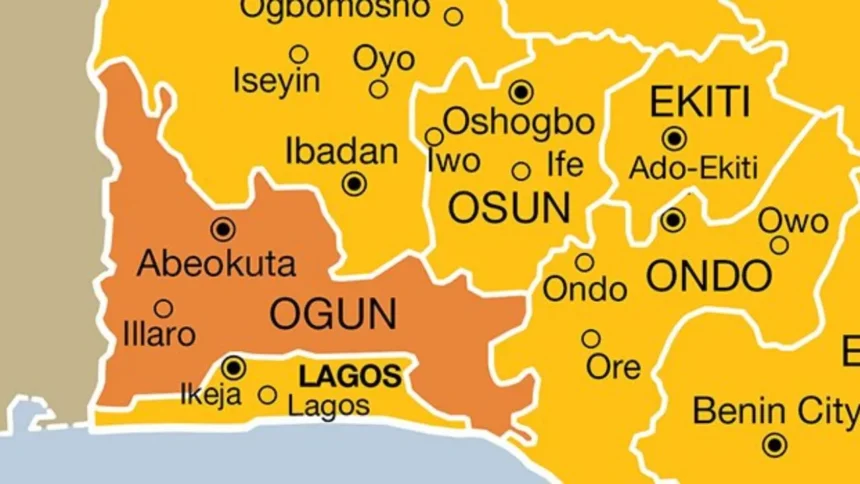
Ogun State Government has attributed the recurring gas emissions recorded in parts of Ijebu-Ode and its environs to natural underground geological activities.
It, therefore, dismissed insinuations linking the emissions to traditional myths or spiritual beliefs.
Dr Ola Oresanya, the State Commissioner for Environment, disclosed this at a stakeholders’ town hall meeting organised by the state government at the Bisi Rodipe Hall, Government Reservation Area (GRA), Ijebu-Ode.
ALSO READ: 2027: APC, Accord, ADC members defect to APM in Ibadan
The commissioner explained that scientific investigations conducted by experts revealed that the gases being emitted in the affected areas are mainly methane and sulphide, originating from underground fractures along an existing geological fault line.
He noted that the affected locations lie along the Ifewara-Zungeru Trans-Atlantic Fault Line, a major geological feature that stretches from Mojoda through Ijebu-Ode into Osun State and extends to Zungeru in Niger State.
“There is what we call the Ifewara-Zungeru Trans-Atlantic Line that cuts across Mojoda, Ijebu-Ode into Osun State through Zungeru in Niger State. That fault line has existed from time immemorial, and investigations have shown that it connects directly to the areas where the gas emissions occurred.
Coincidentally, all the affected schools are located within this corridor,” he said.
The commissioner further explained that the affected parts of Ijebu-Ode were historically forested and sparsely inhabited, adding that many of the schools currently impacted were missionary institutions established on lands that were largely unoccupied at the time.
Oresanya said investigations are ongoing to determine whether the methane and sulphide emissions are thermogenic or methanogenic in origin.
While adding that experts are also seeking to establish whether the area sits atop significant natural gas reserves, which may have contributed to the pressurised gas emissions.
In her remarks, the State Commissioner for Health, Dr. Tomi Coker, urged residents not to panic, but to adhere to safety precautions whenever gas emissions occur.
She advised residents to cover their noses with wet handkerchiefs instead of wearing face masks, warning that face masks could pose additional risks during such incidents.
On the reopening of schools affected by the incident, the Commissioner for Education, Science and Technology, Professor Abayomi Arigbadu, assured parents that the temporary closure was a precautionary measure.
He said the schools would be reopened after consultations with principals of the affected schools and Zonal Education Officers to ensure all necessary safety arrangements are in place.
Leading the scientific investigation, the Head of the Department of Earth Sciences at Olabisi Onabanjo University, Professor Philip Ikhane, appealed to residents to remain calm, assuring them that experts were working diligently to determine the exact cause of the gas emissions.
He advised residents to minimise activities capable of aggravating the fault lines, including indiscriminate borehole drilling and quarry blasting, warning that such activities could worsen the situation and pose greater risks to lives and property.
Speaking on behalf of stakeholders, Messrs. Adegbenro Adetayo, Olawale Kukoyi, Monday Ajayi, and Mrs. Morayo Adebanjo commended the Ogun State Government for its swift response and ongoing intervention.
WATCH TOP VIDEOS FROM NIGERIAN TRIBUNE TV
- Relationship Hangout: Public vs Private Proposals – Which Truly Wins in Love?
- “No” Is a Complete Sentence: Why You Should Stop Feeling Guilty
- Relationship Hangout: Friendship Talk 2025 – How to Be a Good Friend & Big Questions on Friendship
- Police Overpower Armed Robbers in Ibadan After Fierce Struggle


