

In a market often defined by meme coins, viral hype, and speculation, financial literacy remains one of crypto’s biggest blind spots. That gap, analysts warn, helps explain the industry’s recurring boom-and-bust cycles and could set the stage for another correction if left unaddressed.
A recent study cited by Cointelegraph found that financial literacy among crypto investors is significantly lower than the general population. Professor Santiago Carbó-Valverde of the Universitat de València noted that this disconnect often leads to misplaced confidence, overexposure to risk, and poor understanding of diversification and portfolio management. Many investors who consider themselves financially savvy actually display a “financial literacy bias” overestimating their own knowledge while underestimating market risks.
This overconfidence amplifies volatility. When prices drop, uninformed investors panic-sell, accelerating declines and fueling the very instability that keeps institutional money cautious. The literacy gap also limits adoption: surveys show that lack of education remains a primary barrier for underrepresented groups, particularly women and first-time investors, reinforcing inequality in access to financial innovation.
The paradox is clear, crypto was designed to democratize finance, yet without education, it risks deepening divides. As blockchain adoption accelerates, platforms like Binance Academy are stepping in with structured courses to help users understand key topics like risk, security, and decentralized finance.
Ultimately, knowledge, not hype, will determine who thrives in the next crypto cycle. A more informed investor base could mean fewer speculative bubbles, steadier adoption, and a market driven by understanding rather than emotion.
Financial Literacy ‘Dangerously Low’ Among Crypto Community
Last November, PiP World released a report detailing financial literacy, or the lack thereof, among members of the crypto community. The findings were concerning to say the least. Per the study, basic financial literacy on topics ranging from risk management, diversification, even simple concepts like compound interest, was “dangerously low.”
A study of over 2,121 respondents, conducted by Santiago Carbo-Valverde, a professor of economics at the Universitat de València (Spain) indicated another cause for concern. That would be the high prevalence of people in the crypto community who mistakenly think they have high financial literacy. These individuals could be more likely to engage in the sort of risky speculation that leads to high volatility and financial bubbles in the crypto market.
Based on the findings of these studies, alongside other studies containing similar data, it is not surprising that the cryptocurrency market has remained highly volatile, even as it has gradually entered the financial mainstream. Rising institutional adoption of crypto may help to temper this overall market volatility.
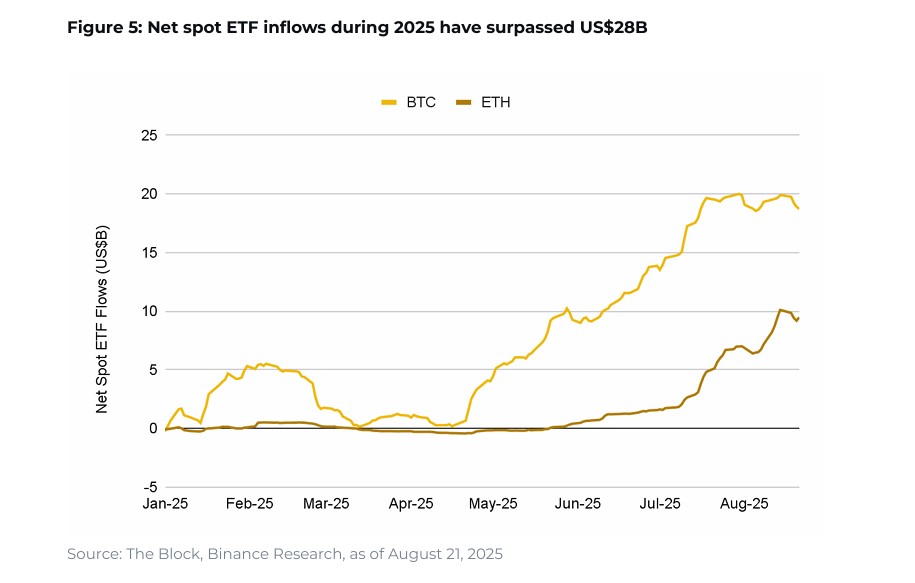
In Binance Research’s August 2025 edition of 10 Charts Shaping 2025, one of the key topics discussed was how spot ETF inflows (a proxy for institutional investment) continue to climb, as seen in the chart below. Still, as retail crypto investors remain a large portion of the market, “hype” may be at risk of staying a key component of the overall market.
Binance Academy Helps to Build the Knowledge Base
Whether one is unaware of concepts like blockchain technology, decentralized finance (DeFi), Web3, or crypto itself, Binance Academy offers a beginners course that goes through the fundamentals of cryptocurrency trading and investing.
For intermediate users, the platform offers a course that digs deep into complex DeFi concepts, the mechanisms behind decentralized applications (DApps), along with other related topics. The platform also offers great educational resources for experienced crypto users, including courses such as “Blockchain and P2P Fundamentals,” “Blockchain for Business Sustainability,” as well as “Digital Assets and Blockchain Industry.”
Outside of the Binance ecosystem, the company is also helping to make crypto education accessible around the world. Through partnerships with educational institutions like Pakistan’s Ministry of IT and Telecom, Binance is doing its part to equip students with early knowledge about blockchain-based finance.
Back in August, Binance launched the “Humans of Binance” content series to spotlight real people whose lives have been transformed by blockchain technology and the Binance ecosystem. Binance CMO Rachel Conlan shared, “At Binance, we believe authentic storytelling is the foundation for building meaningful connections with people from all walks of life. Through ‘Humans of Binance,’ we’re encouraging everyone to share their unique crypto stories, with the hope that this will be the start of a movement to debunk misconceptions of crypto and highlight its true potential.”
“In a market that’s often crowded and misunderstood, emotional narratives like this allow us to cut through the noise, build genuine brand trust, and inspire new users to discover the possibilities of blockchain technology. We are excited to be part of the crypto journey for the next one billion crypto users and beyond,” Rachel added.
If the crypto industry, regulators, and other stakeholders begin to follow Binance’s lead, and take a proactive role in promoting crypto education, it may do wonders in terms of improving the overall financial literacy of the market. In turn, this may mean a more sustainable expansion of the space moving forward.
Knowledge Over Hype
Although few have yet to stress the importance of financial literacy as strongly as platforms like Binance, things appear to be moving in the right direction. For instance, earlier this year, lawmakers in the U.S. State of Georgia proposed legislation that would make crypto and blockchain education a component of the public school curriculum.
Looking to compete with the top name in the market, crypto exchanges and other blockchain-based financial service companies could start to integrate blockchain and financial educational tools into their ecosystems.
Put it all together, and the resultant improved knowledge could help to reduce the “hype” factor that has kept crypto a more chaotic, volatile market compared to that of stocks. For this asset class to mature, and for crypto to become fully integrated within the global financial system, it may prove necessary for this to happen.
WATCH TOP VIDEOS FROM NIGERIAN TRIBUNE TV
- Relationship Hangout: Public vs Private Proposals – Which Truly Wins in Love?
- “No” Is a Complete Sentence: Why You Should Stop Feeling Guilty
- Relationship Hangout: Friendship Talk 2025 – How to Be a Good Friend & Big Questions on Friendship
- Police Overpower Armed Robbers in Ibadan After Fierce Struggle


