
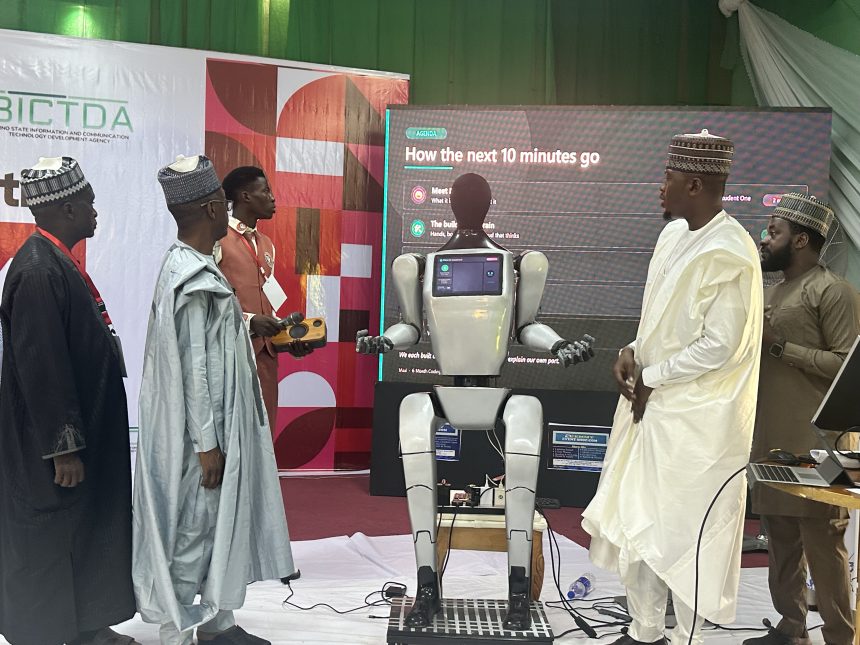
Secondary school students in Borno State have developed a humanoid robot capable of responding to questions and following instructions, in an innovation aimed at supporting teaching and learning.
The robot was unveiled on Tuesday in Maiduguri at the graduation ceremony of participants in the “Empowering Ideas, Empowering Communities” Artificial Intelligence Bootcamp and Data Analytics Fellowship organised by Maxzeeton Technology in collaboration with the Borno State Information and Communication Technology Development Agency (BICTDA).
Speaking at the event, the Managing Director of Maxzeeton Technology, Abdullahi Usman Alkali, said the robot was designed and developed by the students after months of training in artificial intelligence and robotics.
Alkali said the programme began in September 2024 and was initially planned for six months but was extended to allow the students to develop practical innovations.
He said the project was conceived partly to address challenges in the education sector, especially in communities where a shortage of teachers had affected learning.
According to him, the robot could support pupils both at home and in the classroom, particularly in mathematics.
“The robot is designed to guide learners step by step, especially when they are faced with difficult mathematical problems,” Alkali said.
He said the project demonstrated the capacity of young people to develop useful technological solutions when given the right training and opportunity.
Also speaking, the Executive Secretary of BICTDA, Kabir Wanori, said the initiative was part of the state government’s digital transformation programme aimed at developing young people with practical technology skills.
ALSO READ: US speeds up asylum cases with new rule impacting Nigerians
Wanori said the agency, in collaboration with Maxzeeton Technology, trained the students in ICT, robotics and innovation, adding that the programme enabled them to turn their ideas into practical solutions.
He described the students’ robotic innovation as a significant beginning, saying it could pave the way for wider application of robotics in different sectors.
“We want a situation where, in the future, robots can perform tasks in industries and other areas of life,” Wanori said.
He said robotics could be applied in education, agriculture and healthcare, adding that the programme was also designed to “create talent, create wealth and support innovation.”
Wanori said BICTDA would provide further training for the students and expose them to the international community to enable their innovations to gain wider recognition.
One of the students, Al-Mustapha Kabir Matazu, said the training progressed from programming and coding to robotics and artificial intelligence, enabling the participants to develop the robot, which he identified as “Max Zulum”.
He said the robot has a screen on its chest for interaction and voice communication and is designed to assist children in learning through simple, step-by-step explanations.
Another participant, Fatima Abdulrahman, said the programme had made a significant difference in her life, particularly after she emerged as a competition winner.
She said the experience had motivated her to further develop her skills and contribute to her community through technology and innovation.
The ceremony featured demonstrations of the students’ innovations and marked the completion of their training in artificial intelligence, robotics and data analytics.
WATCH TOP VIDEOS FROM NIGERIAN TRIBUNE TV
- Relationship Hangout: Public vs Private Proposals – Which Truly Wins in Love?
- “No” Is a Complete Sentence: Why You Should Stop Feeling Guilty
- Relationship Hangout: Friendship Talk 2025 – How to Be a Good Friend & Big Questions on Friendship
- Police Overpower Armed Robbers in Ibadan After Fierce Struggle


