Tribune OnlineTribune OnlineTribune Online
  • Home
  • News
  • Columns
  • Editorial
  • VIDEOS
  • Entertainment
  • Politics
  • Health
  • Opinions
  • SPORTING TRIBUNE
Reading: Walkways, not walls
Share
Notification Show More
Font ResizerAa
Tribune OnlineTribune Online
Font ResizerAa
  • Home
  • News
  • Columns
  • Editorial
  • VIDEOS
  • Entertainment
  • Politics
  • Health
  • Opinions
  • SPORTING TRIBUNE
  • About Us
  • Contact us
  • Disclaimer
  • Privacy Policy
  • Advertise
Have an existing account? Sign In
Follow US
© 2026 African Newspapers of Nigeria Plc. All Rights Reserved. | Disclaimer | Privacy Policy | Editorial Policy | Corrections Policy | Terms & Conditions
Home » Walkways, not walls
Opinions

Walkways, not walls

Prakash Loungani
December 29, 2024
Share
against Tunji-Ojo to Sowore age of modern legends, Medical cannabis industry and the cost of prohibition Misapplication of omo ale omoluabi concepts Renewed Hope Automobile Credit Fund deserves Nigeria where women can lead freely Education minister’s mission to reform When will Nigeria and Africa time come Walkways not walls Dakuku and the art of redefining intellectual Tinubu’s tax mentality needs Cost of living crisis, The uprising ground rent collection, The Oba (Dr.) Adekunle Aromolaran II that I knew A tribute How the constitution deleted Just before you embark on protest, Nigeria’s relationship with money, Cybersecurity starts at the top: Why management must lead the digital defense
Add as a preferred source

Macroeconomics, by definition, focuses on the big picture. It neglects smaller micro developments at the business or sectoral level. In 2007, Edward Leamer, an economics professor at the University of California, Los Angeles, pointed out the high costs of this neglect by arguing that it’s meaningless to try to understand business cycles without paying attention to the housing sector.

As he argued in a now-famous paper titled “Housing IS the Business Cycle,” the housing market is central to understanding why economies go through booms and busts. He pointed out that nearly all recessions in the United States since World War II were preceded by problems in the housing sector. Macroeconomics would, in other words, be better served by building walkways to housing economics rather than simply walling it off.

After all, housing’s impact on the macroeconomy is evident everywhere. Cities are among the world’s most productive places, brimming with creativity and innovative ideas and powering economic expansion. Yet accommodation in many cities is prohibitively expensive even for relatively high-paid professionals, let alone essential workers on lower pay who keep cities safe, clean, and running smoothly. Many of these workers—police officers, teachers, nurses, delivery drivers—must turn up to work in person. They cannot take advantage of the shift toward remote work to find more affordable places to live and raise a family.

Across the Organisation for Economic Co-operation and Development’s mostly rich countries, house prices have risen by almost 40 percent in real terms over the past decade, with the cost of a home in the United States up by about 50 percent. Demand for housing has been extremely strong in recent years, spurred by increases in population and income. At the same time, housing supply has failed to keep up, partly because of land-use regulations (such as preventing neighborhoods with single-use housing from allowing multifamily housing), which restrict how many housing units can be built on a particular plot of land. Among other effects, this risks exacerbating intergenerational inequality: 60 percent of people aged 18–29 reported being somewhat or very concerned about securing adequate housing. Affordability is a growing concern for businesses, too, as they say it’s forcing them to pay higher wages and budget for higher labor costs.

And it’s not just a problem for the rich world. Affordable housing is especially scarce for the poorest. In Colombia, for instance, 82 percent of renters in the lowest income quintile hand over more than 40 percent of their income to private landlords, according to the OECD.

Expensive homes and high rents can push people to take on too much debt. Household borrowing can boost economic growth in the short term, but it imposes serious costs later on: consumers cut spending to make repayments, the economy slows, and unemployment rises, as the IMF has shown. In China, for instance, a housing downturn has had a significant impact on consumption. To take it up a level, a sudden economic shock—such as a collapse in home prices—can trigger a spiral of credit defaults that shakes the financial system.

Had walkways been in place between macroeconomics and real estate economics, we might have better-anticipated developments during the 2008–09 global financial crisis. We might also have better understood more recent policy conundrums, as the articles that comprise this issue’s cover package show.

This year, macroeconomists faced two central challenges. The first is understanding the sources and likely duration of the 2021–22 upsurge in inflation. The second is figuring out how to bring about a “soft landing” by slowing down the economy to tame inflation without tipping it into recession. Macroeconomists would have done a better job on both central policy issues with a deeper knowledge of developments in real estate markets.

The stubbornly high rate of inflation in the United States reflected a complex and shifting mix of demand and supply factors. Yet one surprise was the role of housing, which sent prominent macroeconomists scrambling to understand the minutiae of how house prices and rents are reflected in measures of the cost of living. Indeed, the increase in borrowing costs for housing contributed to the puzzling pessimism in consumer sentiment about economic conditions and led to much hand-wringing by economists determined to explain the disconnect with the consumer price index.

Central banks faced the challenge of figuring out how the increases in interest rates that they were engineering to subdue inflation would affect the housing sector and the economy overall. This is no easy task. The channels through which interest rates affect housing markets are complicated and shift over time—they require a study of housing markets with a depth of knowledge that would be rare in macroeconomics textbooks, just as Leamer noted almost two decades ago when he lamented his failure to find a single textbook that placed real estate “front and center, where it belongs.”

One channel that affects the impact of interest rates on housing is the prevalence of fixed-rate mortgages, which can vary from close to zero in South Africa to more than 95 percent in Mexico and the United States. Other factors that affect monetary policy’s potency include the extent of homeowner debt, the extent of supply restrictions, and the extent of house price appreciation and possible overvaluation, which can be very difficult to measure.

As if all this did not already make for a complicated picture, the strength of these channels changes over time. The share of fixed-rate mortgages has, for instance, increased recently in many countries. The availability of refinancing also differs across economies and over time. A deep country-specific understanding of housing and housing markets is needed to calibrate monetary policy.

Food, clothing, and shelter are considered to be basic needs of humankind. Indeed, the 1948 Universal Declaration of Human Rights and other such international treaties have recognized the right to adequate housing. The eradication of hunger is very prominent in the UN’s Sustainable Development Goals (SDG 2 is to end hunger). UN agencies such as the World Food Programme swing into action when food prices spike and even the IMF launches new loan programs to help people and countries cope with the effects of food price shocks. Shelter is a poor cousin. Housing gets barely a mention in the SDGs. This is despite the fact that housing affordability is a pervasive problem, affecting many, if not most, of the world’s major economies. Little wonder then that housing has surfaced as a major issue in several national and local electoral races.

*PRAKASH LOUNGANI is director of the applied economics master’s program at Johns Hopkins University

READ ALSO: 2025: Businesses should prepare for more stress —LCCI


WATCH TOP VIDEOS FROM NIGERIAN TRIBUNE TV

  • Back to School, Back to Business A Fresh Start

  • Relationship Hangout: Public vs Private Proposals – Which Truly Wins in Love?

  • “No” Is a Complete Sentence: Why You Should Stop Feeling Guilty

  • Relationship Hangout: Friendship Talk 2025 – How to Be a Good Friend & Big Questions on Friendship

  • Police Overpower Armed Robbers in Ibadan After Fierce Struggle


    Get real-time news updates from Tribune Online! Follow us on WhatsApp for breaking news, exclusive stories and interviews, and much more.
    Join our WhatsApp Channel now


TAGGED:Businesswalls
Previous Article Between Tinubu’s birthday and lynching of northerners Nigeria’s potential can be unlocked through… An appraisal of Oluwatoyin Madein The imperative of emergency rule Inspiring the next generation of tax-conscious citizens necessary shift for the APC The Plantation, What a wicked society Are Nigerian women human?,Why cultural education is imperative in addressing Nigeria’s kokoma on M.K.O Abiola’s grave Why the Supreme Court should rescue A reading list for public servants No more politics of principle Electoral reform is beyond INEC Coping in Nigeria’s high-inflation Prince Samuel Ademola Adeladan (1932-2024) Three key legal challenges for startups The leaders needed at this time Open letter to Governor ‘Seyi Makinde Tunji-Ojo Interior Ministry rule of law in the Sahel Learning from Sweden’s public health Professor Kingsley Moghalu, With technology Nigeria’s dependence on noisy Professor Nuhu Yaqub, The real enemies are poverty Harnessing AI to transform where only God can make the poor live A time for reflection On justice a just society and the Counting the gains of President Tinubu’s Xmas in those good old days No excuse for violence against How Interior Ministry is redefining national service Senator Abiola Ajimobi’s posthumous birthday Future of journalism Navigating identity in the diaspora Role of good governance Of VCs CMDs dying patients Measuring national progress NBS data Tinubu’s troika Awo’s legacy lives on as Awolowo Dosumu champions women’s Nigeria’s only matrilineal society Delta State’s 2025 budget The Tribune @ 75 nepotism in appointments Nothing with ‘N’ works anymore Ogun student’s demise devious antics of How crypto mining became You can’t be everything! Economic treason Tinubu’s cabinet reshuffle Exploiting advantages from shift New Collective Quantified Goal Life of a journalist Dry port Yet another game changer Oloyede as living expression How Nigerian SMEs, Word of hope and optimism Setbacks on Oyo State highways Effects Don Etiebet Straight like an arrow Leading with conviction Faith and integrity Ebonyi people in the federal equation Building drought-resilient green economy Islam and nation building Tribute to Isaac Ajiboye Omodewu Beyond oil Niger Delta development Dapo Abiodun’s harvests of projects The obstacles Nigerian journalists face APC ‘s baby-making manifesto When quick fixes backfire August protests Rebellion rhetoric Understanding agricultural revolution One year of resilience and renewal What is the Nigerian dream What is the Nigerian dream Promoting respectful diplomatic relations Tinubu Of grand visions and US election 2024 Between the devil and the Ode to meritorious judicial service The race for political power amidst The fear of Mpox! On Governor Bala Mohammed’s leadership in What has Russia got to do with it? Lagos and the ‘on-street parking’ Gov Uba Sani protest and How DBN’s accreditation by GCF will unlock finance for Nigeria’s Kogi guber: Judges injustice,Unyielding spirit of Nigeria The current protest in National protest The Adeleke Supreme Court verdict on LGs Walking in govs’ Road infrastructure housing and Osun finance reports Between mischief and ICPC High-Risk Classification: A time for reflection
Next Article It’s time for a rethink Kemi Badenoch: It’s time for a rethink

Most Read

  • Opay to customers: How to check eligibility for FG’s N50,000 cash support
    Opay to customers: How to check eligibility for FG’s N50,000 cash support
  • FULL LIST: Nigerian-Americans who won US mid-term elections
    FULL LIST: Nigerian-Americans who won US mid-term elections
  • FULL LIST: Identities of nine victims killed in Florida jet crash revealed
    FULL LIST: Identities of nine victims killed in Florida jet crash revealed
  • We must give our children confidence, capability to be part of digital future — Awolowo Dosumu
    We must give our children confidence, capability to be part of digital future — Awolowo Dosumu
  • UPDATED: Trump blames Iran for US midterm election results
    UPDATED: Trump blames Iran for US midterm election results
  • DEVELOPING: Trump's party suffers defeat as Democrats take control of US Congress
    DEVELOPING: Trump's party suffers defeat as Democrats take control of US Congress
  • Elon Musk jokes about Republican’s midterm election loss
    Elon Musk jokes about Republican’s midterm election loss
  • 2027 and the electoral fortunes of Nigeria (1)
    2027 and the electoral fortunes of Nigeria (1)
  • Nigeria registers 3,500 firms, 20,000 products under ETLS — Minister
    Nigeria registers 3,500 firms, 20,000 products under ETLS — Minister
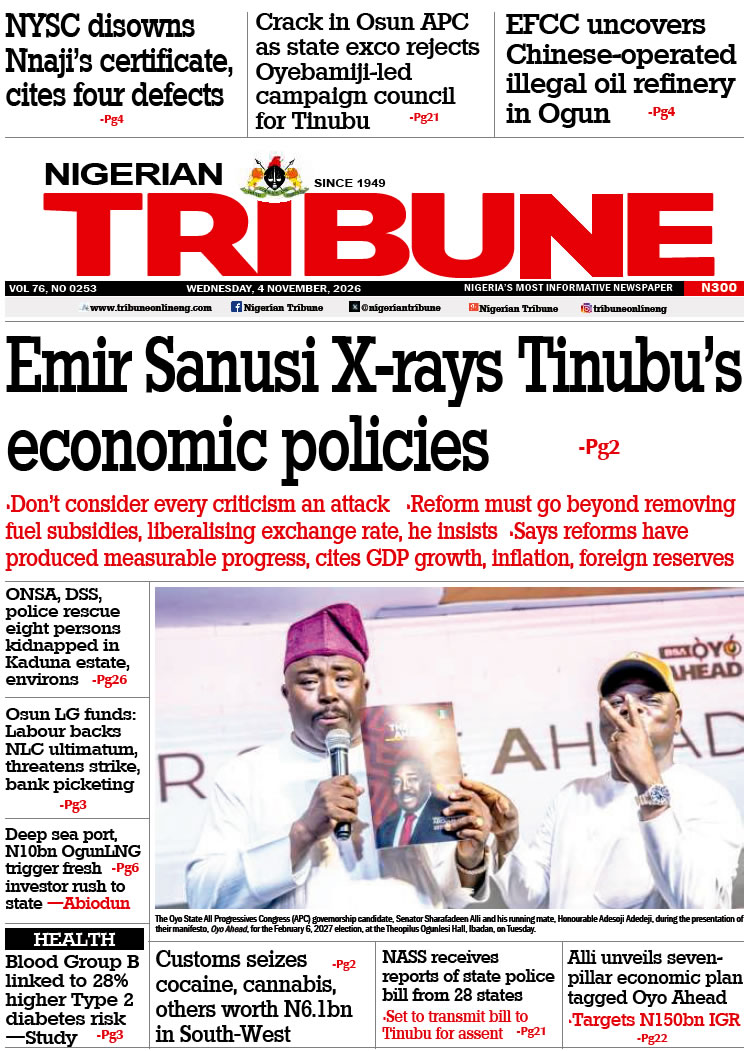
  • Emir Sanusi X-rays Tinubu’s govt
    Emir Sanusi X-rays Tinubu’s govt

Frontpage Today

Subscribe to e-Paper

E-Vending, e paper, pdf, e-paper, Tribune
QUICK LINKS

About Us
Advertise with Us
Contact Us
Privacy Policy
Disclaimer
Editorial Policy
Corrections Policy
Terms & Conditions
COLUMNS

Aplomb
Ask The Doctor
Autoclinic With The Mechanic
Awo's Thought
Empowered For Life
Festus Adebayo's Flickers
Gibbers
Intimacy
Language & Style
Leadership & Management
Lynx Eye
Monday Lines
Mum & Child
Natural Health
Notes from Atlanta with Farooq Kperogi
On The Lord's Day
Your Life Counts

ENTERTAINMENT

Entertainment

RELIGION

Tribune Church
Church News
Muslim Sermon
Eye of Islam
Islamic News

EDITORIAL

Editorial
Opinion
Letters
News Extra

BUSINESS

Capital Market
Money Market

REGIONS

Niger Delta
Arewa
MORE

Sexuality & Health
Special Report
Sports
Tourism
Travelpulse & MICE
Weekend Lagos
Book Review
Education
Event Digest
Crime & Court
Ecoscope
Energy
Maritime
Aviation
Brands & Marketing
Agriculture
Info Tech
Labour
Leadership & Management
Arts & Culture
Arts & Reviews
Politics
Health News
© 2026 African Newspapers of Nigeria Plc. All Rights Reserved. | Disclaimer | Privacy Policy | Editorial Policy | Corrections Policy | Terms & Conditions

Add Tribune Online to your Homescreen!

Add
Welcome Back!

Sign in to your account

Username or Email Address
Password

Lost your password?