
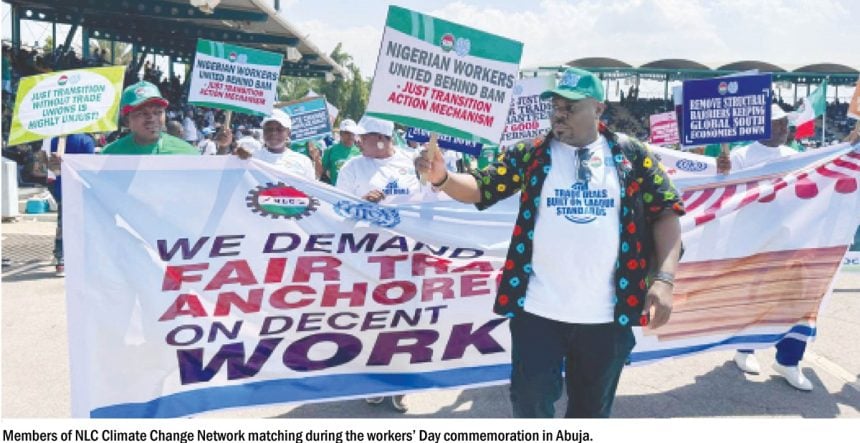
The Nigeria Labour Congress (NLC) and the International Labour Organisation (ILO) have called for enhanced participation of workers in climate governance. They warn that the global transition to a green economy may exacerbate inequality and jeopardise livelihoods unless workers are actively involved in the development of climate policies and decisions.
This call was made during the Post-COP30 and Pre-SB64 Tripartite Review Meeting held in Keffi, Nasarawa State, where labour leaders, government representatives, employers, and development partners convened to assess the outcomes of the 2025 United Nations Climate Change Conference (COP30) in Belém, Brazil, and to prepare Nigeria’s position for the upcoming Subsidiary Bodies (SB64) negotiations.
Inviolata Chinyangarara, Senior Specialist for Workers’ Activities at the ILO Abuja office, stated that climate change has transitioned from a mere environmental issue to a pressing labour market concern that directly impacts workers and their communities. “Climate change is no longer a distant environmental concern; it is a labour market reality,” she remarked.
Chinyangarara noted that workers in Nigeria and other developing countries are already experiencing the effects of climate change, including extreme weather events, loss of livelihoods, rising stress, and disruptions in essential sectors such as agriculture, transportation, construction, and energy.
She emphasised that climate policies must be grounded in decent work principles and supported by strong social dialogue to ensure the protection of workers during the transition to a low-carbon economy.
Chinyangarara urged Nigeria to align its climate strategies with employment creation and social protection policies, ensuring that workers’ interests are adequately represented in the country’s Nationally Determined Contributions (NDCs) and broader climate agenda.
She highlighted that a successful just transition should provide decent jobs, opportunities for skills development and reskilling, social protection, and respect for fundamental rights at work. “The transition to a sustainable economy must be based on decent work principles, ensuring that no worker is left behind,” she asserted.
The ILO official reaffirmed the organisation’s commitment to supporting Nigeria through technical assistance, capacity building, and policy guidance to help integrate labour concerns into climate action.
However, organised labour emphasised that workers should not just be consulted but should have a formal role in decision-making processes that affect their future.
In his opening remarks, delivered by Comrade Eche Asuzu, National Coordinator on Climate Change and Just Transition for the NLC, on behalf of the union General Secretary Comrade Emmanuel Ugboaja, the Congress acknowledged several gains from COP30 but insisted that further efforts are needed to ensure climate justice for workers.
Ugboaja described the adoption of the Belém Action Mechanism (BAM), now institutionalised under the United Nations Framework Convention on Climate Change (UNFCCC) as the Just Transition Mechanism (JTM), as a significant victory for trade unions worldwide.
He noted the development reflects years of advocacy by labour movements aiming to centre workers in climate action.
READ ALSO: Tourism: ICRC okays $21m development of Jabi Lake in Abuja
“Unlike previous COPs, trade unions are pleased that our core demands at COP30 were realised, particularly with the institutionalisation of the BAM as the Just Transition Mechanism,” he stated.
Despite this progress, the NLC argued that the mechanism will only achieve its goals if workers are granted formal decision-making powers within its governance structure. “We demand that trade unions assume an active stakeholder role in the Just Transition Mechanism, particularly through holding formal decision-making power,” Ugboaja declared.
The labour centre also called for dedicated financing to support workplace climate adaptation measures, including skills development, upskilling and reskilling programs, occupational safety and health initiatives, social protection systems, and compensation for workers adversely affected by climate change.
Ugboaja further raised concerns regarding the increasing global demand for critical minerals required for renewable energy technologies.
He warned that Africa risks remaining trapped in an extractive economic model that exports raw materials while local communities bear the environmental and social costs.
He argued that the continent’s mineral wealth should contribute to industrialisation, decent job creation, and economic transformation, rather than perpetuating poverty, pollution, and inequality.
The NLC also urged the Federal Government to formally ratify and implement Nigeria’s Just Transition Guideline and Action Plan (JT-GAP), which has already been validated by stakeholders, and to ensure the effective implementation of the country’s updated Nationally Determined Contribution (NDC 3.0).
Congress has called for reforms to the global climate finance architecture, emphasising that climate funding for developing countries should primarily be provided through grants rather than loans. Labour leaders argue that African nations need sufficient financial support to pursue green industrialisation, expand energy access, and create decent jobs while fulfilling global climate obligations.
As preparations for the SB64 negotiations intensify, participants stressed the importance of discussions surrounding climate finance, adaptation, loss and damage, trade measures, and the operationalisation of the Just Transition Mechanism. These discussions are crucial for ensuring that climate commitments translate into tangible benefits for workers and communities.
Despite the challenges, both the International Labour Organisation (ILO) and the Nigeria Labour Congress (NLC) expressed optimism that climate action could serve as a catalyst for economic diversification, youth employment, social inclusion, and sustainable development, provided that workers are prioritised in the process. “The green future must be a workers’ future if it is to succeed,” stated Ugboaja.
Supporting this viewpoint, Chinyangarara emphasized that a just transition cannot happen by chance; it must be intentionally negotiated and implemented through effective social dialogue among governments, employers, and workers.
The two-day meeting was organised by the Nigeria Labour Congress in collaboration with the International Labour Organisation and other social and development partners as part of the preparations for the forthcoming SB64 climate negotiations and future global climate engagements.
WATCH TOP VIDEOS FROM NIGERIAN TRIBUNE TV
- Relationship Hangout: Public vs Private Proposals – Which Truly Wins in Love?
- “No” Is a Complete Sentence: Why You Should Stop Feeling Guilty
- Relationship Hangout: Friendship Talk 2025 – How to Be a Good Friend & Big Questions on Friendship
- Police Overpower Armed Robbers in Ibadan After Fierce Struggle


