By: Patrick. A. Ebojele
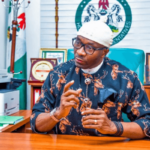
EDO State governor, Senator Monday Okpebholo, is a very confident man. He speaks about the future of Edo State with a level of confidence that confounds his critics. It is not the confidence built around political theatre. Rather, it comes from visible projects and active construction sites he has activated; and the belief that Edo State is entering a new phase of development under his leadership driven largely by infrastructure renewal. And it dates back to November 12, 2024, when he took office; he has repeatedly promised that Edo would rise again.
During his inauguration, Governor Okpebholo assured residents that his administration would focus on rebuilding roads, improving infrastructure, strengthening security, upgrading healthcare, supporting agriculture, and restoring confidence in governance. Nearly two years later, many of those promises are now becoming visible realities across different parts of the state.
Infrastructure is the centrepiece of the administration’s development agenda. Across Benin City and other communities, ongoing projects now dominate public discussion. Roads that were previously abandoned are under reconstruction, drainage systems are being expanded, erosion sites are receiving intervention, and major traffic corridors are undergoing transformation.
Governor Okpebholo believes infrastructure is the foundation upon which every other aspect of development depends. Roads connect communities to schools, hospitals, farms, and markets. Drainage systems reduce flooding and protect lives and property. Bridges and flyovers improve movement and support economic activity. For Governor Okpebholo, rebuilding Edo begins with rebuilding its physical structure.
That vision has become increasingly visible during the governor’s recent inspection tours across the state. Governor Okpebholo has consistently chosen to personally inspect projects rather than supervise from a distance. In recent days, he has visited several ongoing projects in Edo State, including the Adesuwa Flyover on Sapele Road, the Ikpoba Hill Flyover and erosion control project, the Ekiuwa-University of Benin Road, Oba Erediauwa Road off Upper Mission Road, Temboga Road, Uteh Palace Road, Ramat Park.
He had earlier inspected the extensive stormwater drainage project stretching into the Ikpoba River, the Agbonze and Iyore Street corridor at Ohoghobi, Camplink Road along Obagie Ihriri, the Evbhukhu-Amagba Road, and the increasingly significant Okpagha-Amufi Road and flood control project.
Standing at the Adesuwa Flyover where sections of the road had already been asphalted, the governor expressed satisfaction with the pace of work and pointed to the project as evidence of the administration’s commitment to modernising Edo.
“As you can see, we are making progress. A lot has been done in Edo State,” he said while addressing journalists during the inspection. He added that more visible progress would emerge within weeks as construction continued.
The governor then made a statement that has since shaped public conversation around the administration’s development agenda: “We have achieved so much and I believe that by the grace of God, if we continue like this, Edo will become a modern city before the end of our first four years.”
For supporters of the administration, the statement reflected growing confidence rooted in visible infrastructure renewal rather than mere political optimism.
Among the many projects, the Okpagha-Amufi Road and surrounding erosion and flood control works have become particularly symbolic of the administration’s governing philosophy. For decades, residents of Amufi, Okpagha, Iyanomo, and Egiekpe communities battled severe flooding, erosion, and deteriorating road conditions with little government intervention.
During heavy rains, movement became difficult, homes were threatened, and residents repeatedly complained about neglect. According to many members of the affected communities, previous administrations focused attention on more politically visible areas while communities like theirs continued to suffer environmental and infrastructural decay.
During his inspection of the Okpagha-Amufi Road and adjoining water retention and drainage infrastructure, Governor Okpebholo openly acknowledged the neglect experienced by residents.
“The people that live on this road are voiceless,” he said, describing communities that had gone years without meaningful government attention. The statement resonated strongly because it reflected a rare public admission that some parts of the state had been overlooked for far too long.
The governor further explained that constructing the road and addressing the flooding challenge represented part of his responsibility to the people. “Constructing this road for them is a thing of joy. If we don’t do it, who will?” he asked while speaking at the project site.
The Okpagha-Amufi intervention extends beyond ordinary road construction. The project includes drainage expansion, water retention infrastructure, and erosion control measures designed to provide lasting environmental protection for surrounding communities.
Engineers supervising the project have explained that the broader road and erosion control network spans several kilometres and covers multiple adjoining communities.
For residents who endured repeated flooding for decades, the project represents far more than asphalt and concrete. It represents visibility, inclusion, and government presence in places that once felt forgotten.
The administration’s broader infrastructure efforts follow the same pattern across the state. In flood-prone parts of Benin City, drainage expansion projects are being executed to reduce the destructive effects of heavy rainfall. Areas that previously became impassable during the rainy season are gradually receiving long-overdue intervention.
The stormwater drainage project leading into the Ikpoba River remains one of the administration’s largest environmental infrastructure projects, aimed at redirecting floodwater away from densely populated communities. Across several road corridors, reconstruction work is simultaneously improving mobility and reducing years of infrastructural deterioration.
Governor Okpebholo has repeatedly acknowledged that he inherited serious infrastructural challenges upon assumption of office. According to him, bad roads, insecurity, flooding, and weak public infrastructure were among the realities confronting the administration from the beginning.
“Bad roads across Edo State are one of the things I inherited,” the governor stated during one of his project inspections.
Rather than focusing on blame, however, the administration says it has concentrated on rebuilding damaged infrastructure and restoring confidence in governance through visible projects. That approach has become central to the administration’s public messaging.
Beyond Benin City, road rehabilitation and construction efforts are also ongoing across other parts of Edo State. The administration insists infrastructure development must not be limited to urban centres alone. Rural communities require functional roads to support agriculture, trade, education, and healthcare delivery.
In many farming communities, poor road conditions have historically made it difficult for farmers to transport produce to urban markets. Government officials argue that improving rural road networks is critical to economic growth, food production, and job creation.
The governor has also linked the pace of development in Edo State to support from the Federal Government under President Bola Ahmed Tinubu’s Renewed Hope Agenda.
•Dr. Ebojele is the Chief Press Secretary to Governor Monday Okpebholo of Edo State
WATCH TOP VIDEOS FROM NIGERIAN TRIBUNE TV
- Relationship Hangout: Public vs Private Proposals – Which Truly Wins in Love?
- “No” Is a Complete Sentence: Why You Should Stop Feeling Guilty
- Relationship Hangout: Friendship Talk 2025 – How to Be a Good Friend & Big Questions on Friendship
- Police Overpower Armed Robbers in Ibadan After Fierce Struggle