
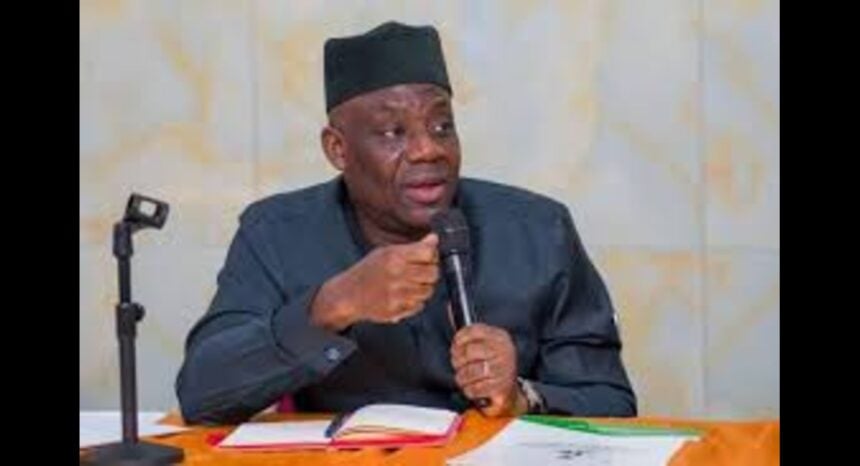
The Federal Government on Wednesday cancelled the National Language Policy, which stipulated that the language of instruction in early childhood to primary school (up to Year 6) should be the mother tongue or the language of the immediate community.
Recall that in 2022, the Federal Government of Nigeria approved a National Language Policy (NLP) providing that from Early Child Care Education to Primary 6, the language of instruction would be the mother tongue or the language of the immediate community. The policy aimed to promote indigenous languages, recognise their equal status and improve early childhood learning outcomes, while English remained the official language used in later education and formal settings.
The Minister of Education, Dr Olatunji Alausa, however announced the abolition of the policy at the opening ceremony of the Language in Education International Conference 2025, organised by the British Council in Abuja. He affirmed that English is now the language of instruction in Nigerian schools — from primary to tertiary levels — as the cancellation has voided the use of the native language of the immediate community as the language of instruction in primary schools across the country.
Alausa said Nigerian children have been performing abysmally in public examinations as a result of being taught in the mother tongue, adding that evidence-based, data-driven research by the ministry has shown damage to the education system because pupils proceed to higher classes without learning sufficiently. He reassured Nigerians of the commitment of the current administration to fix the rot and decadence in education in line with the express directive of President Bola Ahmed Tinubu to address problems in the sector and put it on the path to sustainable development.
He maintained that he had the President’s mandate to fix Nigeria’s education system and put it on a sustainable path, “this includes making unpopular and difficult decisions”. “We will take those decisions a thousand times, so that every single Nigerian child will get the highest quality of education,” Alausa said.
He said: “The National Policy on Language has been cancelled. English is now the language of instruction in our schools, from primary to tertiary levels. As you know, one of the most important and powerful things in education is language. That’s how the role of language instruction is going to be developed in all subjects. That achievement starts from the foundational stage of education: primary, junior secondary schools, and two other levels of education, senior secondary school and tertiary education.
“The language policy in Nigeria states that mother-tongue language will be used in the early stage of primary school, Primary One. So we reviewed the data available to us: is it really working for us, teaching in the mother tongue? The unanimous outcome of our review, which is evidence-based and data-driven, compared and now combined with real-life situations across the geopolitical zones, shows that over-use of mother-tongue instruction — from Primary One to Primary Six and from JSS One to JSS Three — has led some to advocate that mother-tongue language be used in secondary school. We have seen total damage to Nigeria’s system, and I use that word carefully, where children graduating from school, finishing up to JSS3 and even SS3, have not learned anything. They sit national exams — WAEC, JAMB, NECO — and are failing.
“Exams are conducted in English, but we teach these kids through their education in the mother tongue. Also, we have a lot of peculiar situations in some parts. You go to Borno State, for example, where the assumed mother tongue is Hausa; a large part of the people in Borno do not speak Hausa, they speak Kanuri. You come to Lagos, my home state, and go to areas like Ajegunle, where there are predominantly people from the south-eastern part of the country, but 90 per cent of our teachers are from the south-western part of the country. So we have a unique, God-given diversity. We love the challenge of ethnic and language diversity, but the mother tongue as a language of instruction in foundational school — we tested it for 15 years, and it is not working; that is why we have made the strong decision to do away with it and revert to what we were doing 15 years ago, with English as the medium of instruction.”
He commended the British Council for convening the important dialogue and for sustaining its partnership with Nigeria in advancing education reform and language development.
Also speaking, the Minister of State for Education, Prof Suwaiba Ahmad, reaffirmed Nigeria’s commitment to implementing inclusive language-in-education policies that promote equal learning opportunities for all children, regardless of linguistic background. She noted that language remains a vital tool for educational equity, cultural preservation and sustainable development. “Language is not merely a medium of instruction but a powerful agent for educational equity and national development,” the minister stated. “Our language policy is both a pedagogical instrument and a socio-political mandate.”
The conference, held from 12–13 November 2025, had the theme “Inclusive Language-in-Education Policy and Practice — Empowering Every Learner in Sub-Saharan Africa.” The minister observed that Nigeria’s language policy, as outlined in the National Policy on Education, supports the use of the mother tongue in early learning, but admitted that implementation has faced challenges due to linguistic diversity, teacher-deployment issues and inadequate instructional materials. He also identified a “digital divide” that limits access to learning materials in local languages, adding that most online content remains in English.
Outlining the government’s strategy for improvement, the minister called for renewed policy harmonisation, enhanced teacher training, curriculum reform and the adoption of technology to promote language inclusion. “Inclusion begins with language that brings everyone together,” he said. “When learners are taught in English, they gain confidence in national examinations and develop courage, dignity and agency.”
The minister reaffirmed that under President Tinubu’s Renewed Hope Agenda, Nigeria remains committed to achieving SDG 4 and the Continental Education Strategy for Africa (CESA 16–25) through equitable language-in-education policies. “Nigeria is committed to building an education system where no child is disadvantaged by the language of instruction,” he added. “This will require political will, academic partnerships and regional cooperation.”
Julian Parry, Director of English Programmes for Sub-Saharan Africa, said the conference aimed to ensure every learner, regardless of language background, can access education. Donna McGowan, Country Director of the British Council in Nigeria, said the event would give stakeholders the opportunity to improve English-language proficiency and explore testing solutions, bringing together policymakers, educators, researchers and partners from across Africa, South Asia and the UK to examine how language can support inclusion and improve learning outcomes across education systems.
ALSO READ TOP STORIES FROM NIGERIAN TRIBUNE
WATCH TOP VIDEOS FROM NIGERIAN TRIBUNE TV
- Relationship Hangout: Public vs Private Proposals – Which Truly Wins in Love?
- “No” Is a Complete Sentence: Why You Should Stop Feeling Guilty
- Relationship Hangout: Friendship Talk 2025 – How to Be a Good Friend & Big Questions on Friendship
- Police Overpower Armed Robbers in Ibadan After Fierce Struggle


