Many Africans have shown pioneering integrity in enhancing the formidable intellectual image that has come to be associated with the Black race. Specifically, Nigeria’s intellectual network has become so important to this movement that it is inescapable and impractical to dismiss the contributions of academics and thinkers from the country to human intellectual advancement when discussing knowledge production and intimation as related to Africa and the world generally.
The Nigerian intellectual mission produced outstanding historians such as Kenneth Dike, and J.F. Ade Ajayi, among others, who did exceptionally well in restoring African dignity through their expansive African history research that not only challenged the body of unsubstantiated assertions about the African past but also about its essentialism. Similar feats by many other scholars and writers such as Bolanle Awe, Adeboye Babalola, Amos Tutu, D.O. Fagunwa, Chinua Achebe, Wole Soyinka, J.P. Clark, and hundreds of others, effectively discountenanced the widely held misconception that the history of Africa was devoid of literary history or tradition through their literary knowledge and styles. J.A. Atanda, however, constitutes another significant bulk in this intellectual tradition as a member of the generation of African historians who have extensively expanded the intellectual coast of the people by expanding upon the work of his predecessors.
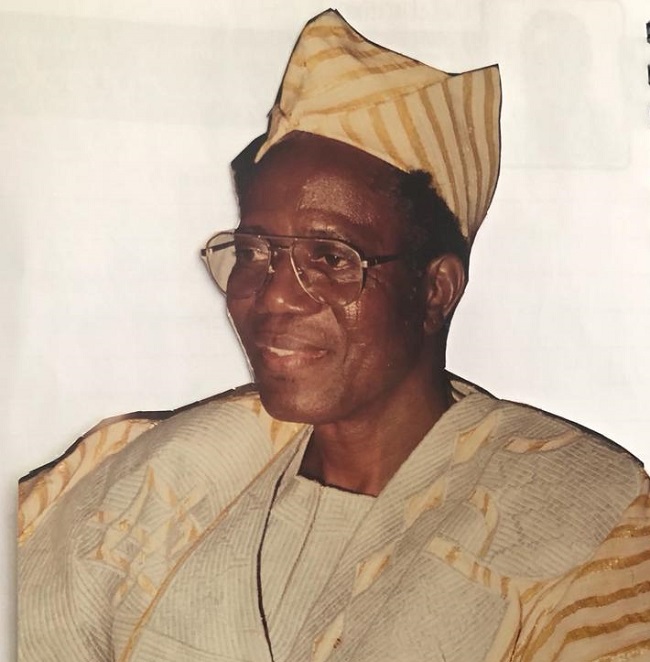
Born in 1932 to Eruwa parents, a community in the Yoruba society that falls under the current Oyo State of Nigerian, Dr. Joseph Adebowale Atanda enjoyed first-hand the cultural traditions of the Yoruba people, which exposed him to Yoruba knowledge and understanding. People who often make landmark impacts in their respective fields, such as J.A. Atanda, are habitually seen not as the product of their formative experiences but as individuals who struggle to improve themselves in the course of their journey. However, while success, brilliance, quality delivery, and impact are not impossible to court in adulthood, the general truth is that formative education and exposure usually dictate people’s eventual dispositions as adults. Following this idea, the overwhelming success of Atanda as a public figure and intellectual maestro are attributed to the experiences that shaped his knowledge as a child raised in the Yoruba society, consolidating, in effect, a common assumption that there cannot be a river without a source. For this, the source and the product have proven to be significantly symbolic; while celebrating Atanda, the Yoruba must also be granted the necessary accolades they deserve.
After obtaining his B.A. (Hons) degree in History at the University of London, 1964, he received his Ph.D. in 1967 from the University of Ibadan, Nigeria. Without a doubt, the exposure to different cultural and academic climates contributed immensely to the facilitation of his knowledge which would later be useful in driving African knowledge systems and productions to a greater height. Dr. Atanda took a keen interest in African history, believing that the degenerating and anti-intellectual generalizations of the Eurocentric knowledge episteme against the knowledge production of Africans are either motivated by a raging desire to undermine an otherwise vibrant and impressive intellectual system or to silence the body of works of prehistoric Africans. However, to accept these generalizations without making sufficient efforts at the interrogation of facts and the cross-examination of evidence is unbefitting of a reasonable scholar. This dictated the almost overzealous dedication to exploring the African past, particularly the Yoruba of the Western part of Nigeria and Buganda in the East of Africa. With great determination he pursued this agenda, resulting in his success and those of other committed individuals.
It was through the pioneering works of Atanda that we are now aware of the immeasurable achievement of the Yoruba’s past, and through his analytical ability, we have come to know how substantial growth, culturally, politically, and economically are achievable when the materials of the past are used appropriately. He joined others to open a line of intellectual discussion about the Yoruba to the extent that their prehistoric history and the histories of their exchanges with external civilizations are generally considered epochs in the evolution of the people’s cultural genealogy. Although a historian is expected to present the chronology of past events so that people understand and learn of their past and thus find a great way to their future, Dr. Atanda did more than that. Atanda, in presenting his work, remained cognizant that the projection of a people’s image, especially negatively, can affect how they react and respond to their surrounding activities and be very intrusive in the way they perceive themselves. To internalize the story that Yoruba people, for example, sold their people into slavery, engaged in paganism, and paraded outrageous customs can be devastating on the people who carry that identity around, for they would believe that their past histories are predominantly malevolent. This would potentially impact their claiming and representing of the Yoruba identity continentally and internationally.
Meanwhile, through replicable research, Atanda was able to bring to the fore the knowledge of the Yoruba people that has always been marred by the narrative of darkness. The reconstruction of Yoruba history through generally accepted methodologies substantially helped to restore people’s cultural confidence and reclaim aspects of their identity. Atanda challenged, among other things, the revisionist history that Yoruba people clung to their traditional thinking. For example, in one of his academic engagements, submits that marriage, contrary to outsiders’ views, was used to expand the socialization network of the families involved so that bonding is possible while simultaneously increasing the dependency of individuals on one another. In viewing the way that the Yoruba family is structured, controversy to this idea is somewhat difficult as many are interconnected in the society. Additionally, Atanda challenged the dismissal of the Yoruba religious systems from the misguided generalization that they are particularly primitive and uncivilized. Atanda contested that the Yoruba moral, political and cultural systems should be viewed not as separate entities. For example, the discouragement of stealing that is inherent in the invocation of the spirit is meant to prevent people from mismanaging opportunities when given. In this manner, these systems are not dispassionately disjointed but are complementary systems seeking a common purpose.
Professor Atanda remains a shining armor whose accomplishments cannot be overshadowed by mere wishful thinking in academics. He continuously demonstrated similar capacity at different leadership levels. He was a Representative of the Faculty of Arts on the Board of Studies and the Faculty Board of Education at the University of Ibadan. During his service in these highlighted capacities, he ensured that African knowledge productions should not be relegated because their social and cultural traditions are something of immeasurable importance. Besides his agitation and actualization of the native education agenda, especially in fighting for the domestication of the education system to accommodate several ideas, he also ensured that the administration of the people was discharged diligently. Professor Atanda also functioned at the school in a management capacity. He served as a Senate member and was an integral part of the Senate Committee for the Institute of African Studies, University of Ibadan, Nigeria. Throughout his time in all these capacities, the achievements he earned continue to speak for him even decades after his departure.
To have a grasp of the depth of Atanda’s contributions to knowledge production in the field, one can begin by examining his academic achievements. Apart from serving as the arrowhead for the promulgation of African knowledge epistemology, at a time that the general cultural and political traditions were circumscribed, he raised the bar for the enhancement of African knowledge essentialism. Dr. Atanda also became a compass for navigating the Yoruba and the Buganda peoples’ pasts in many respects. The majority of the knowledge ideas today associated with these groups has been cast away with mindless abandon as something not worthy of human consideration, over the assumption that it was of low-quality intellection. But because he was bold and courageous, with a special dedication to his beliefs, Professor Atanda was able to make himself the Iroko tree of Yoruba knowledge systems so that others would draw inspiration and motivations from him. It is on this basis that he remains a celebrated individual while his records speak volumes of him.
These testaments validate the assumption that the organization of conferences in his name is just a minor part of the celebration of his unusual ingenuity. While he was alive, Professor Atanda was offered several awards to recognize his invaluable contributions to humankind generally. The Rockefeller Foundation gave him a Travel Grant as visiting Lecturer at Makerere University, Kampala, Uganda, which was granted in January–August 1969. He also received the Life Honorary membership from the Frank London Brown Historical Association, Chicago, Illinois, U.S.A. These international awards are indubitable evidence that he achieved beyond the borders of his home country, Nigeria. Professor Atanda remains valuable to us all, as even the Yoruba Studies Review names its annual best paper award after him. Furthermore, a 7th lecture and conference will be held in his honor at Babcock University from June 21st to 23rd where The J. A. Atanda Distinguished Award for Yoruba Studies will be launched, to honor a scholar who is prominent in the field of Yoruba studies in Africa and the Diaspora.
Toyin Falola is a Professor of History at University of Texas at Austin
YOU SHOULD NOT MISS THESE HEADLINES FROM NIGERIAN TRIBUNE
Battle For First Bank: The Untold Story
Last week was one of twists and turns for First Bank of Nigeria Limited, the nation’s oldest banking institution. It was a week that saw the bank’s MD sacked and reinstated, as major shareholders struggled for control of the financial powerhouse. SULAIMON OLANREWAJU reports…
#EndSARS Panel: Drama As Witness Presents Video Evidence Of Slain Lekki Protesters
A witness of the Lekki tollgate shooting incident, Miss Sarah Ibrahim has presented video evidence of people injured and killed at the scene to the Lagos State Judicial Panel. Tribune Online reports that…
WATCH TOP VIDEOS FROM NIGERIAN TRIBUNE TV
- Relationship Hangout: Public vs Private Proposals – Which Truly Wins in Love?
- “No” Is a Complete Sentence: Why You Should Stop Feeling Guilty
- Relationship Hangout: Friendship Talk 2025 – How to Be a Good Friend & Big Questions on Friendship
- Police Overpower Armed Robbers in Ibadan After Fierce Struggle