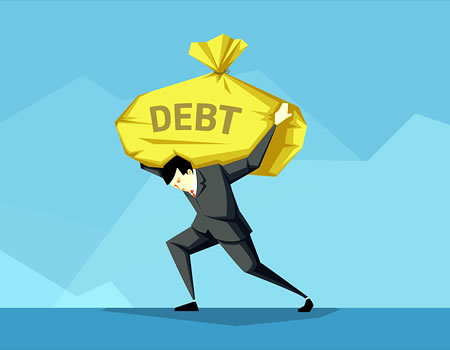
The recent warning signal raised over Nigeria’s ever escalating debt profile by the globally recognised technocrat and President of the African Development Bank (AfDB), Dr. Akinwunmi Adesina, should be food for thought for our policy makers and those who implement them. According to him, Nigeria is currently using 50 per cent of its revenue to service debts, compared to the average of 17 per cent for other African countries. This is unsustainable. But this is just part of an economic malaise that has consigned millions of Nigerians in the poverty quagmire even as a few favoured ones continue to enjoy the wealth of the nation.
Furthermore, going by the frightening figures recently made public by the Debt Management Office (DMO), the total debt stock stood at some humongous amount of N24.047 trillion as of March 31, 2019. While that of the Federal Government stood at N17,086, 204.66, states’, including the Federal Capital Territory (FCT) equaled N 7,860,875.93. Reports have it that N560 billion out of these was borrowed in only three months.
BREAKING: Ajibade Gbadegesin Ogunoye emerges new Olowo of Owo
As of September 2018, the debt stood at N22.43 trillion. But as of June 30, 2015, the country’s total debt was N12.12 trillion. That means that within the first three and a half years of the current administration, the debt rose by N10.31 trillion which is 85.06 per cent. The external debt component of both the federal and state governments, including the FCT, increased by 109.21 per cent, according to the DMO.
We surely do not need rocket science to understand that the country’s economic growth is undermined by the huge debt and other obvious factors, including sheer profligacy in running government apparatus. Crass corruption in high places and the huge pay package of political office holders, with that of our lawmakers ranking amongst the highest in the world, have contributed in making Nigeria the poverty capital of the world.
It will be recalled that back in June 2017, experts on the nation’s economy, including Professor Pat Utomi and Mr. Bismarck Rewane, had expressed similar worry over the increasing debt burden at both the state and federal levels. Indeed, I had to write an opinion essay entitled; “Who will pay these huge debts?” in July of 2017 as a follow up to the one with the title; “Nigeria’s debilitating debt profile,” published by different newspapers in January 2013. But, the situation has only worsened over the years.
For instance, as of September 30, 2012, the external debt jumped to $6.2 billion with a domestic debt profile of N6.3trillion. Yet, back then, the state governors were still asking for an additional $7 billion external loan. Fast forward to 2017; as of March that year, the nation’s total debt had risen by N7.1 trillion to a mind-boggling N19.16 trillion. And wait for this – Acting President Yemi Osinbajo had, through a letter to the National Assembly, requested that $1.94 billion loans be approved for 10 states. The explanation given was that the huge sum was meant for projects from the 2016 to 2018 External Borrowing (Rolling) Plan of the Federal Government for the concerned states.
This rather scary economic situation throws up some salient questions, all begging for answers. Have we, as a country not been making money from crude oil sales over the past few years? What about the huge revenues from other sources such as the multiple company taxes including VAT, inflow from the ports and that from the Customs Service?
Where have all these gone in the face of decrepit and dilapidated infrastructure, annual budget deficits, fragile healthcare system and a drastic dip in the standard of education across the country? With 23 out of 36 states unable to pay salaries to civil servants as and when due, in spite of the so called bailout funds, one cannot but remember the question Prof. Ayodele Awojobi (of blessed memory) asked the Alhaji Shehu Shagari-led administration that: “Where has our oil money gone?” Your guess is as good as mine.
Besides, many of the commercial banks are not lending to the real sector to boost manufacturing. Sundry consumable including textile materials and electronic equipment, especially from China and other South-East Asian countries, are either being imported daily at astonishing rates, or smugglers are having a field day. All these have no doubt led to an unprecedented unemployment level and an upsurge in the wave of crimes including armed robbery, kidnapping, banditry, arson and hideous ritual murders!
One’s current concern, however, is who will pay these huge debts? Will the burden being left by the reckless and frivolous political class not be too weighty for the lean shoulders of our jobless children? Will they not be turned to slaves and beggars in their own country by the creditor nations, just because they want to pay off the debts left by the locusts that have ravaged our common patrimony? But that is not all.
Surprisingly, as of 2013, former Minister of Finance, Dr. Ngozi Okonjo-Iweala, the very person who assisted the country out of the huge debt burden to Paris Club back in 2005, was justifying these new debts. Back then, she claimed that such loans were needed to finance infrastructural development, especially in the critical power sector. On the surface, Okonjo-Iweala’s argument then was that Nigeria’s macro-economic stability, a Sovereign Fund of $1billion placed in the international market for lending, stable economic growth of an average of 7 per cent and attraction for Foreign Direct Investment (FDI) all pointed to the best time for borrowing.
She even added that the loans have been negotiated with multilateral institutions on highly concessionary terms. She sounded convincing then. But years later, similar reasons such as the need for stable power supply and infrastructural development are being provided as the basis for new huge loans. Yet, the ordinary Nigerian cannot understand why in spite of the huge loans, monthly allocations and bailout funds not a few state governors cannot pay staff salaries as and when due. Power supply is still epileptic and infrastructure are still in utter decay.
One is surprised too about the speed with which governors who at the end of their tenure go for questionable bonds. What is the guarantee that the incoming administration and the subsequent ones would have the capacity to repay without harming the security and welfare of the citizens which is their primary purpose of being in government. The earlier we start having credible answers to these burning questions, the better for us all.
The unbundling of the electric energy generation/supply and distribution meant that government should spend less, while the partners from the private sector should inject more funds. Why should we then be bent on borrowing huge sums of money from external creditors at high interest rates at a time the naira-dollar exchange rate is astronomical? Indeed, Nigerians are hard put to support the reasons advanced by our political and economic pilots for the loans because of the grave implications for the average citizen. This is dehumanising.
Baje writes via [email protected]
WATCH TOP VIDEOS FROM NIGERIAN TRIBUNE TV
- Relationship Hangout: Public vs Private Proposals – Which Truly Wins in Love?
- “No” Is a Complete Sentence: Why You Should Stop Feeling Guilty
- Relationship Hangout: Friendship Talk 2025 – How to Be a Good Friend & Big Questions on Friendship
- Police Overpower Armed Robbers in Ibadan After Fierce Struggle