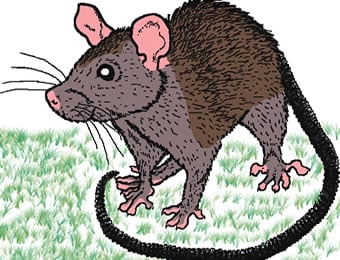
With an evidence of rat in the home, the first inclination may be to reach for the strongest rodent killer on sale. Wanting to ward them off has becomes a priority especially because worldwide, rats and mice spread over 35 diseases, including Lassa fever.
These diseases are spread to humans directly, through handling of rodents, through contact with rodent faeces, urine, or saliva, or through rodent bites. In fact, some of these diseases carried by rodents can also be spread to humans indirectly, through ticks, mites or fleas that have fed on an infected rodent.
But right choice of pesticide that is environmental friendly but also safe is always a concern because they can also be harmful to humans. Children particularly are especially susceptible to harm from pesticides, because their bodies and immune systems are still developing.
Now, researchers at the University of Ibadan have developed rodenticides from cassava waste. Bioplastics are made from the cassava waste and a toxic substance is embedded into it to make the rodent bait.
Most garri processing sites generate a lot of waste. Although some of the wastes generated are used in feeding animals, its starch residue is often thrown away. But these wastes are sources of starch that can be converted to biopolymers.
Dr Oladapo Okareh, a senior lecturer at the Department of Environmental Health Sciences, Faculty of Public Health presented the bioplastic rodent bait made from cassava waste at the Research Day 2016 of the College of Medicine, Ibadan, Ibadan.
The bioplastic rodent bait was produced using cassava waste, rodent attractant and an inorganic substance (Zinc phosphide). It differs from others in the sense that it contains poisoned bait, which is packaged into the biodegradable film made from cassava residues.
The rodent bait was tested under laboratory conditions on 27 male Wistar rats using the bait having different concentrations of the poisonous inorganic substance.
After exposing the rats to various feeds, morphological changes and time of death of the animals were also assessed, the researchers found the bait very effective.
Although the project started with looking for alternative sources of bioplastic, Dr Okareh said he decided on developing bioplastic rodent baits when the bioplastic left in his office to dry were eating up by rats.
“We came back the next day and found that rats ate everything. So I decided that if rats can eat everything, if I put a poison there, then it can also kill the rat,” he said.
Okareh added that the attractants was added to make the bait more specifically to attract rats.
“The good thing about the product is that it is a rubber material and it is safer than the common rat killers in the market. When holding it, you will not know that it is poisonous since it is a plastic material. And rats eat it since cassava is something they like as food.
“Interestingly, in the course of our study, when we kept rat feed on one side of the room and our poisoned bait on the other side, the rats refused to eat their own food but fed on the poisoned bait. And within three hours, the rats were dead.”
He said work was ongoing to find an organic substance that can be used as poison in the bait as well as how to ensure its proper packaging.
Okareh, however, said the bioplastic rodent bait can be used for rodent control in different situations, adding “if it is for Lassa fever control, I will leave it as the size of rice granules but for more ferocious animals, it can be fed as pellets or the size of sweets or biscuits.”
The health and safety expert said he intended to patent the discovery, adding that scaling up this technology will provide economic opportunities and improved environment.
The Pest Control Association of Nigeria has said that to effectively combat the scourge of Lassa fever, which is caused by a virus borne by rodents, there should be active control of rodents.
President of the association, Mr. Ayo Ogunyadeka had also warned Nigerians against procuring rodenticides, which are brazenly displayed in roadsides and shops by quacks because these are toxic materials must be used with care.
According to him, all rodenticides can be toxic when eaten, while most are also toxic when inhaled and when they come into contact with the skin.
WATCH TOP VIDEOS FROM NIGERIAN TRIBUNE TV
- Relationship Hangout: Public vs Private Proposals – Which Truly Wins in Love?
- “No” Is a Complete Sentence: Why You Should Stop Feeling Guilty
- Relationship Hangout: Friendship Talk 2025 – How to Be a Good Friend & Big Questions on Friendship
- Police Overpower Armed Robbers in Ibadan After Fierce Struggle