
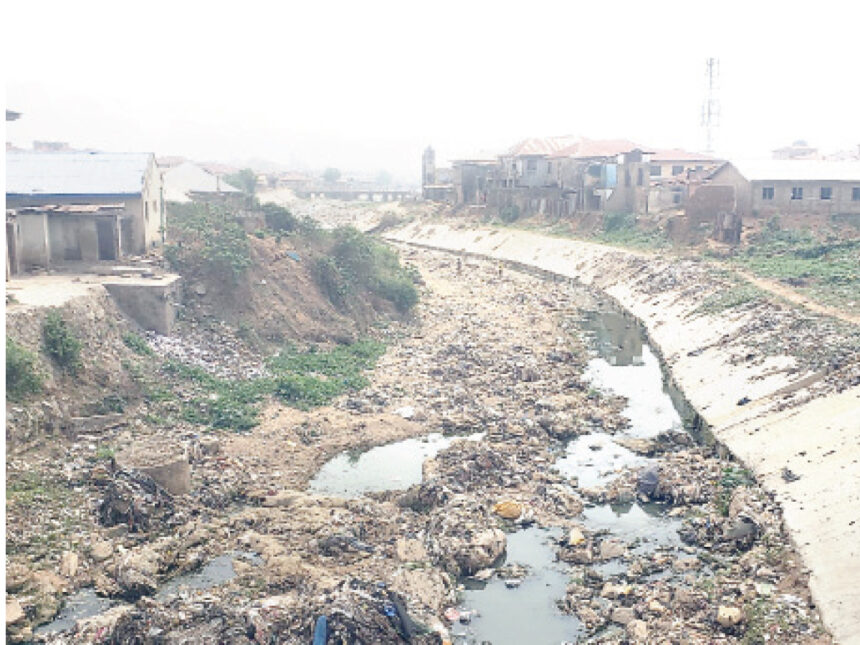
•Experts speak on how state, federal governments can end open defecation in Nigeria by 2030
Weeks after Sunday Tribune reported on the sanitation crisis in Oranyan, PHILIP IBITOYE revisited the community where many residents expressed disappointment over the lack of change. He also spoke with experts on how the country can end open defecation in rural communities where the practice is widespread.
NEARLY three months after Sunday Tribune exposed the decades-long sanitation crisis in the Oranyan area of Ibadan, Oyo State, not much has changed. The stench still rises from the Kudeti River, which continues to double as a waste dump and open defecation site for many of residents. The cries of the people remain muffled under the weight of government neglect. And the community’s fragile hope for intervention is fast fading.
“I don’t think anything will change,” a resident, who craved anonymity, said during Sunday Tribune’s return visit. “Nobody has come here to ask us anything since your last visit. We’re on our own.”
As the resident posited, the people in the community are on their own, unless something drastically shifts. Oranyan is not alone in the struggle; it is a microcosm of what thousands of communities across Nigeria have faced for decades.
According to findings from the latest Water Sanitation and Hygiene National Routine Mapping (WASHNORM) survey report, 47 million people in Nigeria still practise open defecation. In spite of former President Muhammadu Buhari’s 2019 Executive Order 009 directing the Ministry of Water Resources to take steps to end open defecation by 2025, actions and results have been scarce.

With less than seven months left until the end of 2025, communities like Oranyan show no evidence that the Buhari administration’s goal will succeed. Experts across Nigeria agree that the country’s ambition to eliminate open defecation by 2025 is collapsing under the burden of poor implementation, insufficient political commitment, underfunding, and a lack of community-driven solutions. But they also insist the situation is not hopeless—if the right steps are taken urgently.
A medical practitioner and community health proponent, Dr Adewale Obalenlege, strongly advocated for strategic public engagement as the starting point. “Sensitisation and advocacy are the driving tool in achieving an open defecation-free Nigeria,” he said in a recent interview with. For Dr Obalenlege, the solution lies in building a culture of hygiene through sustained awareness campaigns, active community involvement, and clear enforcement policies. But this advocacy must be backed by accessible sanitation infrastructure.
That infrastructure, however, remains largely absent in many Nigerian communities. In places like Oranyan, not a single public toilet exists for hundreds of residents. Households are forced to choose between using open fields and makeshift buckets. According to Olumide Idowu, an environmentalist and climate change expert, “To ensure there are improved sanitation practices among residents, we must provide basic toilet facilities.”
For him, the issue is not merely about building toilets; it is about ensuring that these facilities work, last, and are owned by the communities they serve. Without a sustainability strategy, even the well-funded interventions may eventually collapse. “We also need to look into sustainability plan to ensure that every local community has a sustainable plan and community-based structures to end open defecation,” Idowu added.
Another missing piece is political will, according to experts. For years, successive administrations at the state and federal levels have launched ambitious initiatives to end the scourge of open defecation, but they often end up being symbolic, with unmet goals. Like clockwork, in November 2024, Vice President Kashim Shettima launched the revised Clean Nigeria Campaign (CNC) Strategic Plan aimed at ending open defecation by 2030. Experts noted that whether the latest initiative succeeds will depend on the political will to turn words into action.
“We need political will to tackle open defecation. We need to make it real and make washing our hands a priority,” said UNICEF Chief of WASH, Jane Bevan. Her statement speaks to a broader frustration among WASH advocates: while Nigeria has the technical capacity and donor support to address open defecation, it lacks the consistent political leadership required to drive meaningful change.
This is particularly troubling considering Nigeria’s status as the global capital of open defecation, a title it earned in 2019 when it surpassed India—despite India having over six times Nigeria’s population. For Acting Coordinator of the Clean Nigeria Campaign, Chizoma Opara, Nigeria can still learn from India’s experience. “[The campaign] has the potential to be a ‘transformational’ social movement,” Opara said. She believes that with strategic adaptation of India’s approach—localised messaging, behaviour change campaigns, and international partnerships—Nigeria could yet turn the tide.
But none of these plans can succeed without adequate funding. According to Communications Lead at Connected Development (CODE), Kevwe Precious Oghide, the financial backbone of sanitation initiatives remains too weak and too centralised to meet the nation’s vast needs.
“To urgently tackle open defecation, relevant ministries must set up strong sanitation policies and make budget provisions that reach even the most remote grassroots areas [like Oranyan]. Nigeria needs a separate budget line for sanitation with a special allocation to end open defecation and put measures in place for accountable spending,” she said in an op-ed.
This point is reinforced by UNICEF’s Monday Johnson, who argues that the present budgeting format lumps sanitation with water and hygiene, diluting its impact. “Over the years, we have always seen that the budget for wash is usually lumped together for what has three components – water, sanitation and hygiene. Now, when you are making a budget, you are putting those three components together,” Johnson told newsmen recently. He insists that states must take the initiative to mobilise resources and set sanitation as a stand-alone priority.
In sending this message to the right authorities, Johnson was in Oyo State in March 2025 when the state government announced that it was in partnership with UNICEF and WaterAid Nigeria to review, finalise and validate the state’s WASH policy document and its implementation strategies to combat open defecation.
“This document is essential for attracting investments from both local and international development partners, as it outlines the state’s commitment to improving access to safe water, sanitation, hygiene, and achieving an open defecation-free status,” the Chairman, Oyo State Rural Water Supply and Sanitation Agency, Babalola Afobaje, disclosed at a stakeholders’ engagement in Ibadan.
The UNICEF representative stated that UNICEF would develop and document the necessary steps to advance the state’s progress in this sector. “After this, we will have a policy that is acceptable to all stakeholders, enabling us to work together to advance the sector,” Adebayo Alao, the representative of WaterAid Nigeria, added.
Yet even if all the plans, policies and budgets were to fall perfectly into place tomorrow, the scale of Nigeria’s sanitation deficit would still present a formidable challenge. A WASH specialist at UNICEF Nigeria, Bioye Ogunjobi, puts it starkly: “The current effort is like a drop in the ocean.” While only about 100,000 toilets are constructed annually, Nigeria needs to build at least 2 million toilets each year to meet the 2025 open defecation-free target. At the current pace, that goal remains a fantasy.
So what must change?
According to the experts, Nigeria needs a unified strategy built on five pillars: mass sensitisation and behaviour change, provision of basic sanitation facilities, strong political leadership, adequate and separate budget lines for sanitation, and long-term sustainability plans at the community level. None of these can work in isolation.
For communities like Oranyan, where open defecation is both a symbol and source of neglect, the residents are scared for their health and anxious for help. They say they need toilets. They say they need the federal and state leaders to finally take the issue as seriously as the public health disaster it truly is.
READ ALSO: Oyo govt inaugurates 20-man task group to end open defecation
WATCH TOP VIDEOS FROM NIGERIAN TRIBUNE TV
- Relationship Hangout: Public vs Private Proposals – Which Truly Wins in Love?
- “No” Is a Complete Sentence: Why You Should Stop Feeling Guilty
- Relationship Hangout: Friendship Talk 2025 – How to Be a Good Friend & Big Questions on Friendship
- Police Overpower Armed Robbers in Ibadan After Fierce Struggle

![South Africans and Nigerians black magic As Tinubu’s cat on Mapo Fubara and Nigeria's corruption Èmil’ókàn ] You be terrorist Ahmadu Bello Louis Edet House Oyinlola’s crocodile ADC death Tinubu’s Chicago Owo Park June 12 casualties Sanwo-Olu on Tinubu White House Oloyede’s tears, Aso Rock voodoo statistics Baba Fasoranti at 99 Tinubu’s Àjàntálá son Umo Eno Oborevwori and Okowa’s Mike Adenuga at 72 Nigeria hosts Nyerere’s one-party Nigerian leaders as CBEX Goodnight Voltaire Tell Your Papa as spirit of Rwanda’s Profiling Natasha as Segilola](https://tribuneonlineng.com/wp-content/uploads/2025/04/flickers-150x150.jpg)


