
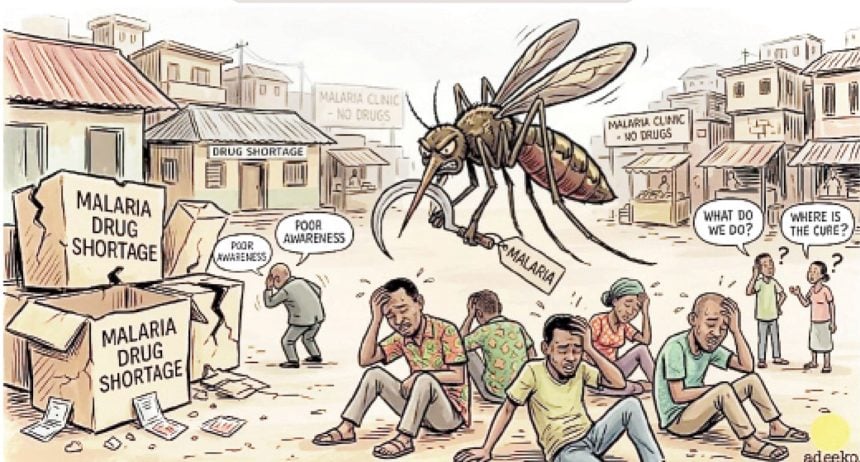
Sade Oguntola examines the rising challenges weakening the fight against malaria, showing how a once winnable battle is becoming increasingly difficult to overcome.
Malaria is a disease many Nigerians have grown up hearing about, experiencing, and, at times, underestimating. For decades, it has remained one of the most common illnesses affecting families, particularly in rural and low-income communities.
While the country has made meaningful progress in reducing cases and deaths, the fight against malaria is far from over. Across communities in Oyo State and other parts of Nigeria, people continue to face serious challenges, ranging from limited access to essential drugs and inadequate information to misuse of preventive tools and persistent funding gaps.
Health experts, community leaders, and programme managers agree on one central point: malaria can be controlled, and even eliminated, but only if both the health system and the public work together.
For many, malaria feels like a normal part of life. This long familiarity has created awareness, but not necessarily effective control. People may recognise the symptoms, yet that does not always translate into proper management or treatment of the disease.
Alhaji AbdulFatai Oloyede, the Oyo State Chairman of the Ward Development Committee (WDC), noted that malaria has existed for so long that it is deeply embedded in how people understand illness.
“Malaria is not new to us. Even in the time of our forefathers, almost every sickness was called malaria,” he said.
According to Oloyede, one of the biggest challenges communities face today is not ignorance, but access, especially access to the right drugs at the right time. In many primary healthcare centres, malaria medications are not consistently available.
He described the situation as both frustrating and worrying, explaining that in some cases, drugs are only available for about one week each month.
“The drugs are not completely absent, but they are not there all the time. Sometimes you go to the health centre and there is nothing,” he said.
For families dealing with malaria, this inconsistency can be dangerous. When medications are unavailable at public health facilities, people are forced to turn to private pharmacies. For many low-income households, this is a significant burden.
“People end up spending more money, and some may even delay treatment because they cannot afford it,” he added.
There has also been a shift in how malaria treatment is accessed. In the past, many medications were provided free under government programmes. Now, in some areas, patients are required to pay a small fee.
“Before, it was free. Now we contribute a little. We understand that the government cannot do everything, but at least the drugs should be available,” Oloyede said.
Despite these challenges, he emphasised that communities are willing to support the system, as long as it functions effectively.
“We are ready to cooperate, but people should not go to the hospital and come back without drugs,” he added.
Even when preventive tools are provided, they are not always used correctly.
Mrs. Titilade Ogunkunle, a Project Coordinator with the Family Counselling Centre in Oyo State, has observed this issue firsthand. Her organisation works closely with communities to monitor healthcare services and improve awareness.
According to her, one of the key challenges lies in how information is communicated and sometimes misunderstood.
“The problem is not just about giving people mosquito nets. It is about helping them understand why and how to use them,” she said.

Insecticide-treated nets (ITNs) remain one of the most effective ways to prevent malaria. Yet, many people do not sleep under them.
Ogunkunle expressed concern that some individuals do not use the nets at all. “Some even sell them,” she said.
Such behaviour undermines the impact of government and donor efforts. Nets may be widely distributed, but if they are not used, malaria transmission continues.
She also highlighted the role of environmental factors. “If your surroundings are bushy, if there is stagnant water, and you are not protecting yourself, mosquitoes will continue to breed,” she explained.
Despite these challenges, Ogunkunle pointed to encouraging progress: malaria cases in Oyo State and other parts of Nigeria have declined over time.
READ ALSO: Nigeria targets 50% reduction in malaria burden by 2030 – FG
According to her, malaria prevalence in Oyo State has dropped from about 22 percent to 12.2 percent.
“This shows that what we are doing is working. But we cannot relax,” she said.
She also commended the government for providing free malaria testing and treatment in many public health facilities.
“When people come in with fever, they are tested using rapid diagnostic kits. If the result is positive, they are treated free of charge. This is an important step, especially in reducing incorrect treatment,” she explained.
However, progress does not eliminate risk, especially for vulnerable groups. Malaria does not affect everyone equally. Children and pregnant women face significantly higher risks.
Children under five years old are among the most vulnerable, as their immune systems are still developing and less able to fight infection.
“Children suffer the most. If they are not treated quickly, it can become very serious,” Ogunkunle said.
Pregnant women are also at high risk. Malaria during pregnancy can lead to severe complications, including miscarriage. When a pregnant woman contracts malaria, both the mother and the unborn child are affected. These risks make early care and adherence to medical advice critically important.
Beyond community-level challenges, broader systemic issues also persist.
Dr. Taiwo Olarinde of the Malaria Consortium in Oyo State identified funding as one of the biggest threats to malaria control efforts.
Programmes such as Seasonal Malaria Chemoprevention (SMC) have significantly reduced infections, particularly among children.
“We have seen a big drop. From very high infection rates, we are now seeing much lower numbers in some areas. But maintaining these gains requires funding, and not enough is available. We currently have only about half of what we need. That is a serious problem,” Olarinde said.
She also warned that heavy reliance on international funding is unsustainable.
“We need to start looking inward. We need to invest more as a country,” she added.
There is a common concern that malaria drugs may lose effectiveness over time. However, experts say this is not currently the main issue in Nigeria.
Prof. Fatai Fehintola, a physician-pharmacologist at the University College Hospital, Ibadan, stated that recommended treatments, particularly artemisinin-based therapies, remain effective.
“The drugs are doing their job. The problem is how they are used,” he said.
Many patients fail to complete their prescribed dosage once they begin to feel better, while others self-medicate without proper diagnosis.
“Some people take drugs for one or two days and stop. That is dangerous,” he explained.
Fehintola also highlighted the issue of misdiagnosis, noting that many people assume all fevers are caused by malaria and begin treatment without testing.
“This can lead to malaria not being properly treated or other serious illnesses being ignored. That is why testing is strongly encouraged before treatment,” he said.
Even with significant progress, experts stress that Nigeria is still far from eliminating malaria completely.
Prof. Olugbenga Mokuolu, Strategic Adviser to the Honourable Ministers of Health on Malaria Elimination, described the journey as long and gradual.
“This is not something that will happen overnight. It is a marathon, not a sprint,” he said.
He explained that eradication refers to completely eliminating malaria worldwide, while elimination means reducing it to zero within a specific area.
This goal underpins the National Malaria Elimination Programme, which coordinates interventions nationwide.
Mokuolu, a professor of paediatrics at the University of Ilorin Teaching Hospital, noted that malaria is more complex than many diseases because it involves both humans and mosquitoes.
“You can treat people. Even if treatment is effective, the disease will continue if the environment supports mosquito breeding,” he said.
He emphasised that malaria control extends beyond healthcare, encompassing environmental management, infrastructure, and community behaviour.
Recent data reflects continued improvement. According to the 2025 Malaria Indicator Survey, malaria prevalence dropped to 15.2 percent, down from 22 percent in 2021—a 30 percent reduction.
Mokuolu highlighted government and partner-supported programmes that provide millions of diagnostic kits, medications, and preventive tools across the country.
“Preventive tools like mosquito nets are distributed free of charge. Testing is often free, and anti-malarial drugs are also provided at no cost in many cases,” he said.
In some states, vaccine rollout has shown promising results.
The rollout began in late 2024 in Kebbi and Bayelsa states and has since expanded to Bauchi and Ondo states. In Kebbi State, malaria prevalence dropped from 49 percent in 2021 to 18.12 percent in 2025, a 62 percent reduction.
“The standout difference in Kebbi is the addition of vaccination alongside other interventions. This demonstrates the added value of vaccines as a complementary tool,” he said.
Mokuolu added that no state in Nigeria is currently classified as having “high” malaria prevalence, with most now falling into moderate or low categories.
Meanwhile, Lagos State is approaching very low prevalence levels, with rates between 2.6 and 2.8 percent.
While progress is evident, he stressed that sustaining these gains will require continued investment, innovation, and public cooperation.
“We are moving in the right direction. But malaria elimination requires persistence across healthcare, environmental management, and community engagement,” Mokuolu said.
At the community level, there are also signs of improvement.
Dr. Aderonke Alabi, a Medical Officer of Health in Lagelu Local Government Health Authority, said partnerships have helped strengthen healthcare services.
Patients are now tested before treatment, reducing errors. Preventive tools such as mosquito nets are distributed, and pregnant women receive subsidised care.
“We now have better tools and support in many of our facilities,” Alabi said.
However, challenges remain. “There are still gaps. Not all facilities have the same level of support,” she added.
Alabi also noted that some individuals still rely on traditional remedies instead of seeking medical care, which delays proper treatment.
At the heart of the malaria fight lies a simple truth: no single group can solve the problem alone. Government must ensure that drugs and resources are consistently available. Health workers must provide accurate diagnosis and proper care. Communities must take responsibility for prevention and treatment.
Sleeping under mosquito nets, maintaining clean surroundings, seeking testing when fever occurs, and completing prescribed medication are simple actions that can make a significant difference.
Malaria is preventable and treatable, but it must be taken seriously.
Nigeria has made substantial progress in its fight against malaria. Fewer people are falling ill, and fewer lives are being lost. Yet the journey is not over.
Drug shortages, poor practices, funding gaps, and misinformation continue to hinder progress. Addressing these challenges will require sustained commitment, cooperation, and consistency. Malaria can be defeated, but only if everyone acts now and plays their part.
WATCH TOP VIDEOS FROM NIGERIAN TRIBUNE TV
- Relationship Hangout: Public vs Private Proposals – Which Truly Wins in Love?
- “No” Is a Complete Sentence: Why You Should Stop Feeling Guilty
- Relationship Hangout: Friendship Talk 2025 – How to Be a Good Friend & Big Questions on Friendship
- Police Overpower Armed Robbers in Ibadan After Fierce Struggle


