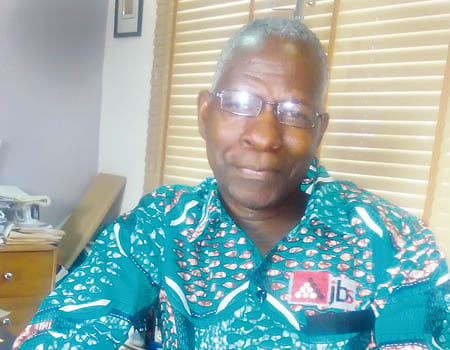
 Nde Ezekiel Gomos is a seasoned administrator, a retired Deputy General Manager of New Nigeria Development Company (NNDC), former Managing Director of Plateau Investment and Property Company and also former Secretary to the Plateau State Government. At present, he is the Director, Jos Business School and Chairman, Plateau State Economic Team. In this interview with ISAAC SHOBAYO, Gomos speaks on the state of the economy in the North, insecurity, the way out, among others. Excerpt:
With your background in both public and private sectors, especially at the NNDC, similar to the likes of Odua Investment Company, what are the causes of economic backwardness in the North, compared to the southern part of the country?
Challenges facing the North are huge. The North predominantly was commodity-driven, apart from Kano, which engaged in merchant trading. Most parts of the North engaged in agriculture commodities, except Plateau which thrived on the tin. When agriculture was jettisoned for petroleum and commodities prices began to crash worldwide, the economy of the North suffered its first challenge. And the fact that the North lags behind other parts of the country in education means that it has continued to lack manpower, especially skilled manpower to drive some of its economic institutions. North has not been sufficiently endowed in term of skilled manpower. So, lack of sufficient manpower also affects the economy of the region.
There is also the issue of attitude. The significant number of people in the North found themselves in the public service and only a few of them went into the private sector, that also affects the economy of the North. Most of the educated people are in the public sector. Also, the culture of risk taking is low in the North, except for places like Kano. In most part of the North, particularly in the Middle Belt, the culture of risk-taking is very low. The economy is based on contentment, as long as they are satisfied with what they are doing, they are OK. No drive for surplus. This also affected the economy of the North in the early days. Many don’t have an entrepreneurial spirit like a typical Igbo person.
Another thing is that as soon as the civil war was over, a lot of northerners moved into the public service. Those in the private sector began to move into the public service because there were so many vacancies for the North in the public service and this left the private sector virtually unmanned. A lot of the bright brains moved into the public sector, so the bright minds were always offered jobs in the public sector. It was later, with the expansion of the banking sector, that the North began to go into the private sector. Also, the discovery of oil made the activities of the country to gravitate towards the oil sector. A lot of people began to move to the South, especially Lagos and Port Harcourt and, as a result of this, most states and cities that were not producing became consumers without any contribution. Since then, the economy of the North has been slow.
But the NNDC was established to galvanise the economy of the North, what has it done since inception to arrest the slide?
NNDC, in its early days, did a lot to galvanise the economy of the North, don’t forget that it started as a Northern Regional Development Company, it wasn’t a profit-making organisation in the beginning, it was like a development agency that was supposed to harness resources of the North like cotton and groundnut into industries, which it did significantly. Almost all the textile industries in the North were pioneered by the NNDC, it was into so many industries in the North, be it a hotel, textile industry, cement, and so on. But NNDC began to lose track especially with the Structural Adjustment Programme (SAP) and the collapse of the textile industry which could not compete with Chinese textiles and also because cotton became expensive for the local textile industries and they began to use synthetic materials and these industries were not designed for such materials.
Many died because they could not reinvent themselves to dovetail into the modern trend, but initially, NNDC did a lot of tremendous good work for the North, the first Merchant Bank, Stock Exchange was established by the NNDC but it caught up with the wild wind and, therefore, could not continue again.
In spite of the intervention of some of the state governments in the North, coupled with Federal Government’s efforts, the economy of the North is still at a low ebb, what is the way out of this?
I think the North should focus on its areas of comparative advantage. The North is endowed in agriculture but I see them dabbling in areas they cannot control and have no comparative advantage. I think that is a waste of efforts. There is hardly any state in the North that is not a food basket, if the North could focus on agribusiness, it can export any food for dollars. Take for example Plateau State, there is no state in the federation that has a comparative advantage over Plateau on two commodities, which are Irish potatoes and vegetable and for Benue, no state has a comparative advantage in growing yam than the state. Taraba has tea and coffee. So each state can competitively drive its own advantage. They should also realise that infrastructure is also important to the economy. A lot of states in the North have not paid attention to rural infrastructure and this is very critical to agriculture.
Another thing is knowledge, a significant change can be driven by the knowledge that is education, skills. Education in this part of the country is not centred on skills, and we still import a lot of skills from the southern part of the country. For example, if you are looking for painters and other artisans, the majority of them are from the southern part of the country. Though some states are making efforts with the help of the Industrial Training Fund (ITF), but technical and artisanal skills are very important, the government needs to pay attention to this. There are a lot of youths roaming the streets without any job to do, get them out off the streets and train them. Others can take a cue from the Kano State government; the government is partnering with Peugeot Automobile to train people on how to repair cars. If you go to most of the mechanics’ workshops in the North, the names you will hear are not from northern Nigeria. We need this manpower and it could also be a solution to the problem of insecurity in the North.
You were Secretary to the Government of Plateau State for close to five years, especially at the peak of Jos crisis in 2001 to 2004, what were the challenges you faced then and how did you summon them as an administrator?
What I discovered then was that a lot of people took a side during the crisis; they took a side based on sentiments and ethnicity, but the problem might not be religious or ethnic, it could be a misunderstanding between A and B over a plot of land. If you are Mohammed and the other man is John, those sympathisers would go along religion line, forgetting that the problem between the two was a land issue. The religious issue is always volatile, it could tear the society apart, Based on our attachment to religion, there is no emotional connection to religion and ethnicity in Nigeria. The people of Plateau then often viewed issues from these two angles and thereby worsening the crisis, but thank God, people are beginning to get educated. I spent 20 years in Kaduna, outside my state of origin and because of that, I understand people more. If I am arguing with a Hausa man, I know his perspective and where he is coming from more than the people who have not lived in the North before. So, education and exposure are very important, they give you a better understanding of people and how to relate to them.
Secondly, one of the biggest ways people get into crisis is through deliberate exclusion, especially if they are excluded from decision making. Once people are excluded from governance, it becomes easy for them to destroy the system. As long as you exclude people in any process, for example, in fetching water in a community and you say all those living on the left side should not fetch water from this well, only those on the right side should fetch and the people from the left want to get water but they cannot, there is the possibility of them throwing stones into that well, in fact, they will destroy the well. So as people are excluded from the development process, they become a serious problem for the government and the society. Once people have the feeling that they don’t belong, they have no obligation to protect the system and so, one of the ways to solve problems all over the world is to make everybody relevant.
What is your opinion on the prohibition of open grazing? Do you think it can solve the problem of frequent clashes between the Fulani herdsmen and farmers as it is being canvassed in the country?
Solutions that are driven by sentiment and reaction will work for a short time but do not solve problems for long. Grazing generally, if done on somebody else’ land, is dangerous, especially the way it is practised today, that you don’t see an adult being in control. It is dangerous as it is left for kids who don’t care wherever the cows go to, who lead the cows into people’s farms to destroy their harvests. This can cause a lot of emotional anger and the moment you touch the kids or the cows, then the adults appear with guns and other weapons and a fight breaks out. The development could lead to the total ban on open grazing. The ban has been placed in danger of the moment and I don’t think the solution should be based on anger. The anger is justified, no doubt, but should it be the basis for a long-lasting solution? If your cows destroyed my farm and you quietly apologise and pay for the destruction, there will be no call for the total ban. So, the issue is that we should go beyond that anger and sit down. Part of the solution is that in the 21st century, moving cattle from point A to point B is outdated and it is counterproductive. It is not economically viable, whether it is the cultural basis or not. So, in this century, cattle rearing should be based on modern methods. You have to combine the desire for the modern method of cattle rearing with safety and co-existence before you come up with the policy.
What is the modern method of cattle rearing? Nowadays people do ranching, in a modern society, you don’t see cattle moving anyhow looking for grass, no matter how culturally it is. Where people call cattle route have been overtaken by modernity, people are now living there, cities have grown on most of these routes. You cannot say how your great-grandparents used to rear cattle is the way you will continue to rear your own. If taking cows from Kano to Lagos was by road and most of the routes have become towns and cities, you cannot insist on passing through those routes the way your grandparents used to do. So, for this reason, you have to devise another means of moving your cow from one place to another. I support ranching and co-existence.
Can you tell us a little about your background?
I am a mixture of both public and private sectors but more of a private sector than the public sector. NNDC, where I retired as a deputy general manager, is a private sector while public sector includes my stint as the Secretary to the Government of Plateau State. Before I became the SSG, I was seconded to the state in 1992 to establish the Plateau State Investment and Property Company; I was its Managing Director up to 1997 and was able to set up the first stockbroking firm in the North Central through the PIPC Securities. I later co-founded Jos Business School but the significant part of my working life has been in the private sector.
These have been rewarding in my life, these combinations have been very rich and rewarding and the private sector has its advantages, efficient use of resources and trying to make result driven by the management system while the public sector had to do with effectiveness and trying to do public good. So, the two have their advantages. The private sector lays emphasis on profitability while the public sector is on impact and cost recovery. These have built me up and today, I am retired and doing my own private business.
WATCH TOP VIDEOS FROM NIGERIAN TRIBUNE TV
- Relationship Hangout: Public vs Private Proposals – Which Truly Wins in Love?
- “No” Is a Complete Sentence: Why You Should Stop Feeling Guilty
- Relationship Hangout: Friendship Talk 2025 – How to Be a Good Friend & Big Questions on Friendship
- Police Overpower Armed Robbers in Ibadan After Fierce Struggle