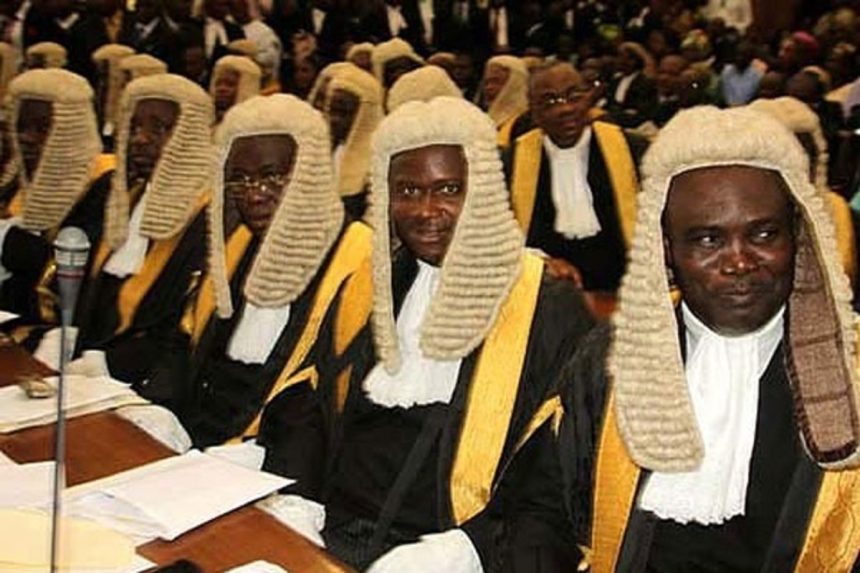
Senior Advocates of Nigeria (SANs), Mr Francis Amobi Nzelu and Dr Abiodun Layonu, have called for far-reaching judicial and constitutional reforms, including the creation of dedicated anti-corruption courts, to address persistent delays in the trial of corruption cases in Nigeria.
Speaking in an exclusive interview with the Nigerian Tribune, the senior lawyers argued that prolonged corruption trials are symptomatic of structural failures in the Nigerian judicial system, rather than a problem limited to anti-graft cases alone.
Nzelu said one of the most effective solutions would be the establishment of specialised courts solely dedicated to corruption-related matters, backed by constitutional amendments to give such courts a clear legal footing.
ALSO READ: APC North-East adopts consensus at zonal congress
According to him, the 1999 Constitution would need to be amended to formally provide for these dedicated courts, which would focus on handling corruption cases involving public office holders, civil servants, and other related defendants.
He noted that the concept is not new, citing the existence of family courts and juvenile courts in Lagos as examples of specialised courts designed to deal with specific categories of cases more efficiently.
“The law needs to be amended. That’s the 1999 Constitution. To call them dedicated courts… to handle issues of corruption, both civil servants, people in public offices, and the rest of them,” Nzelu said.
He added that the model should be replicated nationwide, proposing that each state should have at least six dedicated anti-corruption courts staffed by experienced and well-trained judges.
Nzelu argued that such a framework would significantly reduce delays by ensuring that corruption cases are heard by judges with the expertise and focus required to manage them speedily and effectively.
On his part, Dr Abiodun Layonu took a more pragmatic view, saying corruption may never be eliminated in any society, but can be controlled and reduced to a manageable level through deliberate institutional reforms and effective enforcement.
Layonu stressed that no country in the world is entirely free from corruption, arguing that the realistic goal should be to keep it within tolerable limits rather than assume it can be totally wiped out.
“You cannot end corruption. You can only manage and control it and reduce it to a manageable level. There is no country in the world where there is no major amount of corruption,” he said.
He noted that while some countries adopt extremely harsh penalties, including capital punishment, such measures may not be politically or socially feasible in Nigeria.
Layonu also made the striking observation that corruption has become deeply woven into Nigeria’s economic and political systems, describing it as a difficult reality that continues to undermine genuine reform efforts.
“The economy of Nigeria runs lightly and thrives lightly on corruption. That’s the sad part of it,” he said.
Layonu further emphasised that delays in corruption trials are not unique to anti-graft matters, but rather reflect a broader crisis within the Nigerian justice system.
According to him, virtually all categories of cases suffer prolonged delays due to overcrowded dockets, overburdened judges, poor infrastructure, weak court administration, and outdated procedures.
“The issue of delay in the legal system or in the judiciary is not peculiar to corruption cases. It’s general. Cases spend too long a time in court,” he said.
He said judges are often overwhelmed by the sheer volume of cases before them, while many courts operate under poor working conditions that make it difficult to maximise judicial productivity.
Layonu painted a grim picture of the daily operational challenges facing many courts, especially in Lagos, where erratic power supply and inadequate facilities can significantly disrupt proceedings.
He said some courts are unable to commence sitting early because of power-related issues, with proceedings in some instances not starting until 10 a.m., while others are cut short by early afternoon due to energy constraints.
According to him, there have been instances where courts sit only between 10 a.m. and 2 p.m., reducing the number of matters that can be heard in a day and worsening case backlogs.
He added that in some situations, judges are compelled to streamline proceedings, urging counsel to simply adopt written addresses without oral elaboration because of time and logistical constraints.
Another key concern raised by Layonu was the continued reliance on longhand note-taking by judges in many courts, which he described as outdated and a major contributor to delays.
He said courts that have adopted more modern systems, particularly in parts of Lagos, have seen faster proceedings because judges can focus on hearing matters rather than writing down every detail by hand.
“At the court level, one of those things is this long handwriting. We shouldn’t be having it anymore,” he said.
He urged authorities to invest in digital recording systems, modern transcription tools, and stronger court registry support to improve efficiency across the judiciary.
Layonu said the justice sector must address what some may consider peripheral issues, such as electricity, registry efficiency, scheduling, and courtroom technology, because they directly affect the speed and quality of justice delivery.
He warned that there is no quick fix to the problem, insisting that the entire legal ecosystem must function properly for corruption trials and all other cases to be concluded within a reasonable time.
The interventions come amid continued public concern over the slow pace of high-profile corruption prosecutions in Nigeria, with many cases dragging on for years without final resolution.
WATCH TOP VIDEOS FROM NIGERIAN TRIBUNE TV
- Relationship Hangout: Public vs Private Proposals – Which Truly Wins in Love?
- “No” Is a Complete Sentence: Why You Should Stop Feeling Guilty
- Relationship Hangout: Friendship Talk 2025 – How to Be a Good Friend & Big Questions on Friendship
- Police Overpower Armed Robbers in Ibadan After Fierce Struggle