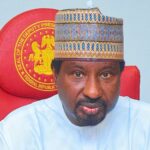
The new Vice-Chancellor of Lagos State University (LASU), Professor Ayodeji Badejo, has charged members of the university’s Senate to move the institution from one admired for its size to one that Lagos State cannot do without.
Badejo gave the charge at her inaugural Senate meeting held on Thursday at the university’s main campus in Ojo, where she outlined her vision for the institution and called for collective commitment to academic excellence, institutional unity and measurable impact.
The vice-chancellor expressed appreciation to the Lagos State Government, the people of the state and the university’s Governing Council for the confidence reposed in her. She also acknowledged the contributions of her predecessors, both substantive and acting, to the university’s stability, disciplined academic calendar and growing reputation as a first-choice institution.
ALSO READ: NAPPS seeks CAC partnership to boost schools registration compliance in Bauchi
Describing the Senate as the place where the university thinks, Badejo said she was appearing before its members not merely as an administrator but as a colleague whose professional life had largely been shaped by LASU.
“LASU is not an institution one merely administers. It is an institution one inherits, one serves and one hands forward,” she said.
The vice-chancellor, in a statement made available by the university’s spokesperson, Mr Ademola Adekoya, particularly appealed to senior professors who had stopped attending Senate meetings to return to the chamber, participate in deliberations and freely challenge the administration whenever necessary.
She stressed that the experience of senior academics remained essential to the university’s development, especially as a new generation of scholars emerged across its faculties.
“A Senate without its elders is a Senate condemned to repeat its mistakes,” she said, urging younger academics to work alongside experienced colleagues to combine fresh ideas with institutional memory.
Reflecting on LASU’s establishment in 1983 by the administration of the late Governor Lateef Jakande, Badejo said the university had fulfilled much of its founding promise in terms of size and reach.
She disclosed that 84,326 candidates had chosen LASU as their first-choice institution in the current admission cycle, making it the most preferred university in Nigeria for the second consecutive year.
The institution, she added, currently serves more than 85,000 students across its campuses in Ojo, Ikeja, Epe and Badagry, with almost all its academic programmes enjoying accreditation.
She also highlighted the opening of West Africa’s largest digital library, LASU’s selection to host the South-West’s only national centre of excellence in artificial intelligence, robotics and cyber sciences, and the university’s women’s football team representing Africa on the global stage.
However, she said these achievements must translate into greater institutional value and impact, rather than merely serve as measures of physical expansion and institutional growth.
According to her, while LASU had earned recognition for its admission figures, accredited programmes and infrastructure, it had yet to achieve comparable recognition for its outputs and measurable contributions to society.
She identified low research income, inadequate classrooms and laboratories relative to student enrolment, and uncertainty among some staff members over their verified entitlements as areas requiring urgent attention.
Badejo maintained that identifying the university’s shortcomings should be seen as an act of institutional courage rather than an accusation against any individual or group.
She further stressed the need for all LASU campuses to operate as one cohesive institution, with achievements and policies capable of surviving beyond the tenure of any particular administration.
Building on her campaign vision, Towards an Even Greater LASU, the Vice-Chancellor said the institution must look beyond the ambition of becoming Nigeria’s best state university and aspire to become Africa’s most consequential city university.
She outlined five major areas to achieve the ambition.
These include carrying out research and innovation to practically solve societal problems, prioritising outputs over inputs in terms of student completion rates and graduate employability, providing every student with an academic adviser, establishing a University Counselling and Wellbeing Centre and a Student Opportunity Fund, providing every staff member with a confidential statement of verified entitlements within its first 100 days in office, and also achieving institutional sustainability for the university.
Badejo said this would be achieved through a published institutional strategy, transparent annual performance reports and a framework that would encourage her successor to improve on existing plans rather than discard them.
Badejo emphasised that she was not asking the Senate merely to approve her vision but to take ownership of it.
She urged members to place academic excellence above academic politics, embrace evidence as the common language of the university, put students at the centre of policy decisions and ensure that research generated tangible benefits beyond the university community.
She also assured the Senate that her administration would not take decisions on matters requiring the chamber’s prior consideration without first presenting them for deliberation.
She promised that supporting evidence for every proposal would be made available and that dissenting opinions would be heard and respected.
In a strong appeal for institutional unity, the Vice-Chancellor declared an end to divisions within the university, insisting that there was no separate LASU for Ojo, Ikeja, Epe or Badagry, no old or new LASU, and no management or Senate LASU.
Rather, she said, the institution remained one university, united by one seal, one motto and one name on every certificate.
“Whatever side any of us stood on in the seasons behind us, there is only one side now, LASU’s,” she declared.
In closing, Badejo acknowledged that the Senate had heard inaugural speeches in the past but urged members to assess her administration through tangible results.
She specifically identified the delivery of the academic quality audit, staff entitlement statements, annual performance reports, and the return of absent senior professors to Senate deliberations as some of the measures by which her administration should be judged.
“We can manage the university we inherited or we can build the university the next generation deserves,” she said. “I choose to build.”
She concluded by reaffirming her commitment to LASU’s development and calling on members of the university community to embrace their shared responsibility for its future.
WATCH TOP VIDEOS FROM NIGERIAN TRIBUNE TV
- Relationship Hangout: Public vs Private Proposals – Which Truly Wins in Love?
- “No” Is a Complete Sentence: Why You Should Stop Feeling Guilty
- Relationship Hangout: Friendship Talk 2025 – How to Be a Good Friend & Big Questions on Friendship
- Police Overpower Armed Robbers in Ibadan After Fierce Struggle