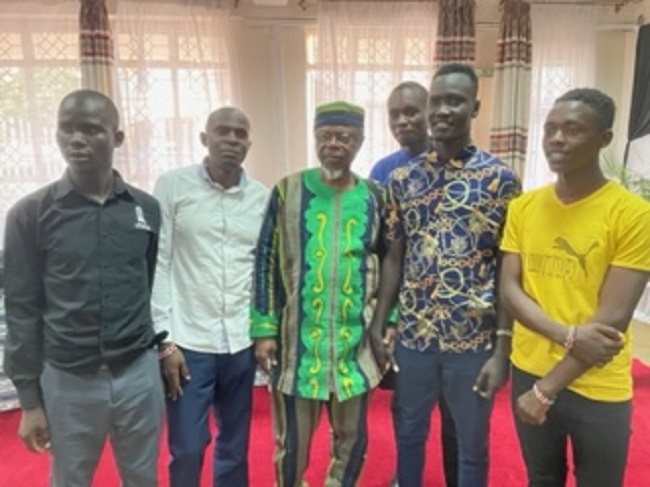
Opening Remarks at the Lecture on Decolonization at Kenyatta University
Knowledge operates in economic and political contexts. The colonization of Africa extended beyond the mere physical occupation of its territories. It was a comprehensive project of domination that seeped through the African continent’s character, beliefs, and structure. For the colonialists to succeed, they upturned models that required Africans to join the labor machine. These included prior means of employment in sectors that did not benefit them. The education system prevented school leavers from venturing into more technical industries. As long as Africans worked as labourers on colonial plantations or kept records for the white man in clerical offices, it did not matter whether they acquired knowledge that could help their country develop.
Beyond this, the colonial masters ensured that Africans discarded many of their ways through different social creations. The French, in particular, tried to encourage assimilation into French culture. They designed native societies such that Africans believed that imitating the white man was the path to economic and social prosperity. In education, studies were centered on the philosophy and literature of the white man, as still exist in some places till today. Language-wise, foreign tongues gradually displaced local ones in many circles, entrenching themselves as superior.
While research has highlighted a broad range of indignities visited on Africa by white men, the colonial era is well and truly behind us. What exists are its imprints that dominate our societies today. Years after, African education has continued to develop in the model set by Europeans. Knowledge production follows curricula that snub the African context but fattens students on ideals far beyond their shores. Therefore, we hope to look at decolonization and the winded process of achieving it.
Decolonization may be viewed as a reversal of colonial legacies, restoring values to territories once administered by alien overlords. The process of decolonization is necessary because foreign ideals have greatly distorted African society. Across the continent, structures created for colonial administrative and economic purposes impact stability. Nigeria and South Africa are prime examples, given that the former is still nursing wounds from apartheid while the latter is struggling to maintain its national fabric. In both situations, cultural identity determines opportunities available to different people, but what appalls deeply is how Africans peddle western ideologies as the gold standard. Any deviation from that thought pattern and the individual is regarded as backward or unnecessarily contrarian. Put differently, Africans, by their intention, consider colonial perspectives as superior to anything they can develop.
As a result, it has been argued that the first step towards replacing thoughts that better apply to Africa is a refurbishment of its intellectual space. This is especially true of its schools. The African education sector is a primary center of socialization, and it is only best that the problem is addressed there. Since we cannot dismiss the impacts that learning during formative years can have on the worldview of young Africans, the exact substance of that education must be examined. Are Africans imbibing values that truly belong to them? Do they understand their history and traditions? How grounded were they in the demeanor of Africa before colonialism? The answers to these questions will determine the approach to correcting our intellectual trajectory. The need for this stems from the fact that knowledge transfer in schools was designed on a purely Eurocentric basis. To superimpose their culture on Africans, the fabricators painted the continent as backward and in need of a facelift. Even so-called European experts on African studies excluded news of Africa’s achievements in technological advancement. With these undercurrents, Africans learned about foreign leaders and intellectuals, a trend that remains unchanged.
However, reforming its intellectual space means challenging principles that have been normalized. An implication of Eurocentric knowledge transfer is that Africans see themselves as inherently inferior. Here, it is not an active exhibition of racism by foreigners; rather, Africans see themselves as subordinate to the white man. This is the material they have been introduced to in schools, which propagated European wonders and the whites’ campaign of global civilization. During this process, they barely acknowledge the existence of their cultural backgrounds. This makes it such that external narratives are all they can access. It becomes difficult to be intellectually flexible or even accept an African definition of sophistication.
Worse still, because colonial teaching models have spoon-fed their minds, their research inclinations automatically lean in that direction. In effect, they assist the West in learning more about itself. Few people who research keenly on African subjects receive little support and encounter difficulties. Also, there are occasions where the political class has meddled in academia for selfish reasons. They make it such that the intellectual flow is centered only on what their foreign partners consider acceptable. Thus, where the social and academic landscape primarily favour western narratives and politics prevent any meaningful growth in indigenous studies, the task of reformation may well be an uphill one.
Furthermore, decolonization must engage the relevance of indigenous knowledge. While there is a genuine desire to re-establish African thoughts, attention must be paid to the dynamics it will blend into. The colonial project halted the development of African cultural perspectives and elbowed them in favour of foreign ones. An attempt at infusing these ways must consider the practices of the modern world and the thoughts that dominate it. It must acknowledge that Africa in the pre-colonial era is different from the present and, by way of this, adapt to what exists. Not all traditions can now be accepted. All must be reviewed to find a balance between both worlds.
Moreover, decolonization must also recognize the diversity of African cultures. There are multiple models of cultural expressions on the continent, and re-examination has to consider this. Rather than aim to morph learning into a one-size-fits-all dimension, the continent can embrace its diversities and design a structure that reflects them. Analysts have proposed that Africa finds unifying elements in its belief systems and apply them to establishing something different but African. The denial of many indigenous cultures in academic curricula negatively reflects those cultures. If the individuals who are meant to shoulder its values cannot do so because they are barred from representing it at schools and trained to believe it is inferior, that culture will steadily descend into oblivion. Similarly, many insights on Africa will be relegated to the background. Incorporating cultural elements in the schools’ curricula is not an excursion to gain bare political weight but rather a historical preservation imperative.
Following the preceding, it is important that decolonization efforts are not isolated. They must be done in synergy with the political class, creating a marriage of governance and intellect. The potential outputs of decolonization cannot be overemphasized. The idea proposes a comprehensive shake-up of the system we have naturalized into. It suggests that we do an about-face towards practices still unfamiliar to us, despite being ours by implication of ancestry. This effort is best made in alignment with political objectives such that intellectuals are not riding solo. We must reform African studies to create potentials to fix the shabby outcomes of colonial nation-building. Ethnic groups will obtain a more relevant position, and inherent in this are developments that intellectualism must lean on politics to consider.
The concept of decolonization transcends playful fancy. Implementing it requires research across multiple disciplines and into different cultures. This is required to avoid failures in the system as time passes.
As stated earlier, colonial influence on education has effectively limited academic interest in African culture, resulting in the availability of few researchers to undertake the thoroughness that the decolonization process demands. In addition, mention must be made of the funding sources for African institutions. Many of these places receive donations from Western organizations, compromising their abilities to make deviant choices; therefore, funding must occupy a premier position in any endeavour to redefine the education sector.
If Africa’s knowledge production centres remain tied to foreign purse strings, it can be assumed that the decolonization project is dead on arrival. We should create autonomies, not be dependent on others for our crucial needs. We should not be exporters of raw materials and importers of finished products. We should not use all foreign academies to sponsor our key needs, including giving us money to buy recharge cards to speak to one another—as demeaning as offering ice creams to dogs. Such degrading dependency is nothing but a continuation of imperialist projects that should compel us to turn our legs into those of horses and flee fast enough, so the maxim guns do not kill any of us.
WATCH TOP VIDEOS FROM NIGERIAN TRIBUNE TV
- Relationship Hangout: Public vs Private Proposals – Which Truly Wins in Love?
- “No” Is a Complete Sentence: Why You Should Stop Feeling Guilty
- Relationship Hangout: Friendship Talk 2025 – How to Be a Good Friend & Big Questions on Friendship
- Police Overpower Armed Robbers in Ibadan After Fierce Struggle