Though the rains are over this year, WALE EMOSU, against the background of the prediction by the Nigeria Hydrological Services Agency (NHSA) early in the year that some cities might experience flash flood, over time monitored some flood-prone areas in Ibadan. However, their travails, he reports, may not have come to an end; they might just have been postponed.
IT was some minutes past 17.00 hours on that Sunday. There were some dark patches in the sky: it looked like rain. From a distance, Happiness Daniel could be seen chatting with a group of boys his age. A further few meters away was the bungalow that serves as shelter for his family – his father’s private property.
For Happiness, 19, that discussion with his peers must have been with a tinge of fear and trepidation because he must have been thinking that if indeed it started to rain, their residence was the last place he could seek shelter.
In fact, the likelihood of the rain falling had drawn Happiness out of the house; if it must rain, he had be

tter not be ‘trapped’ in the house. “That’s why [the likelihood of a rain] I am not at home,” he told Saturday Tribune. The disaster of the last flooding was still fresh in the mind of the teenager, like any other resident of Gbekuba area of Apata, Ibadan. Like a thief in the night, the rain of June 1, 2016, which started at about 6.30 p.m. until the early hours of the following day, had stripped many residents of their possessions.
The things lost to the flooding ranged from cars and electronics to human lives. The perimeter fences of a number of houses were also pulled down. A poultry in the area lost many birds to the disaster. In the estimation of Happiness, the June flooding was “the greatest flooding that we have recorded at Gbekuba.” Since then, whenever they can help it, Gbekuba residents adopt various means, including abandoning their homes, to beat an impending disaster which a potential rain forebodes in the area.
Afeez Lawal, a generator repairer who has lived in the Gbekuba area for 30 years, told of the tragic lot of his family in the June 1 incident. Afeez had divulged the confused state of mind of Happiness to Saturday Tribune about the cloudy weather before the teenager himself spoke to this reporter.

According to Afeez, one of the two persons killed in the flooding was his stepmother, Bolatito Lawal, who had gone out in the rain to trace her son Deji, who she had sent on an errand before the rain started. In the process of looking for Deji, Mrs Lawal misstepped and got washed away by the flood. While the body of the second casualty on the night, a certain Baba Ijebu, was found, that of Mrs Lawal was never found. Deji later returned home unscathed. For the people of Gbekuba and some other parts of Ibadan, indeed, when it rains, it pours.
The NHSA prediction
Since 2012 when Nigeria experienced the most terrible flood on record, the Nigeria Hydrological Services Agency (NHSA) has always made public the flood outlook every year. The purpose is to help relevant agencies put in place pre-emptive measures against this menace.
In July this year, the agency predicted flash flood in certain parts of the country and against that background, advised affected state governments to take steps at ensuring that flooding is controlled in their domains. The cities likely to witness flash flood, according to the NHSA, are Lagos, Ibadan, Port Harcourt, Sokoto, Kaduna, Maiduguri and Yola.
The following month, the Oyo State government made pronouncements to stem flood disaster, once again, in its capital. The state Commissioner for Environment and Water Resources, Isaac Ishola, highlighted measures, which he believed, if they were strictly abided by, would banish flooding from the city. To avoid flooding, Ishola called for an end to dumping of refuse in the river, building on waterways, an appeal to residents of flood-prone areas to always relocate once the rain does not stop after 30 minutes, among others. To mitigate the effects of the rains and avoid flooding within the metropolis, the government promised to expand some of the waterways.
In the rain of August 31, 1980 in the Oyo State capital, scores of lives with properties worth millions of naira were lost. Juju musician, Ebenezer Obey, dubbed the downpour ‘ojo abami’ (weird rain). Over 100 lives and properties in millions of naira were also lost in the August 26, 2011 tragedy that attended the Ibadan rain. Indeed, August rarely augurs well in the city.
The city has recorded some other flood disasters that took place at different times of the year. It is no longer the 1965 Ibadan of the poet, J. P. Clark that was merely “running splash of rust and gold-flung among seven hills like broken china in the sun.” Now, the waters run with the potency to endanger lives and properties in Ibadan, which accounts for 11 out of the total 33 local government areas in Oyo State.
Against the background of government’s warnings, Saturday Tribune visited some of the flood-prone areas as identified by the government itself for an interface with the residents. Gbekuba happens to be one of those areas and its probing culminated in the experiences relayed to Saturday Tribune by Hapiness, Afeez and Wasiu Abioye, a carpenter who had described the Aba Alfa river – always at the centre of flooding in the area –as ‘agbako’ (monster) when this reporter told him his mission to the area. Wasiu, uncle to Afeez, confirmed the

latter’s story of the loss of his stepmother (Wasiu’s sister-in-law) to the June 1 flooding in Gbekuba.
Omi-Adio is located in Ido Local Government Area of the state. Apart from its residential neighbourhood, it boasts of a wholesale farm produce market where traders from virtually all the six states in the South-West converge every five days for transactions. The community also had its share of the disaster of the June 1 flooding which sacked many people from their homes, apart from destroying their belongings.
Speaking to Saturday Tribune, Alhaji Amusa Oyesola, the Baale Oloja, second in hierarchy to the Baba’loja (head of the traders) of Agbebukola market, spoke on behalf of his principal, Alhaji Raimi Olalekan, who was available but was indisposed to talk because he was bereaved, having just lost a relation. According to Alhaji Oyesola, produce lost to the June 1 flooding was worth millions of naira while the promise of relief materials to assuage the traders’ losses was yet to be fulfilled at the time of the visit to the market in October. Saturday Tribune’s correspondent was shown the list of 113 victims of the flooding compiled and given to officials of the National Emergency Management Agency (NEMA) from Abuja who have not returned ever since. NEMA is the agency saddled with the responsibility of managing disasters in Nigeria.
To guide against a future occurrence of flooding at the market or the neighbourhood, the octogenarian Alhaji Oyesola who claimed to have known Omi-Adio since when it was barely made up of about 20 huts many years ago, reasoned that the river required expansion as the community itself was fast developing. But Alhaji Husaeni Raji says an expansion work was carried out last year but believes that it was shabbily done.
Alhaji Raji, born at the neighbouring Anisere Igisogba village, took this reporter round his area to see the damage flooding had done. He drew attention to the heights the water, after travelling about 100 metres, beset some residential buildings. The waterlogged jute vegetable and plantain farm behind his house also bore testimony of the havoc rain had wreaked in the area in recent times. Saturday Tribune also visited the main Omi-Adio river, but its calm nature that morning belied the stories of the pains the river had inflicted on the neighbourhood in times past.
Face to face with flooding
However, eight days later, the river was to be ‘caught’ in the act ravaging households again. Rain had fallen the night before. “Good morning, this is from Omi-Adio, can you come down now to see the extent of damage the rain is doing again?” Alhaji Raji had had the presence of mind to put a call through to this reporter. The time was 04.38am on Sunday – the Christian’s day of worship – soon to become another day of humanitarian service. Moments later, the lot and the losses of the Omi-Adio were to be discovered. This time, it was the whole of the neighbourhood was mourning; the entire Agbebukola market was flooded, forcing traders to display their wares on a side of the main road – the same Abeokuta-Ibadan road. This reporter had also arrived in good time to see some of the residents parking their belongings back into their houses. They had been salvaged when their rooms were becoming flooded in the middle of the night.

A one-and-a-half-kilometre ride with Alhaji Raji on his neighbour, Taofeek Raji’s motorbike to his birthplace at Igisogba Anisere revealed more unimaginable havoc the rain had wreaked overnight. The residential buildings and structures over that distance were not spared. At least two vehicles were also seen half-merged. It was, therefore, a dejected Gafar Adewale that spoke to Saturday Tribune in that village. “Can we say these buildings are too close to the river? The river is about 200 feet away and you can see the damage the flood has done,” Adewale, the head of the landlord association in the Igisogba Anisere area, told this reporter while showing him round the flooded buildings.
Some residents of Ayileka Street in the Odo-Ona area of Ibadan have a knotty issue on their hands and this has to do with the proximity of their structures to the river. A landlord in the area, Alhaji M. O. Osogbede, who told Saturday Tribune that he had been in the area since 1982, recalled that what he met was a stream. But what was known to be a stream many years ago has expanded to become a river and has consequently eaten into the space between it and the buildings. This has now exposed these buildings to flooding. Non-adherence to building codes is frowned upon by government with the attendant penalty being the demolition of such buildings, but where swings the pendulum of the law in a situation like this? In addition, the coordinator, Ibadan Urban Flood Management Project, Mr Dayo Ayorinde, had admonished residents of flood-prone areas to always evacuate if a rain did not subside after 30 minutes.
‘I will never abandon my house’
But some of these building owners have insisted that their structures can’t be demolished, more so when they consider the excruciating effort they put into erecting them; neither do they have the option to relocate, come rain, come shine.
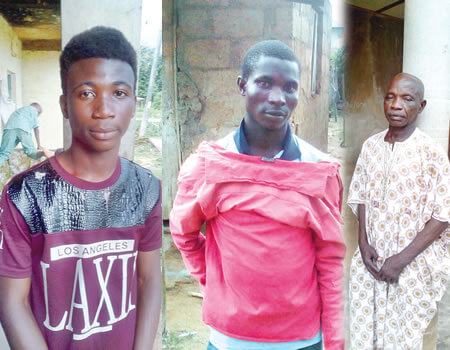
Sabitu Ogundairo is one of such persons in this category. Mr Ogundairo is a landlord at Gbaremu, another area of Ibadan and he has been living in his bungalow since 1996 when, according to him, the river in the area was just a stream. Now many years down the road, the stream has expanded into a river – and a ravaging one at that – during the rainy season. But with his status and the economic situation, if he is willing to move out of his house for the threat of the flood, he says he can’t help it.
“I don’t have anywhere else to go; I am a pensioner. I retired from the Water Corporation of Oyo State in 2008 as a principal superintendent after 35 years in service. Now someone who has laboured for 35 years with just this [pointing to his building] to show for it, please, where do you say such a person should go? I have nowhere to go, I am already pushed to the wall,” he told Saturday Tribune.
However, many have given up on the struggle against nature – not momentarily but for good – abandoning their buildings following persistent disturbance by rains. Such structures abound all over; from Gbaremu to Omi-Adio. Victims are not owners of residential buildings only; even religious outlets, after failed attempts to redeem the situation, have had to relocate.
The main river at the Gbaremu area is known as ‘Odo Onigbese’ (meaning debtor river). It is so called, according to Alhaji Murtala Kolapo, a resident of the area for over 20 years, because many years before the area attained an urban status, many people, especially farmers, had often slipped and lost their farm produce at the river, which by then had no bridge. Consequently, the people, because they had always lost valuables at that spot, named it ‘Odo Onigbese’. “And we never knew that the havoc would ever be pronounced till now,” Alhaji Kolapo told Saturday Tribune. Thankfully, the river has been further dredged to arrest flooding in the area. But our reporter’s guide on the trip to the area, Mr Gilbert Ekwueme, looks at it from a spiritual angle, positing that the spirit behind the derogatory name could actually be responsible for the perennial havoc it wreaks.
Landlords and tenants who have been made vulnerable to flooding as a result of the expansion of the river cannot afford to sleep with both eyes shut. Chief Philip Faleti, chairman of the landlords association in Ayileka area of Odo-Ona, joined by Alhaji Osogbede, Alhaji Onaade and Mr R. O. Akindele, in a cluster round this reporter, recalled their effort on the river in the area. “The bush along the river has just been cleared. Besides, we spend money on clearing the waterway of debris. Recently, we spent N45,000 (about $143) to clear this river. As you can see, we are old; we are pensioners, we can no longer fend for ourselves.” That amount may sound ridiculous, but for Nigerian pensioners who are not regularly paid, it is a whole lot. The Ayileka river, which flows into the main Odo-Ona river, did not enjoy the same privilege as the latter, which was one of the 14 rivers in Ibadan, recently dredged by the government to curtail flooding.
One habit that still festers in the fight against flooding is the dumping of refuse into rivers and streams by some recalcitrant members of the public. Refuse dumped into rivers and streams blocks the waterways, forcing water to find new channels which may lead into houses and other properties. Even when it is obvious that dissuading them from that habit is in their own interest, perpetrators carry it out with abandon, daring and threatening whoever may want to put them in check. The white-livered ones among them have had to brave it to escape from the long arm of the law. And at times, they have had death stare them in the face.

Chief Faleti told of how one fellow landlord was threatened with blindness by diabolical means by a woman who was told to desist from dumping refuse into rivers. Ayobami Akande, a Muslim cleric, told Saturday Tribune how, four days before, he had given an erring woman a chase, at the Aroye Orisumbare area of Gbaremu while trying to dump refuse into the river. With the day yet to fully break, the fleeing woman, according to Mr Akande, unwittingly fell into a low unguarded well. The saving grace for the woman, said Mr Akande, was that the well was dry and empty at that time.
‘I need govt’s assistance’
Throughout our correspondent’s adventures to all these flood-prone neighbourhoods, the case of one man looked most curious. He goes by the name Wahab Ogbonyabiona. A pass had just been made through the frontage of his house at the Aroye Orisumbare area of Gbaremu when he emerged to frontally accuse this reporter and his guide that we were on a sinister mission around the area. But after being told of the actual mission, he became relaxed and that was when the picture of the immediate environment was taken in.
He must be vulnerable to flooding, considering how close his house was to the river. “No,” he said. Over time, town planning authorities had given him the all clear – he had not run foul of any known building law. And neither had he ever experienced flooding, even when his nearest neighbours were mourning their losses to rain. The Muslim cleric, Akande, also attested to this.
Though unlettered, Mr Ogbonyabiona, who appeared to be in his 70s, proved to be a master even beyond his craft. “Anytime one speaks, because one is uneducated, they say one is talking nonsense,” he told Saturday Tribune. A trained bricklayer, apart from bringing his expertise to bear in fighting flooding around him, Ogbonyabiona has practically built houses occupied by the high and mighty in the land.
He digs into history: “We left Lagos in 1975 for Benin City. It was during the time of Governor [Samuel] Ogbemudia. Two housing projects were contracted to our master, one of the houses was meant for Justice [Ephraim] Akpata. He tries to give the description of the location: From Sapele garage, tell anyone you are going to army barracks…”
But Ogbonyabiona’s case is a perfect practical example of the needle that stitches people’s clothes which has remained naked itself. His accommodation mocks his profession. After ‘helping’ others to build mansions and other edifices, his own abode can at best be described as derelict. On one side of his are heaps of gutter sands he said he had gathered for sale to make ends meet for him and his children, his wife having died in 2015.
And to the government he makes an appeal: “I don’t mind if they are willing to help me.”
WATCH TOP VIDEOS FROM NIGERIAN TRIBUNE TV
- Relationship Hangout: Public vs Private Proposals – Which Truly Wins in Love?
- “No” Is a Complete Sentence: Why You Should Stop Feeling Guilty
- Relationship Hangout: Friendship Talk 2025 – How to Be a Good Friend & Big Questions on Friendship
- Police Overpower Armed Robbers in Ibadan After Fierce Struggle