
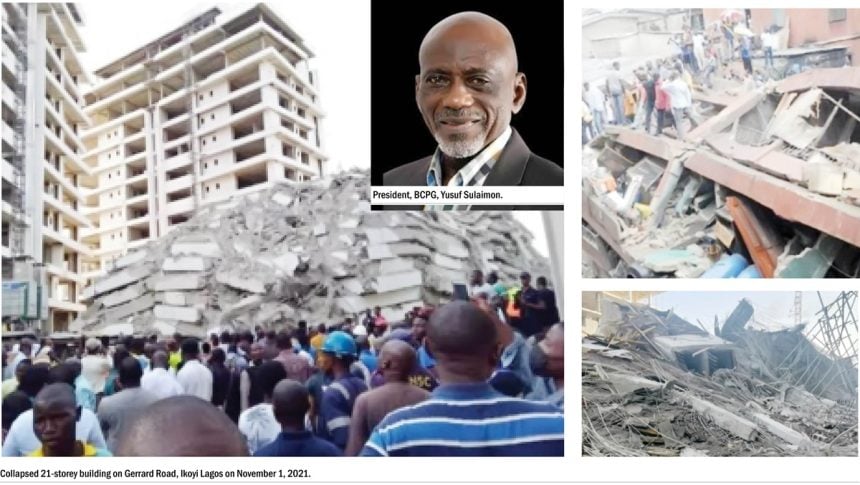
•Five years after Ikoyi tragedy, questions around regulation, poor construction practices continue •Over 50 cases recorded between 2022 and 2026
Five years into the collapse of the 21-storey high-rise building in Gerrard Road, Ikoyi, Lagos, DAYO AYEYEMI, writes that no fewer than 50 incidents occurred thereafter, while professionals and government’s officials continue to search for solutions.
On November 1, 2021, a 21-storey building at 42 Gerrard Road, Ikoyi, Lagos, collapsed, claiming 44 lives of able-bodied men and women. On that fateful day, the high-rise building, under construction then, came crashing down, trapping construction workers, artisans, visitors and the developer, Femi Osibona, Managing Director of Fourscore Heights Limited, beneath the rubble.
Five years after, besides serving as a painful reminder for those who lost loved ones, the tragedy continues to serve as a pointer to the consequences of weak regulatory enforcement, poor construction practices and failures in professional oversight in the state’s built environment.
The disaster shocked the country, raising serious questions about how a building reportedly approved for 15 floors was allowed to rise to 21 floors, and why warning signs and regulatory interventions failed to prevent the eventual collapse.
As rescue workers battled to retrieve survivors and bodies from the debris, the incident exposed the potentially deadly consequences of regulatory lapses, inadequate construction supervision and disregard for established building standards, in the state.
Eyewitness accounts painted a terrifying picture of the final moments before the collapse. People working within and around the building reportedly noticed vibrations and movements between 2pm and 2.25pm before hearing loud cracking sounds as the structure began to give way.
A surviving mason, Innocent Amos Denavide, who was working on the 12th floor with 22 colleagues, narrowly escaped the disaster.
He reportedly said he had been carrying out plastering work with the other workers when the building collapsed.
Another survivor, Adegbola Okikiola Danjumah Olagoke, a contractor who had visited the site for meetings with Osibona, recounted how he escaped death by sheer circumstance.
In a social media account following the incident, Olagoke said he had spent the morning at the building discussing landscaping work with the developer, leaving around 12.15pm before returning at about 1.45pm for another meeting.
By the time he arrived, the high-rise had become a mountain of rubble.
The tragedy led to a coroner’s inquest, which, expectedly, identified failures in regulatory oversight. Reports also indicated that the structure had shown signs of distress and had been subject to previous regulatory interventions.
The Lagos State Government subsequently initiated the controlled demolition of the remaining structures on the site.
However, five years after, the fundamental questions raised by the Ikoyi disaster by industry’s experts remain relevant: Who ensures that developers comply with approved building plans? Who verifies the quality of materials used? How regularly are construction sites inspected? And what happens when authorities identify violations or signs of structural distress?
These questions, experts argued, have become increasingly urgent as building collapses continue to threaten lives and property across Lagos.
Building collapse updates: A persistent and costly problem
Data from the Building Collapse Prevention Guild (BCPG) indicate that Nigeria recorded 817 building-collapse incidents between October 1971 and July 27, 2026, with Lagos accounting for 477.
The figures, cited by quantity surveyor Tomi Ogundare, underscore the disproportionate burden borne by the commercial capital and Nigeria’s most populous city.
Of the 477 incidents recorded in Lagos, 325, representing 68.1 per cent, occurred in occupied buildings, while 121, or 25.4 per cent, happened during construction.
The remaining 31 cases, representing 6.5 per cent, occurred at the end-of-life stage.
Also between 2022 and now, no fewer than 50 to 52 building collapse incidents have been recorded in Lagos State.
A breakdown of the recorded incidents in Lagos State by year includes:
2022: 20 building collapse incidents
2023: 17 building collapse incidents, including the seven-storey building in Banana Island, Lagos.
2024: 13 building collapse incidents (through recorded multi-state tracking)
2025-2026: Additional ongoing incidents -including notable collapses such as the Alakija, Satellite Town-area structure in June 2026.
Experts’ view
The figures, expert said, suggested that building collapse is not merely a construction-site problem, but a public safety crisis affecting people who live, work or conduct business in buildings that may have deteriorated or developed structural defects.
The danger was reinforced on June 25, 2026, when a four-storey building collapsed along Old Ojo Road, near Alakija Bus Stop, in the Amuwo-Odofin area of Lagos. Eight people died, while 26 others were rescued.
ALSO READ: Primate Ayodele sends warning to Tinubu’s govt over state police
The incident prompted renewed calls by built-environment professionals for stricter enforcement of building regulations, more frequent inspections and stronger coordination among government agencies, professional bodies and communities.
At a conference organised by the BCPG Amuwo-Odofin Cell in Satellite Town, stakeholders warned that the recurring disasters reflected persistent weaknesses in the monitoring of construction activities and the enforcement of safety standards.
With the theme, “Building a Resilient Lagos Through Synergy,” the conference brought together building-control officials, planners, construction professionals, developers, academics, emergency responders and community representatives to examine ways of preventing further tragedies.
The consensus was that building safety could not be guaranteed through the issuance of permits alone.
They urged that the regulatory agencies must ensure that developers comply with approved plans and construction standards throughout the building process.
Weak enforcement /professional negligence
The General Manager of the Lagos State Building Control Agency (LASBCA), Mrs Florence Gbaye, identified the use of substandard materials, employment of unqualified workers and inadequate professional supervision as major threats to building safety.
She also criticised professionals who accepted responsibility for multiple projects but delegated critical duties to unqualified personnel without adequate supervision.
Gbaye stressed that architects, builders, engineers and other practitioners must remain actively involved in their respective areas of responsibility throughout construction.
She said LASBCA’s Certified Accreditors Programme, involving more than 150 private practitioners, was designed to improve regulatory efficiency and strengthen professional participation in building control.
However, the effectiveness of such initiatives ultimately depends on the consistency of inspections, the quality of enforcement and the willingness of authorities to sanction violations.
A building approval should not become a licence for developers to disregard approved specifications. Equally, the discovery of unauthorised additional floors, structural alterations or substandard construction should trigger immediate and decisive action before lives are endangered.
The General Manager of the Lagos State Physical Planning Permit Authority, Kehinde Osinaike, represented by Mrs Busola Olatunji, urged residents to report unsafe buildings and unauthorised construction.
She advocated a “See Something, Say Something” approach, arguing that public vigilance could help authorities identify potential dangers before they develop into disasters.
But residents’ willingness to report violations must be matched by prompt action from the relevant agencies.
The experts warned that a reporting system that produced no timely inspection or corrective action can’t provide an effective safeguard.
Beyond regulatory failures, experts said that inadequate soil investigations, poor drainage, inappropriate foundation designs and substandard workmanship can compromise structural integrity.
The Vice President, Africa, of the International Society for Soil Mechanics and Geotechnical Engineering, Dr Sebastian Ozoamalu, stressed the importance of proper ground investigations before construction begins.
He warned that soil conditions can differ significantly between neighbouring properties, making it unsafe to replicate foundation designs without establishing their suitability for the specific site.
Similarly, Mr. Ogonna Agwu, a surveyor, identified inaccurate land surveys, inadequate drainage planning, flooding and erosion as factors that could undermine buildings, particularly in low-lying areas of Lagos.
He called for improved mapping, stormwater management and effective connections between private and public drainage systems.
The Dean of the School of Environmental Studies at Yaba College of Technology and Third Vice-President of the Nigerian Institute of Building, Dr Adesina Aladeloba, also called for the training and recertification of artisans and craftsmen.
He identified poor planning, inadequate financing, abandoned projects and weak project management as additional challenges affecting construction quality.
“The implications are significant. Even where designs and materials meet acceptable standards, poor workmanship and inadequate supervision can introduce defects that compromise a building’s safety,” he said.
From inspections to accountability, BCPG advocated a grassroots approach to preventing building collapse by mobilising built-environment professionals into voluntary cells across local government areas.
The Chairman of its Lagos State chapter, Pastor Joseph Akande, said closer collaboration between professionals, regulators and communities would improve compliance and bring safety awareness closer to residents.
The guild’s President, Alhaji Sulaiman Yusuf, urged other state chapters to replicate the stakeholder engagement initiative.
According to experts that spoke earlier, collaboration must translate into a more effective system of inspection, reporting, enforcement and accountability.
They urged that the government needed reliable records of existing buildings, regular risk-based structural assessments and a tracking system for distressed structures to ensure that identified defects are addressed.
“Buildings showing signs such as major cracks, foundation settlement, tilting, exposed reinforcement, spalling concrete or persistent water damage require prompt assessment by qualified professionals.
“Where a building is considered unsafe, authorities must act quickly to protect occupants and the surrounding community, including restricting access or ordering evacuation when necessary,” the experts said.
The stakeholders also called for stronger controls on structural alterations and changes of use, alongside updated fitness certification and better monitoring of buildings approaching the end of their useful lives.
Former Permanent Secretary in the Lagos State Ministry of Waterfront Infrastructure Development, Mrs Olayinka Patunola-Ajayi, advocated broader risk assessments and the management of buildings and infrastructure throughout their life cycles.
She said digital technologies and mapping could improve planning and monitoring but should complement, rather than replace, professional responsibility.
The Chairman of the BCPG Amuwo-Odofin Cell, Chubike Okafor, said the Alakija collapse highlighted weaknesses in emergency coordination and the need for effective early-warning mechanisms.
He urged property owners, residents and community leaders to report structural defects before they escalate into emergencies.
The Chairman of the conference, Dr Austin Otuoke, maintained that no single profession or institution could guarantee building safety without effective collaboration.
“For Lagos, however, collaboration must go beyond conferences, public warnings and expressions of concern after lives have been lost.
“The state needs a system in which every stage of construction is subject to effective oversight, professionals are held accountable for their responsibilities, developers face consequences for violations, and distressed buildings receive timely intervention, “ they said.
The Ikoyi tragedy, the experts in the built environment said demonstrated the devastating consequences of allowing alleged violations and warning signs to go unresolved; while Alakija collapse reinforced the urgency of addressing the weaknesses that continue to expose residents and construction workers to danger.
Interestingly, a resident, who has properties in different parts of the city, would want the different agencies of the government to ensure they are available for residents, desirous of playing by the rules and not see such residents, or landowners as another source of revenue.
The resident, who would not want his name in print, argued that some resorted to these unholy practices ‘because the price you pay for complying with the rules is rather too huge’.
“The various agencies of the state see you as an object that must be milked. Instead of providing their regulatory works in a way that would be mutually beneficial, the conditions they give most times are almost humanly impossible to comply with. While it is wrong for builders or landowners in this type of situation to resort to self-help, the agencies of the state, too, should be reasonable in their demands, because the consequences of pushing citizens to resort to self-help are usually grave,” he stated.
Interestingly, five years after the Ikoyi building disaster, memories of the tragedy, and those of many others in the state, are yet to recline; since lessons are yet to be learned. Perhaps, a way of learning some lessons, in this regard, is to give questions surrounding building regulatory framework and enforcement some attention. This, stakeholders believe, would go a long way in stopping limbs and lives being lost to tragedies that have to do with building collapses.
WATCH TOP VIDEOS FROM NIGERIAN TRIBUNE TV
- Relationship Hangout: Public vs Private Proposals – Which Truly Wins in Love?
- “No” Is a Complete Sentence: Why You Should Stop Feeling Guilty
- Relationship Hangout: Friendship Talk 2025 – How to Be a Good Friend & Big Questions on Friendship
- Police Overpower Armed Robbers in Ibadan After Fierce Struggle


