
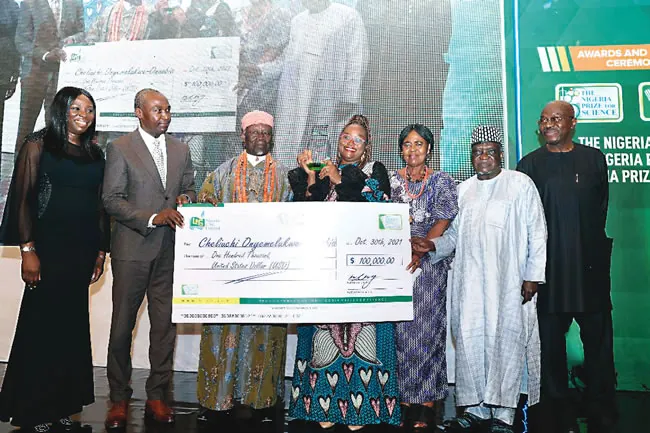
Unlike other literary prizes sponsored by corporate organisations, the 19-year-old The Nigeria Prize for Literature has continued to thrive. But what exactly are its impacts? AKINTAYO ABODUNRIN attempts an answer.
THE 2023 edition of The Nigeria Prize for Literature and The Nigeria Prize for Literary Criticism formally commenced last Friday with the call for entries. Sponsored by Nigeria LNG (NLNG) Limited, the Prize for Literature, now in its 19th year, carries a cash prize of $100,000, while the Prize for Literary Criticism is worth $10,000.
With the biggest purse in Africa, the NPL has become the mighty oak from a little acorn. When it launched in 2004, people didn’t think the prize, which honours the author of the best book by a Nigerian and rotates annually among prose fiction, poetry, drama and children’s literature, would last the distance because corporate Nigeria does not demonstrate sufficient commitment to the arts, especially literature.
Commendably, it has lasted 19 years and birthed the Literary Criticism Prize to affirm further that the NLNG is in it for the long haul with the prize. It won’t sunset in the foreseeable future.
Last week’s announcement of the competition’s commencement by the Advisory Board disclosed that entries would close by March 31. The Advisory Board, which administers both prizes, announced that the 2023 prize would be awarded for drama while unfolding the mechanics.
Professor of Drama and Critical Theory at the Alex Ekwueme Federal University, Ebonyi State, Ameh Dennis Akoh, will chair the panel of judges. The other two jury members are Professor Osita Catherine Ezenwanebe of the Creative Arts Department, University of Lagos and Dr Rasheedah Liman, a Senior lecturer at the Department of Theatre and Performing Arts, Ahmadu Bello University (ABU) Zaria. The Advisory Board also announced Professor Victor K. Yankah from the Department of Theatre and Film Studies, the University of Cape Coast, Ghana, as the International Consultant.
As publishers begin submitting works for the prize, which winner, if any, would be announced in October, there’s a need to assess its impacts and see if it has boosted the development of Nigerian literature as the sponsors intended.
Different generations of winners
First, the age of the prize winners since its commencement in 2004 shows that it has succeeded in stirring the interest of a broad spectrum of the target audience. Different writers have won since its inception in 2004. While no one won the inaugural edition, the late Pa Gabriel Okara and Professor Ezenwa Ohaeto jointly won in 2005. Professor Ahmed Yerima won in 2006, Mama Mabel Segun and Professor Adimora-Ezeigbo jointly won in 2007 and Kaine Agary in 2008. There was no winner in 2009, while the late Esiaba Irobi won in 2010. Adeleke Adeyemi took the prize in 2011, Chika Unigwe in 2012 and Tade Ipadeola in 2013. The late Professor Sam Ukala won in 2014 and Abubakar Adams in 2016, with no winner emerging in 2015. The late Ikeogu Oke won in 2017, Soji Cole in 2018, Jude Idada in 2019, and Cheluchi Onyemelukwe in 2020/21. Romeo Oriogun is the current holder of the prize.
Quality of publishing
Apart from the considerable prize money, the Nigeria Prize for Literature has also given exposure to the winners while helping boost book sales. Focusing on quality and the proviso that only publishers can submit entries helped improve the quality of publications when the literati were tired of poorly produced and edited self-published books.
Former President of the Association of Nigerian Authors (ANA) Denja Abdullahi agrees with this but notes that the prize has not deeply impacted the reading level. He further states that the NLNG and other corporates must do more per reading.
Abdullahi said: “The prize has led to some consciousness in producing well-published texts in Nigerian literature. Before it, writers have written great stuff, but much of that may have needed to be qualitatively published. With the coming of NLNG, those who may want to enter for the prize have always ensured their texts received the best possible editing and packaging. The prize certainly has rewarded the winners handsomely year in and year out. Still, we cannot say it has led to any great Nigerian literature or reading level improvement.
“A lot of ancillary things need to be done by NLNG and other corporate bodies to improve literary culture and reading in society. The Prize is a good addition to the existing prizes and those after it. We must invest more to support writers, writers’ bodies, and institutions promoting creativity, writing and publishing.”
Yardstick for quality
For Professor of African Literary Criticism, Gender Studies and Creative Writing, Razinat Mohammed, the Prize has been a game changer for Nigerian literature, helping to improve it all around.
“The Nigeria Prize for Literature is a laudable initiative aimed at promoting the study and production of literature amongst Nigerians anywhere in the world,” she began. “In my assessment, I think the sponsor has done very well in the management and award of the prize. It has served as a yardstick for measuring quality in the years of its existence. Nigerian writers aspire to upgrade to the standards obtainable anywhere in the world. This has also helped publishers within the country to upgrade to international standards,” she added.
Professor Mohammed further noted that” the appreciation of the written word and the peaked interest in literature by people of all ages have improved significantly because of the prize which has been able to uphold the standard of its winning text to the very highest till date. It also offers good publicity for Nigerian literature through the vast opportunities open to the winners. I assure you that $100,000 is not enough to fail to make headlines worldwide because you are talking about Africa’s Nobel Prize for literature.”
Wonderful opportunity
Commenting on how much the prize has energised writing in Nigeria, Abi Dare, shortlisted in 2021, said, “the NLNG Prize is a wonderful opportunity for literature in all its forms and manifestations to be celebrated, encouraged, and embraced, particularly in a world where there is a shortage of the appreciation of good literature, where so many other forms of media compete in a cluttered landscape. The brightest minds read, and reading can only flourish with good writing. Unfortunately, literature and education have not always been well rewarded. Many writers who aspire to not just win the prize, but to gain recognition are encouraged and motivated by the fact that NLNG has found literature worthy of being recognised and celebrated. It is the biggest literary prize in Africa, an innovation that I hope continues to allow writers to feel they can enjoy some of the financial and non-financial rewards the prize brings.”
Winner takes all
While poet Uzor Maxim Uzoatu loves the prize, his issue is that the winner takes all. In an opinion piece entitled ‘A special plea on Nigeria Prize for Literature’ he wrote last year shortly before the winner’s announcement, he made a case for rewarding longlisted and shortlisted writers.
He wrote: “The celebrated season of the Nigeria Prize for Literature always ends on the note of winner-takes-all. It is incumbent on me to plead now that the longlisted and shortlisted authors also be rewarded with cash. While the overall winner goes home with the grand prize of $100,000, it stands to reason to console the longlisted writers with $1,000 each while the shortlisted ones can be gifted $5,000 each. This is a modern democratic ideal as opposed to the ancient one-man-standing of bullfighting or Russian roulette!”
Uzoatu argued further: “If Britain, where correct publishing thrives, can reward shortlisted authors with cash prizes, what stops Nigerian literary award organisers from doing the needful? This would do a world of good toward enlarging the creative process in Nigeria.”
Receptive sponsors
Commendably, the sponsors have never been insular. The Advisory Board and the company regularly meet with stakeholders, including the media, to discuss further ways of improving the prize. The opening up of the prize to writers in the Diaspora, the introduction of the literary criticism prize and the increment of the prize money to the current amount are some of the results of these consultations. Having been receptive to constructive suggestions over the years, the Advisory Board might look into rewarding shortlisted writers soonest.
Nonetheless, The Nigeria Prize for Literature has been a boon for Nigerian literature. Come October, the ranks of laureates will swell with the emergence of a winner for the much sought-after prize.
READ ALSO FROM NIGERIAN TRIBUNE
WATCH TOP VIDEOS FROM NIGERIAN TRIBUNE TV
- Relationship Hangout: Public vs Private Proposals – Which Truly Wins in Love?
- “No” Is a Complete Sentence: Why You Should Stop Feeling Guilty
- Relationship Hangout: Friendship Talk 2025 – How to Be a Good Friend & Big Questions on Friendship
- Police Overpower Armed Robbers in Ibadan After Fierce Struggle


