
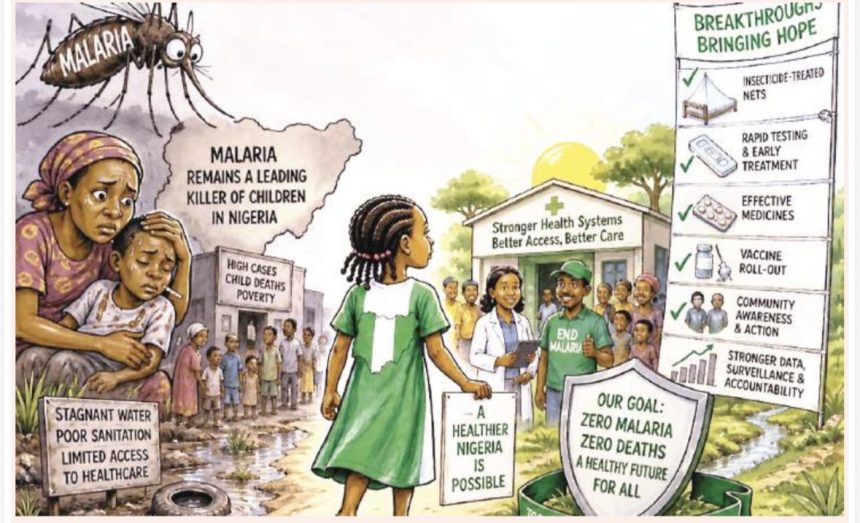
•Why disease still loses significant threat
Malaria continues to pose a significant public health threat in Nigeria, remaining a perilous disease that affects millions annually. In this report, VINCENT KURAUN examines the burden of malaria and the renewed calls by experts for intensified efforts to eradicate it.
On April 25, 2026, Nigeria joined the global community in commemorating World Malaria Day under the theme, “Driven to End Malaria: Now We Can. Now We Must.” This year’s campaign, led by the World Health Organization (WHO), served as a powerful reminder of the urgent need for collective action to combat malaria, particularly in sub-Saharan Africa where the disease remains most prevalent.
It would be recalled that, in a bid to stem the tide of malaria, the Federal Government granted provisional registration approval for the R21 malaria vaccine in April 2023, just days before that year’s World Malaria Day, observed annually on April 25.
As of April 2026, Nigeria has expanded its malaria vaccine rollout, reaching over 1.3 million children in Kebbi, Bayelsa, Bauchi, and Ondo states with the R21/Matrix-M vaccine. Following its initial launch in 2024, this four-dose vaccine, integrated into routine immunization for children under the age of two, has demonstrated a 50 per cent reduction in malaria-related hospitalizations.
Despite these gains, malaria remains a serious health challenge in the country, with an estimated 68 million cases and nearly 200,000 deaths in recent findings.
The WHO reports that Nigeria continues to bear the highest global burden of malaria, accounting for approximately 27 per cent of cases and 31 per cent of deaths worldwide. Recent estimates indicate over 68 million cases and nearly 200,000 fatalities, with children under five and pregnant women being the most vulnerable.
The report highlights that more than 500 individuals die daily from malaria in Nigeria, constituting roughly 55 per cent of all malaria cases in West Africa. The predominant species is Plasmodium falciparum, primarily transmitted by Anopheles mosquitoes.
The WHO concludes that, despite Nigeria’s initiation of the Oxford R21 malaria vaccine pilot program to address high mortality rates, challenges such as a large population, environmental factors (including vegetation and sanitation), and the sustainability of control measures across all regions impede elimination efforts.
As Nigeria confronts significant challenges in the fight against malaria, experts warn that unless drastic measures are implemented, this will continue to be a major public health concern.
Sunday Tribune spoke with a range of experts.
Dr. Charles Adedamola Adeogun, a prominent medical doctor and public health advocate, affirmed that Nigeria carries one of the highest malaria burdens in the world. He outlined several critical challenges in the ongoing battle against the disease.
“Nigeria still carries one of the highest malaria burdens globally, with major challenges including poverty and poor access to healthcare, inconsistent use of preventive tools like mosquito nets, drug resistance concerns, insecticide resistance among mosquitoes, and poor environmental sanitation.”
He further noted that, “delayed presentation to hospitals, overdiagnosis of malaria without proper testing, weak health infrastructure in rural communities, funding gaps for malaria control programs, industrial actions and strikes affecting continuity of care, and climate factors such as flooding and poor drainage also worsen mosquito breeding.”
Speaking about the update on the fight to eradicate malaria in Nigeria, a prominent consultant family physician at Tranquil and Quest Specialist Hospital in Lekki, Lagos, Dr. Adokiye Berepiki informed Sunday Tribune that, in an ambitious and vital effort to eradicate malaria, Nigeria has rolled out vaccines in various regions of the country.
According to him, the initiative represents a significant stride toward reducing the burden of this life-threatening disease that affects millions of Nigerians annually. “The introduction of vaccines is a game-changer in our fight against malaria. It not only enhances immunity but also complements existing prevention and treatment strategies.”
He pointed out that, alongside vaccination efforts, Nigeria has made remarkable advancements in the diagnosis and treatment of malaria, noting that improved diagnostic techniques, such as rapid diagnostic tests (RDTs) and enhanced microscopy, have enabled healthcare providers to identify malaria cases swiftly and accurately.
Emphasizing the importance of diagnosis, Dr. Adokiye noted, “Timely diagnosis is crucial. With improved diagnostics, we can start treatment promptly, which significantly reduces morbidity and mortality associated with malaria.
“Indeed, these improvements have led to a notable decrease in malaria-related deaths and complications in the country, but that doesn’t mean we have achieved enough in this fight, as more needs to be done to eliminate malaria in our environment.”
Responding to the cost of treating malaria today, particularly with the health sector under constant threat of strikes, Dr. Adeogun stated, “The cost varies depending on severity and where treatment is obtained.” He explained that treatment for uncomplicated malaria typically ranges from N3,000 to N15,000+, depending on consultation fees, laboratory tests, and medications, noting that costs may be higher in private hospitals.
He further stated that treatment for severe malaria requiring hospitalization can range from ₩50,000 to over N300,000, especially if blood transfusions, ICU care, dialysis, oxygen, or prolonged admission is necessary. “When healthcare strikes disrupt services, patients often turn to private hospitals, pharmacies, patent medicine vendors, or resort to self-medication.” According to him, this can increase costs due to delayed diagnosis, complications, improper drug use, and loss of income from missed work-days.
“The true economic burden of malaria extends beyond treatment; it includes transportation costs, absenteeism, reduced productivity, school absenteeism, and, in some cases, long-term disability or death.”
Also speaking with Sunday Tribune was a consultant and lecturer at Ekiti State University, Dr. Ajayi Olubukola. He echoed similar preventive measures previously mentioned by the other experts. He stated, “The use of long-lasting insecticide-treated nets and sprays, elimination of breeding sites, and vaccination are the most effective strategies for reducing malaria cases within communities.
Regarding the ongoing strikes in the nation’s health sector and the high cost of malaria treatment, he remarked, “Frequent strikes in the public sector compel patients to seek private facilities where costs are significantly higher. Additionally, self-treatment often occurs without accurate diagnosis, leading to varied out-of-pocket spending on malaria treatment.”
Dr. Ajayi further highlighted that Nigeria faces significant challenges in the fight against malaria, including increasing parasite resistance to antimalarial drugs, mosquito resistance to standard insecticides, and stalled progress due to a widening global funding gap and “siloed” vertical health programs that lack full integration.
When asked whether deaths from malaria have decreased in the past year or are on the rise, Dr Adeogun stated that globally and in Nigeria, malaria deaths have declined compared to previous decades due to improved interventions. However, progress has slowed significantly.
He cited a recent report from the WHO, stating, “According to recent estimates from the World Health Organization and Nigeria’s malaria program, Nigeria still accounts for a significant proportion of global malaria deaths. Deaths are not declining quickly enough, and in some areas, disruptions in healthcare access, inflation, poverty, and medication costs may worsen outcomes.”
On the demographics of the most affected individuals, Dr. Adeogun remarked, “Children under five and pregnant women remain the highest-risk groups. While there has been progress over time, Nigeria is not yet winning the battle at the pace required for elimination.
“Malaria should no longer be killing Nigerians in 2026; it is a disease that is preventable, testable, and treatable. Ending malaria requires government will and commitment, stronger health systems, environmental responsibility, and individual action.”
Turning to the preventive measures that are most effective in reducing malaria cases within communities, Dr. Adeogun reiterated that the most effective malaria prevention measures are still the simplest and most community-driven.
He noted the consistent use of insecticide-treated mosquito nets (ITNs/LLINs), especially for pregnant women and children under five, who are the most vulnerable. Indoor residual spraying in high-burden communities, where feasible, is also important.
He mentioned environmental sanitation practices such as draining stagnant water, clearing gutters, proper waste disposal, and reducing mosquito breeding sites. Additionally, he emphasized the importance of prompt testing before treatment, encouraging people to confirm malaria with rapid diagnostic tests or microscopy instead of self-medicating for every fever.
Dr. Adeogun further noted that intermittent preventive treatment in pregnancy (IPTp) for pregnant women attending antenatal clinics, improved housing infrastructure (such as window nets and screened doors), and community health education to dispel myths, discourage late presentations, and prevent the misuse of antimalarial drugs are crucial. He concluded that Nigeria must move from seasonal awareness campaigns to a year-round prevention culture.
Remarking on the strategies that should be implemented to enhance public awareness about malaria prevention and treatment, Dr. Adokiye noted that public awareness campaigns are vital components of Nigeria’s malaria eradication strategy.
“Raising awareness about malaria prevention and treatment is essential. We need to educate the public through physical campaigns, electronic media, and social media platforms to ensure that everyone understands the importance of preventive measures,” he stated.
According to him, engaging communities through informative sessions and utilizing platforms like radio, television, and social media can effectively spread knowledge about malaria and encourage individuals to take proactive steps.
Dr. Adokiye also emphasized that preventive strategies are equally important in the battle against malaria. “One of the most effective methods is vector control, primarily targeting mosquitoes, which are the primary carriers of the disease. The use of insecticide-treated nets (ITNs) and long-lasting insecticidal nets (LLINs) has proven successful in reducing malaria transmission.
“By ensuring that communities have access to treated nets, we can create a protective barrier against mosquito bites, especially for vulnerable populations such as children and pregnant women.”
He further stated other preventive measures:
“Another critical preventive measure is the elimination of stagnant water, which serves as breeding grounds for mosquitoes.
“Communities must be educated on the importance of preventing stagnant water collection,” Dr. Adokiye advises.
“This involves proper waste management and regular inspection of areas where water may accumulate, such as old tires, flower pots, and blocked gutters.” Indoor residual spraying (IRS) is another effective strategy that involves applying insecticides to the interior walls of homes to kill mosquitoes and prevent them from breeding.
Additionally, the use of intermittent preventive therapy (IPT) in pregnant women is a vital component of malaria prevention. Dr. Adokiye explains, “Pregnant women are at a higher risk of severe malaria, which can lead to complications for both mother and child.
“IPT offers protection during pregnancy and is a critical part of antenatal care. Health facilities must ensure that pregnant women receive appropriate IPT and that this preventive measure is well-communicated within communities.
“Prompt treatment with appropriate medications is essential following a laboratory diagnosis of malaria.” Dr. Adokiye stresses, “Once a diagnosis is confirmed, it’s imperative to begin treatment with effective antimalarial medications without delay.
“Delays in treatment can lead to severe complications and increase the risk of mortality. Healthcare providers must ensure that effective drugs, such as artemisinin-based combination therapies (ACTs), are readily available and accessible to those in need.”
In his concluding remarks, Dr. Adokiye said, “Nigeria’s multifaceted approach to ending malaria involves a combination of vaccination, improved diagnosis, treatment, public awareness campaigns, and preventive strategies. This is the only way we can turn the tide against malaria and ensure a healthier future for our nation.” He asserts that this comprehensive strategy not only aims to eliminate malaria but also to foster a healthier population equipped to thrive in a malaria-free environment. “With continued commitment and collaboration, Nigeria can look forward to a future free from the shadows of malaria.”
Reacting to the ongoing issue, residents of Oyo State, including Mrs. Adetutu Ariyo, a trader in one of Ibadan’s markets, highlighted that malaria is not a distant health concern but a persistent reality for her family. She explained that in her household, there is no specific time when the illness strikes.
“Anytime we notice symptoms, especially when it starts like a cold, we already know what to do,” she shared.
Instead of seeking hospital treatment, Mrs. Adetutu mentioned that her family relies on familiar over-the-counter medications. She explained that this decision is largely influenced by the high cost of medical consultations.
“Going to the hospital can be expensive, so we just buy the drugs we are used to,” she said.
Regarding preventive measures, Mrs. Adetutu noted that her household occasionally fumigates their living space to reduce the presence of mosquitoes and also tries to manage stress, which she believes contributes to falling ill.
In contrast, Mr. Iyiola Babatunde, a teacher, described his experience with malaria as infrequent, occurring roughly once a year. According to him, symptoms usually begin with a headache, but he promptly responds with medication.
“When I notice it, I take medication, and I feel better,” he explained.
ALSO READ: 2027: ‘Not a choice, but an obligation’, Atiku calls for opposition alliance
Like Mrs. Adetutu, his preventive approach centers on limiting exposure to mosquitoes and avoiding excessive stress.
Despite their different experiences, both respondents expressed shared concerns about the accessibility and affordability of malaria treatment. They urged the government to ensure that effective malaria medications are readily available to the public.
While malaria is often treated as a common illness, both Mrs. Adetutu and Mr. Iyiola warned that its complications can become severe if not properly managed. Their perspectives highlight a broader reality: for many Nigerians, malaria is not just a health issue but also an economic and social one, where the choice between professional healthcare and self-treatment is frequently dictated by cost and convenience.
WATCH TOP VIDEOS FROM NIGERIAN TRIBUNE TV
- Relationship Hangout: Public vs Private Proposals – Which Truly Wins in Love?
- “No” Is a Complete Sentence: Why You Should Stop Feeling Guilty
- Relationship Hangout: Friendship Talk 2025 – How to Be a Good Friend & Big Questions on Friendship
- Police Overpower Armed Robbers in Ibadan After Fierce Struggle


