
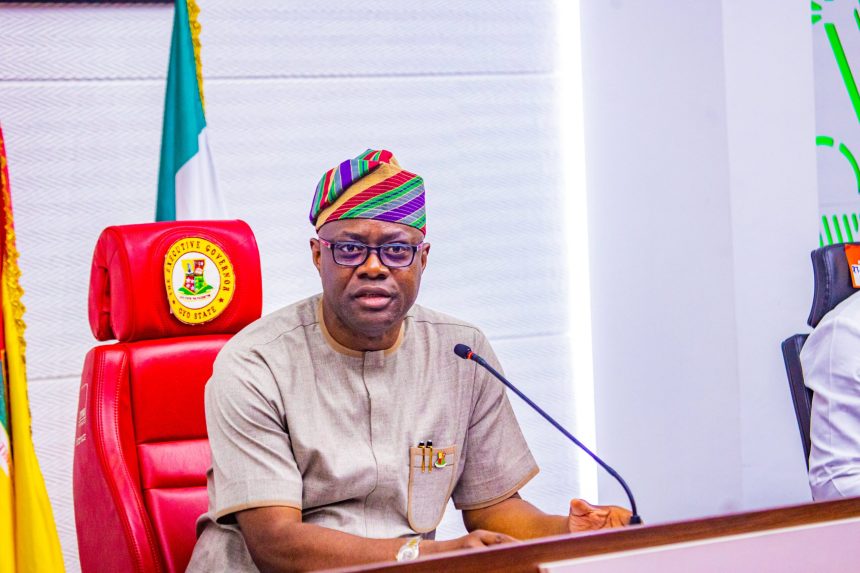
Oyo State Governor, Engr Seyi Makinde, has said Nigeria must move beyond viewing agriculture solely as food production and begin to treat the sector as a complete economic system capable of creating jobs, reducing food prices and strengthening rural economies.
Makinde stated this on Saturday while delivering the keynote address at the launch of the Agri-Connect Nigeria Country Compact held at the International Institute of Tropical Agriculture (IITA), Ibadan.
The event brought together the Minister of Agriculture and Food Security, Senator Abubakar Kyari; Jigawa State Governor, Umar Namadi; former Prime Minister of Ethiopia and Chairman of the CGIAR Board, Hailemariam Desalegn Boshe; World Bank and International Finance Corporation (IFC) representatives; development partners; researchers; and other agricultural stakeholders.
Agri-Connect is a global initiative designed to connect investment, innovation, policy and people towards building a more productive, inclusive and resilient agricultural sector.
Speaking on Nigeria’s agricultural potential, Makinde said the country had hardworking farmers, research institutions, young innovators and a large domestic market, but noted that several challenges continued to limit the sector’s contribution to the economy.
He said, “Nigeria does not lack agricultural potential. We have hardworking farmers, respected research institutions, innovative young people and a large domestic market.”
The governor, however, noted that many farmers remained poor, food prices were high and significant quantities of agricultural produce were lost before reaching consumers.
He said, “Many farmers remain poor, food remains expensive, and too much of what we produce is lost before it reaches the consumer.”
Makinde stressed that increasing production alone would not solve the challenges facing the sector, calling for an integrated approach that connects farmers to processing, storage, transportation, finance, research, technology and markets.
He said, “Agriculture must be treated as a complete economic system. Production must connect to research, extension efforts, finance, rural roads, storage, processing, standards, logistics and markets.”
According to him, failure in any part of the agricultural value chain would affect the entire system and ultimately increase the cost of food for consumers.
“If one part of that chain fails, the farmer earns less, the processor operates below capacity, and the consumer pays more,” he said.
The governor said the value of the Agri-Connect initiative would not be in creating another layer of programmes but in bringing relevant stakeholders together around a common delivery plan.
He said, “The value for Agri-Connect will lie in bringing government, research institutions, finance providers, development partners, farmers and private enterprises around a common delivery plan.”
Makinde also assured that Oyo State was ready to contribute its quota to the initiative, noting that the state had several businesses and institutions relevant to the programme.
He called on young Nigerians to consider agriculture as a viable career and business opportunity rather than a social obligation.
“We don’t want agriculture to just be for the older people. We want to attract young Nigerians because this is the new generation,” he said.
He added, “Agriculture will not be treated as a social obligation. It must offer a credible route to income, enterprise, technology and professional growth.”
Makinde further urged development partners and investors to look beyond Nigeria’s potential and focus on translating the country’s agricultural resources into measurable results.
“Our real measure of success will be what Nigerians can see afterwards: more productive farms, stronger businesses, better-paid jobs, reduced losses, increased processing, more affordable food and greater value within the economy,” he said.
Also speaking, the Minister of Agriculture and Food Security, Senator Abubakar Kyari, said Nigeria did not lack agricultural programmes, projects or investments, but needed better coordination and alignment among existing interventions.
Kyari said, “Nigeria really does not suffer from a shortage of agricultural programmes, projects or investments.”
According to him, substantial resources were already being committed to irrigation, roads, inputs, mechanisation, livestock, finance, land restoration, processing and market access across the country.
He said, “The greatest challenge is ensuring that these investments reinforce one another. Agriculture is a system, and when one part of that system is disconnected, the value of the investment elsewhere is diminished.”
The minister said the Nigeria Agri-Connect Compact would provide a framework for aligning existing investments behind shared national outcomes.
He said its objective was not to assemble projects under one name, but to establish deliberate connections between existing interventions and close gaps within the agricultural value chain.
Kyari said the initiative would focus on three major areas: strengthening the foundations for productive and resilient agriculture; improving the policy and regulatory environment for agricultural businesses; and developing a financial ecosystem that would expand access to capital.
He disclosed that the compact targets the creation of 2.5 million direct jobs by 2030, the provision of high-quality seeds and fertilisers to 9.5 million farmers, and the development of irrigation infrastructure covering 90,000 hectares.
The minister also stressed the importance of private-sector participation, saying Nigeria’s agricultural transformation must be private-sector-led and government-enabled.
“Government must create the conditions in which agriculture can attract investment, while private capital and enterprise will turn viable opportunities into value across our value chains,” he said.
The World Bank Representative and IFC Division Director for Nigeria and Central Africa, Mr Olivier Buyoya, identified underutilisation of arable land and limited access to finance as major constraints to the growth of Nigeria’s agricultural sector.
Buyoya said, “Nearly 25 per cent of Nigeria’s GDP comes from agriculture, and the sector employs about 29 million people. The country has significant land, a large domestic market and a strong base of farmers and entrepreneurs. But the sector is still operating below its potential.”
He noted that about 37 million hectares of arable land remained underutilised, while farmers and businesses continued to face constraints in accessing quality inputs, infrastructure, finance, technology and reliable markets.
Buyoya said the World Bank Group was ready to support Nigeria through financing, knowledge, advisory services, guarantees and partnerships.
He also disclosed that commercial banks and financial institutions currently contribute less than five per cent of commercial loans to agriculture, stressing the need to mobilise more private capital into the sector.
He said, “The aim is not simply to increase production. It is to strengthen the entire chain, from farm to market, and to turn Nigeria’s agricultural potential into better incomes, stronger businesses and more and better jobs.”
Buyoya urged stakeholders to ensure that the compact translates into practical results for farmers, businesses and communities.
“Success will not be measured by the number of initiatives announced. It will be measured by whether farmers can get better inputs and reach real markets, whether businesses can invest, expand and create jobs, and whether families have better access to nutritious food,” he said.
In his goodwill message, former Prime Minister of Ethiopia and Chairman of the CGIAR Board, Hailemariam Desalegn Boshe, said the participation of the Federal and State Governments was significant to the success of the initiative.
He stressed the need for national direction and state-level implementation to reinforce each other, while development partners, researchers, financial institutions and businesses align their support with Nigeria’s agricultural priorities.
The Governor of Jigawa State, Umar Namadi, reaffirmed his administration’s commitment to making agriculture a major driver of economic growth, job creation, food and nutrition security, and youth empowerment.
Namadi said the partnership would focus on unlocking Jigawa’s agricultural potential by connecting farmers and young entrepreneurs to science, technology, finance, markets and modern mechanisation.
Earlier, the Director-General of IITA, Ibadan, Dr Simeon Ehui, said the Country Compact provided an opportunity to deepen partnerships linking agricultural research with practical solutions and investment.
He said bringing together government leaders, development partners, researchers and private-sector stakeholders would help strengthen food security and build a more resilient agricultural sector in Nigeria.
WATCH TOP VIDEOS FROM NIGERIAN TRIBUNE TV
- Relationship Hangout: Public vs Private Proposals – Which Truly Wins in Love?
- “No” Is a Complete Sentence: Why You Should Stop Feeling Guilty
- Relationship Hangout: Friendship Talk 2025 – How to Be a Good Friend & Big Questions on Friendship
- Police Overpower Armed Robbers in Ibadan After Fierce Struggle


