
For decades, financial exclusion has remained one of the less visible barriers holding back rural women, smallholder farmers and persons with disabilities in northern Nigeria. While these groups contribute significantly to agriculture, food processing, trading and local commerce, many have operated outside the formal financial system, relying largely on cash transactions, informal savings and low-return labour.
The Women Farmers Advancement Network (WOFAN) is attempting to change that reality with a financial inclusion model that goes beyond simply distributing grants. At the centre of the approach is an idea that could become increasingly important to rural development in Nigeria: prepare vulnerable producers to attract and manage larger pools of capital through savings, cooperative structures, grants, revolving funds and, eventually, crowdfunding and formal credit.
The organisation’s experience between 2025 and 2026 provides an interesting case study of how community-based financing can potentially create a bridge between informal economic activity and the formal financial sector. According to a WOFAN financial inclusion briefing, the organisation has disbursed N207.58 million to 147 women’s cooperative clusters across Kano, Kaduna, Jigawa, the Federal Capital Territory, Bauchi and Gombe.
The programme has also facilitated more than 90,000 bank accounts for previously unbanked women, while 12,750 persons with disabilities are targeted under the broader ICON2 programme.
The figures are significant, but the more important story is not necessarily the amount of money distributed. It is the financial architecture WOFAN is attempting to build around the beneficiaries.
Moving beyond the grant mentality
Traditional development interventions often face a familiar challenge: beneficiaries receive financial assistance, use the money to establish or expand an enterprise, and then remain dependent on another intervention when the initial capital is exhausted. WOFAN’s model seeks to break that cycle. The organisation’s approach starts with groups of about 30 people, savings, bookkeeping and collective responsibility before beneficiaries progress to larger financial support. In other words, the grant is positioned not as the end of the intervention but as a test of whether beneficiaries can manage capital responsibly.
This distinction is crucial to understanding the organisation’s crowdfunding ambitions. Crowdfunding works best when an entrepreneur or group can demonstrate that there is a viable business, a credible management structure, financial discipline and a convincing proposition to potential investors or contributors. A rural woman who has never operated a bank account or kept business records is unlikely to be immediately attractive to formal lenders or crowdfunding platforms. WOFAN is therefore trying to create the evidence required before beneficiaries approach the next level of financing.
The process is deliberately staged. Of the N207.58 million disbursed, N154.35 million, or 74.4 per cent, went to all 147 clusters in the first round. The second round amounted to N28.03 million and went to 33 clusters, while 12 high-performing clusters received a further N25.20 million in the third round.
That structure introduces an important principle into community financing: capital follows performance. Rather than treating every beneficiary as an automatic recipient of increasingly larger grants, WOFAN appears to reward savings discipline, record keeping, collective enterprise and the capacity to manage additional capital.
Significance of the N4.35 million milestone
The 12 clusters that completed the three-stage process accumulated approximately N4.35 million each, representing a combined N49.3 million, or 23.7 per cent of the entire portfolio. This is where the model begins to move from conventional grant-making into investment readiness.
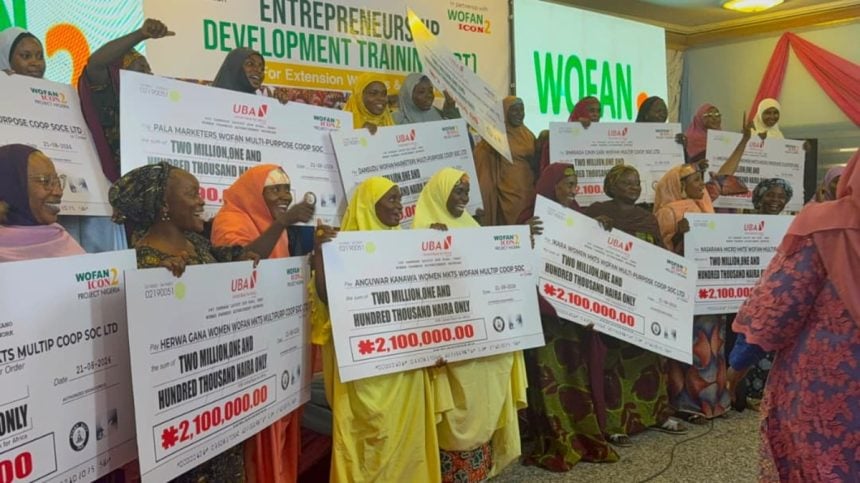
On August 21, 2026, the 12 high-performing clusters received UBA presentation cheques of N2.1 million each, issued in the legal names of their cooperatives. The cheques were presented under the WOFAN-ICON2 programme and the instruments were payable through UBA’s Danbare Layout, BUK Road, Kano branch. The symbolism of putting a cooperative’s legal name on a bank instrument should not be underestimated.
For someone previously operating as a farm labourer or roadside trader, the transition from receiving daily cash wages to controlling capital through a registered cooperative account represents a fundamental change in economic identity. The beneficiary is no longer simply a recipient of assistance. She becomes part of a financial institution’s potential customer base. This is particularly important because WOFAN’s strategy is designed around the proposition that beneficiaries who demonstrate the ability to manage grants can eventually manage loans.
That transition could create a pipeline of rural borrowers with records that banks and other financiers can assess.
Why crowdfunding matters
The most interesting element of the model is WOFAN’s explicit recognition that grants cannot sustain enterprise growth indefinitely. The organisation says beneficiaries are being prepared for crowdfunding and formal credit through training in business pitching, savings, bookkeeping and financial management. Its stated progression is to organise beneficiaries into groups and clusters, open bank accounts, demonstrate financial discipline through staged grants, access revolving capital and eventually pitch for crowdfunding or approach formal lenders.
This represents a potentially important shift in how development finance can be approached.
Crowdfunding could provide rural enterprises with an alternative source of capital at a point where traditional bank lending may still be difficult to access. More importantly, a successful crowdfunding campaign could provide market validation for an enterprise.
But crowdfunding is not simply another word for grants. A grant is generally provided without the expectation of repayment, while crowdfunding can involve donations, rewards, pre-orders, equity or other forms of financial participation depending on the platform and regulatory framework.
Therefore, WOFAN’s current experience should more accurately be described as preparing beneficiaries for crowdfunding, rather than suggesting that the N207.58 million already represents crowdfunding capital. That distinction is important when assessing the sustainability of the initiative.
From individual businesses to collective investment
One of the strongest features of the WOFAN approach is its emphasis on collective enterprise. Individual rural entrepreneurs often struggle to raise sufficient capital to purchase machinery. But when thousands of farmers pool savings, the financial equation changes. The briefing cites mega-clusters of about 3,000 farmers that have pooled N27 million towards a multi-crop harvester, representing half of the machine’s cost, and N9 million towards tractors, with WOFAN providing matching support.
This demonstrates how financial inclusion can move beyond opening bank accounts. A bank account by itself does not transform an enterprise. Its value emerges when it becomes part of a broader financial system through which people save, borrow, invest, purchase productive assets and build credit histories.
The machinery-pooling example shows the possibility of transforming small individual savings into collective productive investment.
Geography also reveals an important lesson
The distribution of WOFAN’s funds across states demonstrates that the number of beneficiaries is not necessarily the same as the value of financing received.
Kano had the largest number of clusters, with 47, followed by Kaduna with 41 and Jigawa with 33. Together, the three states accounted for 121 clusters, or 82.3 per cent of the portfolio. Yet Kaduna received approximately N66.49 million compared with Kano’s N62.84 million.
More revealing is Gombe. The state had only five clusters but received approximately N15.15 million, equivalent to 7.3 per cent of total funding, because three of its five clusters reached the maximum cumulative level of N4.35 million.
The lesson is straightforward: performance, rather than simply beneficiary numbers, can determine access to additional capital.
That principle could become particularly useful if WOFAN’s beneficiaries eventually seek external investment.
Inclusion cannot stop at the bank door
Another significant aspect of the programme is its focus on persons with disabilities.
Under the Mastercard Foundation-backed ICON2 programme, 180 persons with disabilities in Dorawar Sallau, Garun Mallam Local Government Area of Kano State, were organised into six groups of 30.
They received a N1.8 million start-off grant, opened UBA accounts and began making monthly savings. Each group subsequently received ?300,000 through WOFAN’s Credit and Equipment Revolving Scheme. Twenty beneficiaries also received special-needs tricycles.
This is significant because financial inclusion is often narrowly defined as access to bank accounts.
For a person with mobility challenges, however, opening an account does not necessarily mean being able to participate effectively in the marketplace.
WOFAN’s provision of mobility support alongside financial services recognises that accessibility is part of the financial inclusion equation. The broader ICON2 programme is designed to reach 675,000 young people across nine states and the FCT over five years, with at least 12,750 persons with disabilities among them.
ALSO READ: Dangote IPO fever sends NGX Group shares up 21.6 percent SEC warns investors
The bigger test is sustainability
Despite the encouraging figures, WOFAN’s model still faces questions that will determine whether it can become a sustainable financing pathway.
The first is whether beneficiaries can maintain their savings and businesses after grant support declines. The second is whether banks and crowdfunding investors will consider their records sufficiently credible to justify larger financing.
There are also structural challenges. The briefing itself acknowledges constraints including limited female ownership of land, rising climate risks and the high cost of formal credit.
These challenges cannot be solved through grants alone. For crowdfunding to become meaningful, beneficiaries will need bankable business proposals, reliable financial records, transparent cooperative governance, clear ownership structures and credible mechanisms for managing investors’ expectations.
There is also a need for sustained financial literacy. Managing N2.1 million within a cooperative is very different from successfully managing a much larger investment raised from external contributors.
A model worth watching
WOFAN’s financial inclusion programme offers a potentially important lesson for development practitioners and financial institutions: the pathway to finance may be as important as the finance itself.
The organisation is attempting to move rural women from cash-based livelihoods to savings, from savings to grants, from grants to revolving credit, and ultimately from revolving credit to crowdfunding and formal lending.
Its stated philosophy is therefore less about creating permanent grant beneficiaries and more about producing financially visible entrepreneurs.
The evidence presented in the briefing shows that this transition is already taking shape. Women who once worked as farm labourers, food vendors, loaders and processors are building cooperative capital, operating bank accounts and receiving financial instruments in their organisations’ names.
More than 90,000 bank accounts have reportedly been facilitated for previously unbanked women, while collective savings are beginning to finance productive machinery.
The next chapter will determine whether the model can successfully cross the most difficult bridge: from donor-supported capital to commercially sustainable finance.
If the 12 clusters that have completed the three stages can successfully deploy their cumulative N4.35 million capital bases, maintain their savings discipline and demonstrate growing enterprises, they could become more than beneficiaries. They could become proof that rural cooperatives can graduate into credible investment propositions.
And that may ultimately be WOFAN’s most important contribution to financial inclusion: not merely putting money into the hands of excluded communities, but helping them build the records, confidence, institutions and collective bargaining power needed to attract the next naira of investment.
WATCH TOP VIDEOS FROM NIGERIAN TRIBUNE TV
- Relationship Hangout: Public vs Private Proposals – Which Truly Wins in Love?
- “No” Is a Complete Sentence: Why You Should Stop Feeling Guilty
- Relationship Hangout: Friendship Talk 2025 – How to Be a Good Friend & Big Questions on Friendship
- Police Overpower Armed Robbers in Ibadan After Fierce Struggle


