
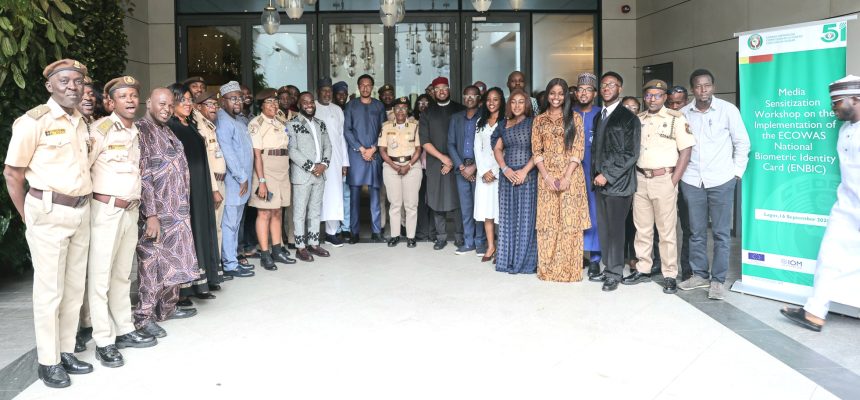
The rollout of the ECOWAS National Biometric Identity Card (ENBIC) marks a definitive watershed moment for West African integration, aiming to simplify cross-border mobility while maintaining a strict equilibrium with national security.
This was the focal point on Wednesday in Lagos during a media sensitization workshop on the ENBIC initiative.
The one-day event brought together key stakeholders from the Nigeria Immigration Service (NIS), the ECOWAS Commission, the International Organization for Migration (IOM), and members of the press across print, electronic, and online platforms to drive public awareness for the biometric project.
ALSO READ: Take your matriculation oath seriously, EKSU VC tells students
Organized under the Free Movement of Persons and Migration in West Africa Phase II (FMM II) Project, the collaborative workshop emphasized that the ENBIC -which serves same purpose with ECOWAS Passport within the subregion-is a critical milestone designed to enable safe, orderly, and rights-based regional migration.
Speaking on behalf of the Comptroller General of the NIS, Kemi Nana Nandap, the Assistant Comptroller General (Passports and Other Travel Documents), Titilayo Olaiya, declared that the card serves as a vital tool for economic and social alignment.
She noted that while the deployment fulfills statutory obligations under the ECOWAS Protocol on Free Movement, Nigeria will not compromise its borders.
“Our operational mandate requires managing a delicate equilibrium between enabling friction-free regional travel and strictly preserving the integrity and security of Nigeria’s borders,” Olaiya stated.
Echoing this sentiment, Obinna Ajugwo, representing ECOWASCommission’s Border Management division, stressed that the ENBIC, which is renewable every five years, addresses modern mobility challenges like cross-border crime and irregular migration.
By harmonizing identification across member states, the card acts as “a symbol of belonging, a tool for inclusion, and an enabler of safe, secure, and efficient movement,” Ajugwo noted.
The international community strongly backed the initiative. Ali Ali Ibrahim, Head of the IOM Sub-office in Lagos, praised Nigeria’s leadership in implementing regional instruments.
Ibrahim highlighted that the ENBIC aligns firmly with the Global Compact for Migration (GCM) by strengthening identity systems, improving regular migration pathways, and enhancing border management frameworks.
He added that the success of the initiative, which Nigeria adopted in 2025, will ultimately be measured by how effectively it contributes to safer mobility and stronger regional integration.
A central theme across all three institutional voices was the indispensable role of the press in educating West African citizens.
Officials warned that gaps in public awareness leave room for confusion and exploitation at regional entry points.
The NIS challenged journalists to use operational insights to shape accurate public narratives, noting that an identity project of this magnitude cannot succeed in a vacuum.
Olaiya pointed out that processing the card is seamless and fast, as applicants can apply online from the comfort of their homes and only need to appear physically at a chosen NIS office for biometric capture and card issuance.
“The total cost implication is N35,500,” she noted.
The ECOWAS Commission described the media as the ultimate bridge between regional institutions and community citizens, vital for building public trust.
Similarly, the IOM urged responsible journalism to counter misinformation, promote an understanding of citizens’ rights, and amplify the positive experiences of border communities, traders, and youth.
Moving forward, the NIS assured stakeholders of an open-door policy as West Africa navigates the implementation phases of this regional biometric project, aiming for a future where regional mobility drives shared economic development.
Speaking on stakeholder inputs to drive the project, panelists including the Deputy National President of the Nigeria Union of Journalists (NUJ), Abimbola Oyetunde, and the Deputy National President (Administration) of the Road Transport Employers Association of Nigeria (RTEAN), Muhammad Abubakar, underscored the roles of their respective sectors in driving the initiative.
They noted that if well utilized, the ENBIC will significantly enhance smooth cross-border travel, commerce, and integration across ECOWAS member countries.
WATCH TOP VIDEOS FROM NIGERIAN TRIBUNE TV
- Relationship Hangout: Public vs Private Proposals – Which Truly Wins in Love?
- “No” Is a Complete Sentence: Why You Should Stop Feeling Guilty
- Relationship Hangout: Friendship Talk 2025 – How to Be a Good Friend & Big Questions on Friendship
- Police Overpower Armed Robbers in Ibadan After Fierce Struggle


