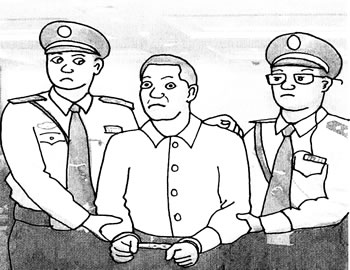
T HE concept of bail is highly essential in the administration of criminal justice in Nigeria and beyond. The reason for its importance is well settled in law as a person who is accused of certain offences is considered innocent until he has been proven guilty in the law court. If a person arrested on the suspicion or allegations that he has committed a crime, the position of the law is that such a suspect must not be unduly detained in police custody or in the custody of other law enforcement agents, as a form of punishment, because the mere fact that a person has been alleged to have committed an offence does not necessarily mean that he is guilty of the offence.
Section 35 (1) of the 1999 Constitution of the Federal Republic of Nigeria, 1999(as amended) guarantees the right to personal Liberty of all Nigerians while Section 35 (5) provides that an accused person who has been arrested on the allegation of having committed an offence must be charged to court within 24 hours where a court of competent jurisdiction is located within a radius of 40 kilometers from the police station; and where a court is located within a radius above forty kilometres form the police station, the accused person must be charged to court within 48 hours or such longer period as the court might consider reasonable. Although several factors are usually taken into cognizance before a suspect is admitted to bail, bail remains the right of every accused person. It must be emphasised that the fact that a suspect or an accused person has been admitted to bail, does not indicate that he or she has been exonerated from the offence(s) made out against him/her.
Having examined the constitutional foundation of bail in Nigeria above, it is crucial to briefly discuss types of bail, other provision of the law governing the granting of bail, and the judicial attitude of the courts in Nigeria towards granting of bail. There are two major types of bail: (a)police bail (b)court bail under section 27 (1) of the Police Act, the police are empowered to grant bail to a suspect who has been arrested pending the trial of such a suspect, except in cases involving capital offences or an offence punishable with death, as this power can only be exercised by the High Court. It therefore follows that where a suspect has been arrested by the police for an offence other than a capital offence, such a suspect is expected to be granted bail by the police within the maximum period of 48 hours. Unfortunately, this is not usually the case in Nigeria, as the police are very notorious for keeping suspects in their custody on the simple reason that they are yet to conclude investigation, and the practice by the police to detain suspects if they are unable to pay bail money to them, this is serious and illegal as well as unlawful.
Section 17 (1) of the Administration of Criminal Justice Law of Lagos State 2011, which is also the same with Section 17(1) of Ekiti State Administration of Criminal Justice Law, 2014 provides thus: “When a person has been taken into police custody without a warrant for an offence other than an offence punishable with death, an officer in charge of a police station shall release the person arrested on bail subject to subsection (2) of this section if it will not be practicable to bring the person before a court having jurisdiction with respect to the offence alleged within twenty-four hours after the arrest.”
It is clear and obvious that the practice of the police and other law enforcement agents to detain suspects in their custody for over 48 hours without charging them to a court of competent jurisdiction is unconstitutional and unlawful as it violates the statutory provisions cited above. For the sake of clarity, the Court of Appeal in the case of FAJANA EDDI – V – COP, it was held that it was unconstitutional and contrary to the provision of Section 35(4) of the Constitution of the Federal Republic of Nigeria, 1999 (as amended) for the police authorities to have detained the accused person and kept him in custody for two years without a formal charge being preferred against him at the High Court. In this case, the accused person was a final year Higher National Diploma (HND) student of the Federal Polytechnic Offa, Kwara State and he was arrested in the course of writing his examination at the polytechnic on the allegation of being a member of a secret cult contrary to Section 17 (1) of the Secret Cult and Secret Societies in Education Institutions (Prohibition) Law, 2004, Kwara State.
Bail by the police is expected to be free because the law does not want a presumed innocent person in its eyes, to pay money to any authority or to be exploited by any authority. Unfortunately, police officers usually demand for money from suspects before they release them on bail in practice. Both the Magistrate and the High Court have powers to grant bail to an accused person and this power must be exercised judicially and judiciously. The meaning of this is that the court must consider the facts of every case and the materials which have been placed before it by the Accused before deciding whether or not to grant the accused person bail. There are two basic instances in which a court can be called upon to grant bail to an accused person and they are; (i) bail pending trial of the accused person (ii)bail pending appeal.
In respect of (i) above, all the applicant need do is to adduce evidence showing that he has fulfilled all the requirements for the grant of bail, and once he has been able to fulfil these requirements, it is the duty of the trial court to admit him to bail as seen in Felix Ikhazuagbe – V – Cop And Ogbuawa – V – FRN. While in roman figure (ii) above, Section 28 of the Court of Appeal Act, empowers the Court of Appeal with the power to grant bail pending appeal, but this power is discretionary and must be exercised upon the existence of special or exceptional circumstances.
- Oluwanisomo, a legal practitoner, is based in Ado-Ekiti, Ekiti State.
WATCH TOP VIDEOS FROM NIGERIAN TRIBUNE TV
- Relationship Hangout: Public vs Private Proposals – Which Truly Wins in Love?
- “No” Is a Complete Sentence: Why You Should Stop Feeling Guilty
- Relationship Hangout: Friendship Talk 2025 – How to Be a Good Friend & Big Questions on Friendship
- Police Overpower Armed Robbers in Ibadan After Fierce Struggle