
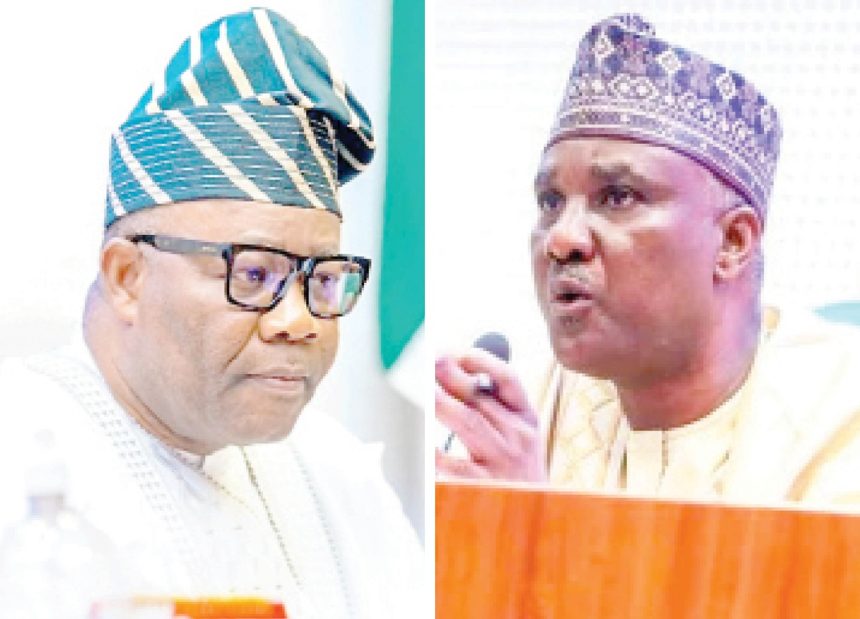
Kehinde Akintola, in this report, examines the ongoing legislative processes in respect of the sixth alteration of the 1999 Constitution by the 10th session of the National Assembly, declaring that the bill may not see the light of day before the 2027 general elections.
CRITICISMS have continued to trail the legislative process on the sixth alteration of the 1999 Constitution by the 10th session of the National Assembly. The uncertainty as expressed by various stakeholders including Civil Society Organizations bothers on how many of the proposed constitution reforms can realistically become law before the 2027 general elections. For the records, a budgetary provision of N1billion is statutorily approved annually for each of the adhoc committee set up on Constitution Review by the Senate and House of Representatives. This has been the practice at least in the last two assemblies over.
But the current uncertainty is not just about whether there is still time in the life of the 10th National Assembly to achieve its purpose, rather, the question bothers on the number of constitutional hurdles left to be covered as the time thins out.
Each of the proposed bills must secure the support of at least two thirds of the members of the Senate and the House of Representatives, apart from the mandatory requirement for positive votes from at least 24 of the nation’s 36 states Houses of Assembly of an Assembly.
The 10th National Assembly had initially projected that the constitutional review exercise would be concluded by December 2025. That target was missed, and by April 2026, civil society groups were already expressing concern that the approach of the 2027 elections could increasingly compete with the reform agenda for legislative attention.
Confusion was, however, ignited in September when the office of the Clerk to the National Assembly announced that it has transmitted the constitution amendment bills to the states. It later emerged that what was transmitted was the State Police bill, which was a component of the constiturion amendment bills before it was pulled out for special treatment because of the urgency attached.
The National Assembly had identified 37 priority constitutional alteration bills from a much larger pool of proposals, ranging from electoral reforms, judicial administration, security and policing, local government autonomy, women’s representation, devolution of powers, fiscal accountability, traditional institutions and other institutional reforms. Among the reforms still in contention are proposals that could significantly reshape the Nigerian political and governance system.
But while the review began as a broad constitutional reform exercise, only one of the major amendment proposals has so far crossed the crucial National Assembly-to-state-legislature threshold: the proposal to establish State Police Services.
The State Police Bill was passed by the Senate on June 24, 2026, and subsequently by the House of Representatives on July 23, 2026. It was then transmitted to the 36 State Houses of Assembly on September 16, 2026 for consideration and approval. The National Assembly said the transmission was made pursuant to Section 9 of the 1999 Constitution which provides that an ordinary constitutional alteration must first secure the support of not less than two-thirds of all members of each chamber of the National Assembly and then be approved by resolutions of the Houses of Assembly of not less than two-thirds of all the states.
ALSO READ: Pension assets hit N31.8trn as PenCom records N3.8trn growth in 8 months
The relevance of the ongoing constitution amendment becomes more essential as political parties prepare for the 2027 electoral cycle. The Independent National Electoral Commission (INEC) has already formally commenced the 2027 electoral process. The Commission had announced February 20, 2027 for the Presidential and National Assembly elections and March 6, 2027 for Governorship and State House of Assembly elections. The Commission also warned of the need for timely action on pending electoral legislation because delays could create logistical and implementation challenges. That electoral timetable puts the constitutional review on a narrowing political and legislative runway.
Even if a constitutional amendment is passed by the National Assembly, the process must still accommodate state-level consideration, the return and collation of resolutions and the subsequent constitutional procedure before the amendment can take effect.
The problem becomes more pronounced where an amendment requires extensive institutional preparation after assent. Changes to electoral arrangements, judicial procedures, local government administration or policing cannot necessarily become operational merely because constitutional text has been altered. They may require consequential legislation, regulations, institutions, funding arrangements and administrative preparation.
There is also the question of political attention. As 2027 approaches, lawmakers will increasingly have to combine legislative responsibilities with constituency activities, party engagements and the campaign for 2027 general elections. This was precisely the concern raised by Policy and Legal Advocacy Centre Executive Director, Clement Nwankwo, who warned in April that political calculations were beginning to compete with the constitutional reform agenda. He recalled that the National Assembly had originally been expected to complete the process by December 2025.
The constitutional review process itself began with extensive consultations. The National Assembly’s review documents state that 12 zonal public hearings were conducted across the six geopolitical zones, alongside consultations involving citizens, traditional rulers, political parties, civil society organisations, women’s groups, youth leaders, professional bodies and security-sector representatives.
For the remaining constitutional bills, the challenge is greater. They must first complete consideration in the Senate and House of Representatives, secure the required majorities in both chambers, be transmitted to the states, obtain approval from at least 24 State Houses of Assembly and then proceed through the final constitutional procedure.
Ultimately, the 2026 constitutional review has reached the point where procedure, time and political attention intersect. The National Assembly still has a constitutional window within its tenure, but the 2027 electoral timetable is already active. The outcome will depend on whether the federal legislature can move the outstanding bills through both chambers, whether the state legislatures can consider and resolve transmitted proposals, and whether sufficient institutional time remains to complete the process before the election cycle dominates the national legislative agenda.
With the 2027 elections already fixed on the national calendar and only the State Police proposal having reached the state concurrence stage, uncertainty remains over how much of the ambitious constitutional reform agenda of the 10th National Assembly will make it into the Constitution before Nigerians go to the polls.
While venting his view on the prolonged delay in the consideration and passage of the Constitution Review bills, Advocacy Officer, West Africa Democracy Solidarity Network, Austin Aigbe who argued that the “Constitutional amendment in Nigeria has become a jamboree”, posited that the exercise “has become an opportunity to, in quotes, share the money.” While noting that majority of the Constitutional amendment does not start in real time. “A regime that will be closing their time at the National Assembly by June of next year is just now sending proposals to the States, and not even all. Apart from the State Policing Reform bill, which of course is backed by the President himself, all other bills are almost inconsequential to the National Assembly. At the end of the day, the only one that may be passed may be the State Police bill. They’ve not even transmitted the specials. The State Police bill, up to date, the National Assembly that came on board in June of 2023, we have 2024, we have 2025, we have 2026 June, less than 100 days by tomorrow to be 100 days to election. You are now trying to meet certain thresholds, particularly the State Police. And that is why people are saying the State Police is political, because it seems to be targeting the election. So you want to quickly rush the State Police, but if they’ve got the threshold for the passage by the States, you quickly clean it up and send it to the President for assent, and you have amended the Constitution. Well, for me, I would like to recommend to the National Assembly, history has a way of reminding people that things you don’t do when you have the opportunity. I would advise, the leadership of National Assembly to set deadline for themselves, set deadline for the States. Agree on the alteration that need to happen, which of course has already happened. Constitution Committee has met, they’ve identified the proposal that need to go. Send all of those proposals to the State immediately. Vote a ‘yes’ on all and let the States determine the course of action. While waiting for the National Assembly to vote a ‘yes’ on any of those bills, will not even have the opportunity of happening now. They only come, do one important thing as motivated by whoever controls them. Imagine coming to just extend the (2025) budget and went back when there are other important bills in the National Assembly. They should set the deadline for themselves. Between now and December, the States would have responded to XYZ bill that had been sent.
“For me, by this month end, the State Police bill should have been returned, cleaned up and sent to the President, so that we know that they’ve done the State Police bill, even though I know that there will be all manner of issues with it. So I think for the National Assembly to write its name even on the sand, not even on the stone, they’ve got to show course why the billions of Naira allocated for the constitutional review process is worthwhile, that Nigerians will not call them out especially those in the National Assembly now who may return in the 11th Senate,” Aigbe warned.
2027 electoral cycle is becoming a serious distraction —CISLAC
Speaking exclusively with Nigerian Tribune, Executive Director, Civil Society Legislative Advocacy Centre (CISLAC), Auwal Ibrahim Rafisanjani, who observed that the constitutional review remains an important opportunity to strengthen Nigeria’s democracy, federal structure, security, inclusion and institutional accountability, however, noted that its success must be measured by reforms delivered, not hearings conducted.
While frowning at the slow pace of the review exercise, he lamented that the “process has been strong on consultation but slow on legislative delivery. State Police has made the clearest progress, while major reforms on elections, local government, women’s representation, judicial independence, devolution of powers and fiscal accountability remain unresolved. With the 2027 elections approaching, further delay is dangerous.”
Commending the regional hearings initiated by the Parliament which created space for Citizens’ participation, he posited that attendance alone is not enough. Nigerians need to know which recommendations influenced the amendments and why others were rejected. Participation must also reach rural communities, women, young people, persons with disabilities and other underrepresented groups.
He maintained that public hearings are useful only if they influence final decisions. The National Assembly should publish a clear feedback report showing citizens’ proposals, committee decisions and reasons for accepting or rejecting them. Public consultation must not become a ceremonial exercise.
Reflecting on the 12 thematic priorities, Rafisanjani who argued that the 12 thematic areas are broadly adequate, however stressed that “greater urgency is required on electoral reform, State Police safeguards, devolution of powers, fiscal federalism, local government autonomy, judicial independence, women’s political representation and institutional accountability.”
The proposals reflect many public concerns, but the real test is whether difficult reforms survive political interests. Nigerians will lose confidence if politically convenient amendments move quickly while reforms that strengthen accountability and inclusion are abandoned.
The CISLAC chieftain, who averred that the Constitutional review remains on the agenda, however lamented that the 2027 electoral cycle is becoming a serious distraction. The National Assembly must prove its commitment through votes, deadlines and transmission of amendments—not public assurances.
While acknowledging that some political will has been demonstrated, he however argued that such attitude is not enough to guarantee completion. Partisan interests, election campaigns, bicameral disagreements and resistance from vested interests could derail the process. Constitutional reform must serve Nigeria’s democracy, not the political calculations of 2027.
As a matter of urgency, the CISLAC boss tasked the National Assembly on the need to “immediately publish a clear timetable, conclude voting on major outstanding reforms, harmonise Senate and House positions, strengthen engagement with State Houses of Assembly and publicly disclose the status of every amendment.”
While stressing the need to set a definite timeline for completion of the ongoing alteration of the Constitution, he expressed optimism that the “completion is still possible, but the window is closing rapidly. The period after the October 13 resumption must be treated as a decisive reform window. Business as usual will not deliver meaningful constitutional change before election politics dominates the national agenda.”
In the bid to accelerate the legislative process, CISLAC helmsman urged National Assembly to immediately “Publish a binding timetable for voting, harmonisation and transmission of amendments; Prioritise transformational reforms on elections, devolution, local government, judiciary, political inclusion, security accountability and fiscal transparency as well as Guarantee full transparency by publishing decisions and voting records at both National and State Assembly levels.
“Nigeria does not need another constitutional review that ends with consultations and political speeches. The real measure of success is whether the Sixth Alteration produces reforms that make institutions stronger, elections more credible, security more accountable and public officials more answerable to Nigerians.”
WATCH TOP VIDEOS FROM NIGERIAN TRIBUNE TV
- Relationship Hangout: Public vs Private Proposals – Which Truly Wins in Love?
- “No” Is a Complete Sentence: Why You Should Stop Feeling Guilty
- Relationship Hangout: Friendship Talk 2025 – How to Be a Good Friend & Big Questions on Friendship
- Police Overpower Armed Robbers in Ibadan After Fierce Struggle


