Tribune OnlineTribune OnlineTribune Online
  • Home
  • News
  • Columns
  • Editorial
  • VIDEOS
  • Entertainment
  • Politics
  • Health
  • Opinions
  • SPORTING TRIBUNE
Reading: What to know about violence that marked Kenya’s protest anniversary
Share
Notification Show More
Font ResizerAa
Tribune OnlineTribune Online
Font ResizerAa
  • Home
  • News
  • Columns
  • Editorial
  • VIDEOS
  • Entertainment
  • Politics
  • Health
  • Opinions
  • SPORTING TRIBUNE
  • About Us
  • Contact us
  • Disclaimer
  • Privacy Policy
  • Advertise
Have an existing account? Sign In
Follow US
© 2026 African Newspapers of Nigeria Plc. All Rights Reserved. | Disclaimer | Privacy Policy | Editorial Policy | Corrections Policy | Terms & Conditions
Home » What to know about violence that marked Kenya’s protest anniversary
World News

What to know about violence that marked Kenya’s protest anniversary

Rowland Kpakete
June 26, 2025
Share
What to know about violence that marked Kenya’s protest anniversary
Add as a preferred source

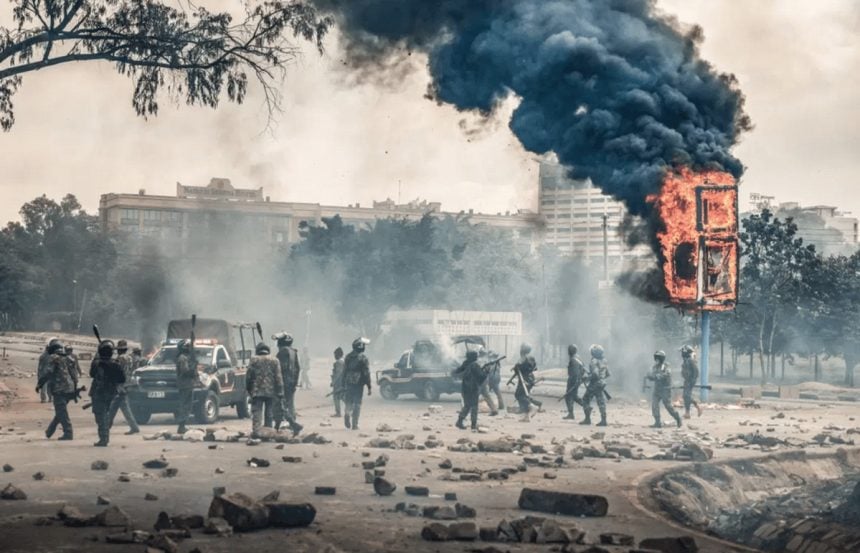
What began as a peaceful march to commemorate the deadly anti-tax protests of 2024 turned into one of Kenya’s most violent days this year. 

On Wednesday,  thousands of people—mostly young demonstrators—took to the streets in Nairobi and 26 other counties for a National Day of Remembrance. The protest, meant to honor those who died a year ago, quickly escalated into deadly clashes with police.

By the end of the day, at least 16 people had been confirmed dead, over 400 injured, and dozens arrested.

The protests were held to mark the first anniversary of a public uprising against President William Ruto’s contentious finance bill in 2024. 

The contentious bill, which introduced steep taxes on essential goods and services, sparked outrage. At least 82 people were killed in last year’s demonstrations, and many more went missing.

Although the government later withdrew the bill, it quietly reinstated many of the same taxes weeks later—on sugar, alcohol, plastics, broadband, and imports—angering citizens further.

“These protests are a symptom of a failed governance system,” said Karuti Kanyinga, a professor at the University of Nairobi. “They are people expressing frustration with the fact that the government has not followed through on its promises.”

According to reports, the peaceful procession on Wednesday turned bloody when security forces responded with tear gas, water cannons, rubber bullets, and live rounds. In Nairobi, roads leading to Parliament and the president’s office were barricaded. 

Protesters waving Kenyan flags were chased down, and in Mombasa, several were hauled into police trucks.

The Kenya National Commission on Human Rights (KNCHR) initially reported eight deaths, all from gunshot wounds. But by nightfall, Amnesty International and KNCHR jointly confirmed 16 deaths, with at least five people shot dead by police.

“Most were killed by police,” said Irungu Houghton, executive director of Amnesty Kenya. “Sixteen people were verified dead as of 8:30.”

KNCHR added that “over 400 casualties have been reported, including demonstrators, police officers and journalists.”

While the National Police Service Commission released a statement affirming the right to peaceful protest and urged officers to “safeguard the rights and lives of all persons, including protesters,” the state also moved to cut off public access to live information.

Earlier in the day, the Communications Authority of Kenya ordered all television and radio stations to cease broadcasting live coverage of the protests. As a result, mainstream media outlets turned to platforms like YouTube, Facebook, and WhatsApp to report events in real time.

In a joint statement, the Law Society of Kenya, Police Reforms Working Group, and the Kenya Medical Association called on authorities to exercise restraint in managing demonstrations.

According to political analysts, the youth-led protest movement is already influencing Kenyan politics. Police accountability is under greater scrutiny, and lawmakers have grown more cautious about introducing controversial measures.

“The protests help to show what is going to happen in 2027—that it won’t be business as usual in terms of politics,” said Mr. Kanyinga. 

“In the past, voters have kicked out 60 percent of the sitting government, sometimes 70 percent at the local level. This time, that number might be higher,” he further said.

(New York Times)

ALSO READ TOP STORIES FROM NIGERIAN TRIBUNE


WATCH TOP VIDEOS FROM NIGERIAN TRIBUNE TV

  • Back to School, Back to Business A Fresh Start

  • Relationship Hangout: Public vs Private Proposals – Which Truly Wins in Love?

  • “No” Is a Complete Sentence: Why You Should Stop Feeling Guilty

  • Relationship Hangout: Friendship Talk 2025 – How to Be a Good Friend & Big Questions on Friendship

  • Police Overpower Armed Robbers in Ibadan After Fierce Struggle


    Get real-time news updates from Tribune Online! Follow us on WhatsApp for breaking news, exclusive stories and interviews, and much more.
    Join our WhatsApp Channel now


TAGGED:KenyaKenya protestprotest
Previous Article illegal abattoir in Agege Lagos govt shuts illegal abattoir in Agege, seizes contaminated meat
Next Article Atiku’s coalition Atiku denies dumping PDP 2027: Atiku’s ADA coalition, deal dead on arrival – Kaduna movement

Most Read

  • How I graduated with 5.00 CGPA — UNILORIN best graduating student
    How I graduated with 5.00 CGPA — UNILORIN best graduating student
  • UPDATED: Court sacks Uzodinma as APC senatorial candidate for Imo West
    UPDATED: Court sacks Uzodinma as APC senatorial candidate for Imo West
  • BREAKING: FG approves N70,000 monthly transport allowance for workers
    BREAKING: FG approves N70,000 monthly transport allowance for workers
  • Why we need fresh $21.7bn loan — Finance Minister
    Why we need fresh $21.7bn loan — Finance Minister
  • 4 tactics fuel attendants use to give customers less fuel
    4 tactics fuel attendants use to give customers less fuel
  • JUST IN: Tinubu to depart Abuja for Makkah to pray for Nigeria
    JUST IN: Tinubu to depart Abuja for Makkah to pray for Nigeria
  • Uche Ogbodo urges women to walk away from marriages that no longer work
    Uche Ogbodo urges women to walk away from marriages that no longer work
  • Adeleke rules out seat-sharing deal with Osun APC
    Adeleke rules out seat-sharing deal with Osun APC
  • CDCFIB recruitment reaches final stage as candidates get important notice
    CDCFIB recruitment reaches final stage as candidates get important notice
  • Abia: NAFDAC secures five-year jail term for businessman over fake olive oil
    Abia: NAFDAC secures five-year jail term for businessman over fake olive oil

Frontpage Today

Subscribe to e-Paper

E-Vending, e paper, pdf, e-paper, Tribune
QUICK LINKS

About Us
Advertise with Us
Contact Us
Privacy Policy
Disclaimer
Editorial Policy
Corrections Policy
Terms & Conditions
COLUMNS

Aplomb
Ask The Doctor
Autoclinic With The Mechanic
Awo's Thought
Empowered For Life
Festus Adebayo's Flickers
Gibbers
Intimacy
Language & Style
Leadership & Management
Lynx Eye
Monday Lines
Mum & Child
Natural Health
Notes from Atlanta with Farooq Kperogi
On The Lord's Day
Your Life Counts

ENTERTAINMENT

Entertainment

RELIGION

Tribune Church
Church News
Muslim Sermon
Eye of Islam
Islamic News

EDITORIAL

Editorial
Opinion
Letters
News Extra

BUSINESS

Capital Market
Money Market

REGIONS

Niger Delta
Arewa
MORE

Sexuality & Health
Special Report
Sports
Tourism
Travelpulse & MICE
Weekend Lagos
Book Review
Education
Event Digest
Crime & Court
Ecoscope
Energy
Maritime
Aviation
Brands & Marketing
Agriculture
Info Tech
Labour
Leadership & Management
Arts & Culture
Arts & Reviews
Politics
Health News
© 2026 African Newspapers of Nigeria Plc. All Rights Reserved. | Disclaimer | Privacy Policy | Editorial Policy | Corrections Policy | Terms & Conditions

Add Tribune Online to your Homescreen!

Add
Welcome Back!

Sign in to your account

Username or Email Address
Password

Lost your password?