
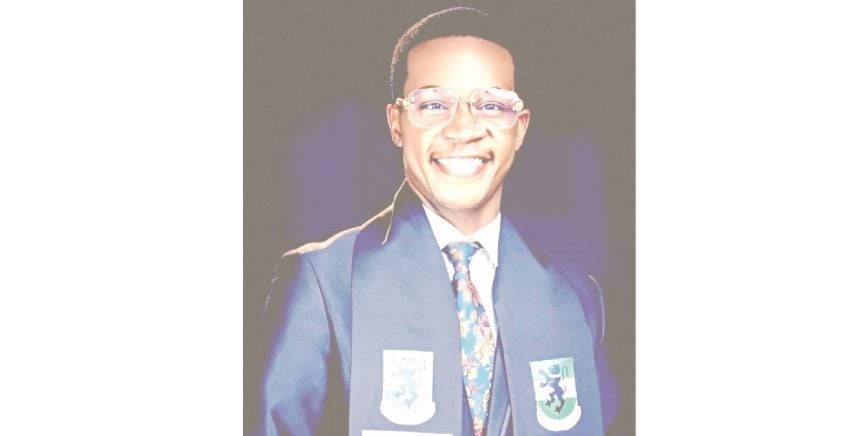
Chinonso V. Anidiobi graduated with a First Class from the Department of Management, University of Nigeria (UNN), for the 2024-2025 session. He finished as the best in his class with a Cumulative Grade Point Average (CGPA) of 4.69 on a scale of 5.0. In this interview by KINGSLEY ALUMONA, he speaks about his academic feat, among other things.
How did you come to study management, and why did you choose to study it at the University of Nigeria (UNN)?
The University of Nigeria was always my dream school. It was UNN or nothing. I had always wanted to be a Lion. Growing up, I came across prominent public figures who passed through the four walls of ‘The Den’, and I knew I wanted that for myself.
As for my course, I was not quite sure initially. One of my school fathers at the time advised me to consider a course under the Faculty of Business Administration (now Faculty of Management Sciences). When I discovered there were four options at UNN, I researched each one thoroughly, and Management stood out. There was something about it that drew me in — the dynamism, the interdisciplinary nature, the way it touched every aspect of how organisations function. I went through the course outline and knew immediately that this was it. I prepared rigorously for JAMB and Post-JAMB, and earned an aggregate score of 284, which placed me not just on the merit list, but as the first name on it.
What did you do differently to graduate with a First Class? And what prizes and awards were accorded you for the feat?
A First Class was always the goal. It was never up for debate. But life tested that resolve very early. My father passed away just a few months after I gained admission. Honestly, I thought that was the end of my academic journey. But my mother was determined that I would finish what I had started.
What did I do differently? Majorly, three things. First, at the beginning of every semester, I would estimate the grade I wanted for each course, write them down on a piece of paper, and place them beside my bed. Seeing it every morning gave me strength on the days I felt like quitting. Second, I started early. During semester breaks, I would collect materials from senior colleagues, so by the time a new semester began, I had already covered most of my courses. Third, I studied smart, not just hard. I studied my lecturers, understood their patterns, and actively engaged in classroom activities. That combination of clarity, preparation, and strategy made the difference.
There were weeks I went without a proper meal, but the goal never changed. Four years later, I graduated with a CGPA of 4.69 and as the best-graduating student in my department.
I was honoured with three prize awards on the Convocation Awards Night for that feat. I also received merit awards as the Outstanding Academia of the Year and the Proactive Male Student of the Year during the annual departmental dinner and award night, among several other recognitions.
What are the main job descriptions of a management graduate or professional in an organisation? Use the banking and the telecommunication sectors to explain these roles.
At its core, a management professional is responsible for planning, organising, coordinating, and optimising resources — human, financial, and material — to achieve organisational goals efficiently. In banking, this translates into roles such as operations management, where professionals streamline branch processes and service delivery; risk management, where they identify, assess, and mitigate financial and credit risks; and strategic planning, where they align the bank’s growth objectives with market realities.
In telecommunications, management graduates drive roles in project management, overseeing network expansion and infrastructure rollouts; human resource management, coordinating large, distributed workforces; and business development, identifying new markets and revenue streams. Across both sectors, the common thread is the same: a management professional ensures that the right people, resources, and systems are working together toward a clearly defined objective.
What aspects or areas of management interest you most, and why?
Strategic management has always stood out to me. The ability to critically analyse complex environments and craft strategies that set organisations apart is something that genuinely fascinates me. It is where vision meets execution, and where the quality of a leader’s thinking determines whether an organisation thrives or merely survives. That fascination is why I made it a point to sharpen my critical thinking skills, both during and after university. However, my interests have evolved. I am currently transitioning into the field of sustainable finance, which, at its core, is strategic management applied to one of the most urgent challenges of our time: how organisations, as well as nations, allocate capital in a way that balances profitability with environmental and social responsibility.
My recent research on ESG reporting in Nigerian banks sits at that intersection — strategy, sustainability, and accountability. For me, the two fields are not separate. Sustainable finance is simply strategic management with a longer time horizon and a wider definition of value.
What was the title of your final-year project work, and what is its significance to society or the business sector?
My final-year project was titled ‘Knowledge management and performance of deposit money banks in Enugu State, Nigeria’. The study examined how three dimensions of knowledge management: knowledge identification, knowledge sharing, and knowledge application, affect bank performance, measured through employee productivity, customer satisfaction, and customer acquisition and retention.
The results were clear: all three dimensions of knowledge management had a significant positive effect on bank performance. Its significance to the business sector is practical. In an industry where competitive advantage increasingly depends on what an organisation knows and how effectively it deploys that knowledge, the study reinforces that banks that invest in structured knowledge management systems do not just improve internal efficiency; they improve the customer experience. It was also, in hindsight, my first serious encounter with researching the Nigerian banking sector, a thread that now runs through my current work on sustainable finance.
In one of the LinkedIn posts in which you announced your first-class feat, you stated, “The journey wasn’t a smooth one. It was a real struggle for me from my third-year second-semester, throughout my final-year first-semester, having no devices.” Tell us about this struggle and how you managed it.
In February 2024, my phone and laptop were stolen from my hostel room, courtesy of the infamous ‘window men’. Anyone who has stayed in a UNN hostel can relate. Other roommates who lost devices replaced theirs almost immediately. I could not. Things were incredibly tough at home. This was at the beginning of my third-year second semester, and the struggle stretched all through my final-year first semester, roughly six months without a personal device. I relied heavily on friends — Kossy, David, and Gerald, borrowing phones to research, study, and keep up with class updates. It affected everything. My reading pattern was disrupted, and my grades took a hit. It also affected my performance in some leadership roles I held at the time. Getting a new phone became a genuine prayer point.
Then a breakthrough came. I was selected as a recipient of the UNN-USA Scholarship. That scholarship allowed me to purchase a new phone and settle my outstanding tuition. More than the money, it reignited something in me. That final semester, I went all in and came out with a flawless 5.0 GPA.
If there is one lesson I want students to take from this, it is the power of social capital. It is one form of capital most people underestimate. You cannot do destiny alone. You need people, quality people. I am grateful I had a few in my corner when it mattered most.
ALSO READ: Why we killed Al Jazeera journalist, Mohammed Wishah — Isreal
If you were to address three national problems in Nigeria using your management expertise, what would they be, and how would you go about them?
I am still growing into my expertise, but three areas stand out. First is poor institutional governance. Many public institutions lack a clear strategy and accountability. A strategic management approach that ties leadership decisions to measurable outcomes would be a starting point. Second is environmental degradation, particularly in the oil-producing regions. My current research in sustainable finance has shown me that the tools exist to measure and manage environmental impact; the gap is in implementation. Third is youth unemployment. Nigeria has an abundance of human capital but a scarcity of structured knowledge transfer systems.
Drawing from my undergraduate research on knowledge management, I believe that building systems where skills, mentorship, and industry knowledge flow more efficiently between institutions and young people would help bridge that gap.
Looking at Nigeria’s current realities, what one national challenge would you advise President Bola Tinubu to manage well?
The integration of sustainability into Nigeria’s academic curriculum. Nigeria cannot build a sustainable economy with graduates who were never taught what sustainability means. I would advise the president, through the National Universities Commission, to mandate the inclusion of sustainability and climate literacy across all disciplines, not just in environmental science, but in business, STEM, law, and the arts. The future of every sector depends on professionals who understand environmental and social responsibility. If we teach it early, we will not need to retrofit it later.
Have you ever thought of becoming a lecturer? If you were appointed a lecturer at your university, which kind of innovation would you adopt to teach your students management better than your own lecturers did?
Absolutely. Lecturing is a long-term goal. I have always loved impacting those around me. In school, I chaired my department’s Academic Board, hosted countless tutorials for peers and juniors, and upon graduation, founded a mentorship forum that paired senior students with incoming ones, thereby bridging the gap I observed in how new students struggled to navigate university life.
If I were appointed a lecturer, I would adopt a case-study and simulation-driven approach, making management tangible, not abstract. Students should solve real organisational problems in the classroom, not just read about them in textbooks.
What three things would you like your university to improve on to make life and study easier for students and staff?
Security, infrastructure, and internet access. The hostel theft problem is well known. It disrupts students’ lives and academics in ways the university underestimates. Hostels and classrooms need urgent renovation. Also, restoring reliable internet access across the campus would significantly enhance learning and research output.
If you were given a fully funded postgraduate scholarship to study in any university in the world, which course would you study, at which university, and why?
Sustainable Finance, without question. How we allocate capital today will determine whether we meet or miss our climate goals. Africa sits at the centre of that conversation, yet the continent lacks enough professionals trained to design the financial systems this moment demands. Although I am still researching schools with the right fit, I am very much open to top institutions in the United States, the United Kingdom, or the Netherlands; all recognised for their strength in sustainable finance research and education. The importance cannot be overstated. The people trained in sustainable finance today will shape the financial architecture that determines what kind of planet the next generation inherits.
WATCH TOP VIDEOS FROM NIGERIAN TRIBUNE TV
- Relationship Hangout: Public vs Private Proposals – Which Truly Wins in Love?
- “No” Is a Complete Sentence: Why You Should Stop Feeling Guilty
- Relationship Hangout: Friendship Talk 2025 – How to Be a Good Friend & Big Questions on Friendship
- Police Overpower Armed Robbers in Ibadan After Fierce Struggle


