Having failed to grow for two consecutive quarters, the Nigerian economy was confirmed by senior officials of government to have entered recession. The reason for this, according to financial and economic experts, is that the Buhari administration was too slow in taking off. Again, since the passage of the 2016 budget, money has not been pumped into the economy in a way that will engender growth and development. SANYA ADEJOKUN looks at a recent meeting between Vice President Yemi Osinbajo and some economists and if and how such efforts would be impactful.
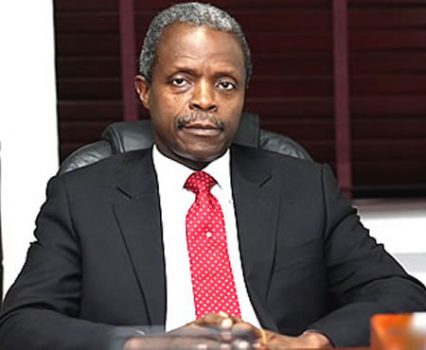
On August 3, this year, Vice President Professor Yemi Osinbajo, who is also head of the Economic Management Team of the Federal Government, along with other members of the team hosted five of the frontline economists from the private sector and academia. The meeting was actually convened to sample the views of the critics on the Mid-Term Economic Framework M-TEF that is currently in the works. No doubt, however, the government team seized the opportunity to also sound out the economic management gurus on way out of current economic quagmire.
Shortly after the meeting, which held at the Presidential Villa, Abuja, Minister of Budget and National Planning, Senator Udoma Udo Udoma said “we’ve just finished a special meeting of the economic management team, as you know, we are in the middle of consultations to develop the new mid-term economic framework, M-TEF. It is part of a comprehensive consultation process that we are embarking on to make sure that we reach out to a wide spectrum of Nigerians to get a feed back in terms of how best to make sure that we come out of this recession.”
Budgets for the next two years will be predicated on the M-TEF, which will be approved by the National Assembly.
The five-man team of economic consultants included Mr Bismarck Rewane, Mr Bode Augusto, Professor Akpan Ekpo, Dr. Ayo Teriba and Professor Badayi Sani. To be sure, the five represent different schools of economic thoughts.
Rewane, Agusto and Teriba are rightist economists, while Ekpo and Sani are a little to the left. This surely is good as government will be in a position to weigh all the development options and arrive at a decision likely to augur well for the economy. However, even without inviting them to the Villa, the views of these erudite economists are all over the cyberspace and most of them have proffered their brand of solutions to the long term economic mismanagement and stagnation that Nigeria has witnessed over the years.
Rewane for instance had early this year, pointed at the looming danger of not passing the 2016 budget on time, warning that except something urgent was done, the economy was going to be in trouble. He had declared during the impasse that followed the face-off between legislative and executive arms of government over budget that “Nigerians and the parliamentarians must understand the difference between what is important and what is urgent. There is no pure budget document. Approve those things that you are comfortable with and the things that you are not comfortable with, throw them back to the ministries to do what they have to do. We cannot afford to wait. You have to stimulate this economy into growth,” the economist stressed.
He added that “the debate at this time should be; is $38 a reasonable and realistic oil benchmark? Is it possible that we can produce 2.2 million barrels of oil per day when our quota is 1.7 and our actual production is 1.8 million? That is almost a 20 per cent deviation from the estimate. Is the deficit going to be N2.2 trillion when the price of oil has dropped and our revenue has dropped by 30 per cent? How are we going to fill the gap? Are we going to borrow? If we are going to borrow almost N2.3 trillion, where is the shortfall going to come from? These are the things we should be talking about.”
Again, Rewane advocated the freeing of naira by the Central Bank of Nigeria many months before the Bank eventually floated the currency when foreign exchange scarcity became an economic epidemic. In June, Rewane accused the Federal Government of insincerity in the efforts to diversify the economy.
“The revenue activity of this nation, are still concentrated on oil and gas, oil is about 89 per cent, LNG, 9 per cent and the rest.”
According to Rewane, “To test this hypothesis, ask yourself, if it is true, that oil makes only 15 per cent of this economy, close the oil wells today. It will mean that if you close them today, 85 per cent of the economy should continue. But (in reality) if you close them down, that same day, there will be no money going into the Central Bank of Nigeria (CBN), no dollar to fund trade, no dollar to convert into naira to fund the Government,”
“Nigeria’s misery index has risen from 44.1 to 45.6 per cent, about 45.6 per cent of the country’s populace could be considered miserable while the other are considered prosperous.
“When the misery index deteriorates consistently for two quarters, the favourable rating of that administration suffers severely. The state of the Nigeria economy, with a GDP of $500 billion and dependent on crude oil crude, as oil makes up only about 12 to 15 per cent of our crude, means that in term of revenue and the fuel that runs the economy, oil and gas mean everything.”
Ayo Teriba on his part, had observed that “while it is true that a myriad of problems was inherited from the previous regime, the new regime appears to be too preoccupied with internal challenges of government to be able to chart a future policy path for others outside government to plug into. The euphoria that heralded President Muhammadu Buhari’s regime is giving way to rising economic policy uncertainty as the regime is not providing any holistic indication of its fiscal or broader economic policy directions that others outside government can base their planning on.”
He then advised on the need to create economic management institutions that will: help him and the National Assembly engage more directly on economic issues and generate ideas and policy directives for ministries to implement in order to overcome the weak Presidential and Parliamentary economic engagement; and undertake the task of budgeting and policy coordination that previous regimes left in the hands of ad-hoc economic management teams, which are best undertaken from the Presidency. Teriba also emphasised the need to build some capacity for economic intelligence cannot be overemphasised, saying that the regime needs to draw practical clues from effective institutions of economic management in the US.
Although Agusto does not have massive media presence, his views are generally known to align with the likes of Rewane and Teriba. He was the Director of Budget between 2003 and 2007 but was rejected as a ministerial nominee by the Senate when late President Yar’Adua put his name forward.
And Just like Buhari, Ekpo, Director General, West African Institute for Financial and Economic Management (WAIFEM) abhors neo-liberalism. Shortly after the President was declared winner by the Independent National Electoral Commission in April 2015, Eko had advocated that the new regime should do away with stipulations of the Bretton Woods institutions as a way of boosting employment and enlarging the economy. According to him, except Buhari discards neo-liberalism, the economy would remain in perpetual doldrums.
When you liberalise your economy to the detriment of local entrepreneurs, it means you are indirectly killing local industries. Also, government must be able to check the excesses of private sector players. Government has a duty to manage the economy, therefore, the in-coming administration must be responsible and intelligent government. Aside curbing corruption, Ekpo wants this government to create public sector jobs by opening up the Civil Service. For instance, we can look at areas like Customs, Police, Immigration, Civil Defence, Air-force, Army, State Security Services (SSS) and Navy, where millions of Nigerians can fit into. “This is the time for government to provide employment instead of trying to down-size. The fact is that private sector is profit oriented and cannot employ a large population of Nigerians. So, deliberate government intervention is required to tackle this unemployment crisis,” he advised.
Sani, a development economist of the Keynesian school graduated from Bayero University (BUK) before proceeding abroad for his master’s degree. He returned to BUK as a lecturer and eventually obtaining PhD from Ahmadu Bello University. Keynesians believe that in the short run, economic output is strongly influenced by aggregate demand especially during recessions
In essence, even though a communique of the meeting between Federal Government Economic Team and the five economists was not issued, their views are well known and it can be deduced what they advised government to do.
In essence, analysts believe that Nigeria needed not have entered recession if government had not been too reluctant in taking some obviously necessary actions and listened to expert advice. Many argue that massive reflation of the economy in order to remove the country from recession. At a time like this, consideration for inflation should be set aside in favour of boosting production, creating employment and expanding the economy. Brazil at a time looked away from inflationary threats to massively pump money and so boost the economy and today, the country is in the global top 10 economies.
In addition, another short term measure is for the Federal Government to go all out and implement the capital and social aspect of the budget. The 2016 budget provides for N1.75 trillion capital expenditure aside the N500 billion allocated to special social intervention programmes. Of the N350 billion meant to be immediately released for the first quarter spending, just about N260 billion has so far been released according to Finance minister, Kemi Adeosun.
Another strategy is to return to the suggestion by Senator Bola Ahmed Tinubu who some time ago, advised the Jonathan administration to reflate the economy by massively printing money and pumping same into the economy. The idea was rejected by the then government, which said that the measure was likely to escalate inflation. Despite this excuse, the United States government and other industrialised nations regularly print money. During the last recession, the US Reserve Bank bought bonds and buying with printed money, or money that was electronically created. Even the CBN deployed this tactic in responding to the banks failure, shortly after Alhaji Sanusi Lamido Sanusi became governor. But since naira is not a convertible currency, political authorities must truly allow the CBN a free hand in managing the foreign exchange. A situation whereby politicians will direct the Bank to sell foreign exchange to pilgrims at concessionary rates while manufacturers are ignored will not help the cause.
Also in the medium term, the CBN should continue on the path of providing special intervention funds which it is already doing through the Anchor Borrowers’ Programme for agriculture and micro, small and medium enterprises development fund.
WATCH TOP VIDEOS FROM NIGERIAN TRIBUNE TV
- Relationship Hangout: Public vs Private Proposals – Which Truly Wins in Love?
- “No” Is a Complete Sentence: Why You Should Stop Feeling Guilty
- Relationship Hangout: Friendship Talk 2025 – How to Be a Good Friend & Big Questions on Friendship
- Police Overpower Armed Robbers in Ibadan After Fierce Struggle