
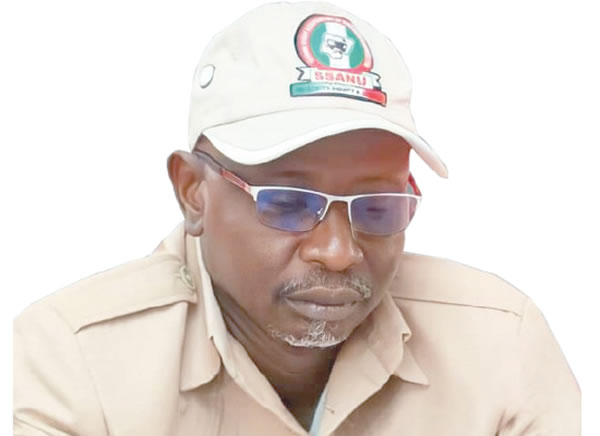
In this interview with CHRISTIAN APPOLOS, Comrade Mohammed Haruna Ibrahim said the continued delay of the Federal Government’s renegotiation of the 2009 agreement with university-based unions has heightened frustration among non-teaching staff in Nigerian universities, particularly after the Federal Government approved a 40 percent salary increment for members of ASUU. Excerpts:
What is the latest on the renegotiation of the 2009 agreement between the Federal Government and SSANU, NASU and NAAT?
Presently, we have reached a point where the committee handling the renegotiation informed us to wait for their offer from the government. The process is that they first receive feedback from their principals in government and then return to us with an offer which we will either accept or reject. That is the stage we are now. In our last interaction with them, we made our submissions and presented our demands as unions representing non-teaching staff in the universities. Those submissions were then forwarded to a technical committee established to review the issues raised. The technical committee looked at what we submitted and invited us for a meeting where we jointly examined the proposals. During that engagement, we looked at the areas where adjustments could be made and also provided additional clarifications where necessary. After that meeting, the technical committee took our feedback back to the main committee, with the expectation that the committee would deliberate and then invite us again to present their own counter-offer. However, the problem now is that the process appears to have stalled. Our major concern is that this renegotiation is taking far longer than expected. If the Federal Government had applied the same energy and urgency it used in concluding discussions with our sister union, the Academic Staff Union of Universities (ASUU), by now the renegotiation with the other university unions would have been completed. But unfortunately, that has not been the case. We have been waiting, and the waiting has been quite long.
What exactly is worrying the non-teaching staff unions about the delay?
Our concern goes beyond just the delay itself. What is particularly worrying to us is the impression that the issues affecting non-teaching staff are not receiving the same level of urgency that was given to the teaching staff unions. For instance, while this delay continues, the government has already issued circulars to universities for the implementation of the 40 percent salary increment granted to members of ASUU. Ironically, our members are the ones implementing those payments because the financial administration of the universities is handled largely by non-teaching staff. We are the accountants, the administrators and the finance officers who process those payments. So you can imagine the situation where someone is processing an increment for a colleague while his own welfare issues remain unresolved. This naturally creates a sense of frustration and dissatisfaction among workers. When people work in the same institution, live in the same environment, go to the same markets and face the same economic realities, it becomes very difficult to explain why one group is treated differently from the other. That is why many workers feel sidelined.
Since January, when we last met with the committee, there has been no further meeting. There has also been no indication as to when the next engagement will take place. If you visit university campuses today and interact with workers, you will notice that there is palpable tension. People are genuinely worried and complaining. It is important for the government to understand that universities do not run on academic staff alone. There is a whole structure that supports the academic work. Non-teaching staff provide essential services such as electricity management, water supply, finance administration, security services, records management, student affairs and many other functions that keep the universities running on a daily basis. Even lecturers cannot effectively carry out their teaching duties if these services are not available. So, the contribution of non-teaching staff is fundamental to the stability of the university system.
How important is it for the government to put a timeframe on the work of the committee?
This is extremely important at this stage.
When issues that directly affect workers’ welfare remain unresolved for too long, it begins to affect morale and productivity. Workers cannot be expected to give their best when they feel neglected or unfairly treated. At the moment, there is a situation where one segment of the university workforce has received a 40 percent salary increment, while the majority of workers, who are the non-teaching staff, are still waiting for negotiations to be concluded. That naturally creates a perception of inequality.
The government must also remember that we are in a political season. University workers constitute a significant portion of the Nigerian population. Apart from being workers, they are also citizens who participate in the democratic process. They are voters, they are opinion leaders in their communities, and they influence many other people. If they feel marginalised or treated as second-class citizens, it will certainly affect their perception of government. Therefore, it is important for the government to demonstrate fairness and commitment by concluding this renegotiation as quickly as possible. The President should empower the committee handling this matter and ensure that relevant institutions such as the Ministry of Education, the Office of the Accountant-General of the Federation, the National Salaries and Wages Commission, the Budget Office and the Federal Ministry of Finance work together to resolve the issues. Workers must be made happy because when workers are satisfied, the system functions better.
Are the unions considering any action if the delay continues?
In the trade union movement, we operate through established procedures and structures. We do not take decisions arbitrarily. Each union has a National Executive Council which is responsible for determining the direction of the union, including decisions on industrial actions. For SSANU, our National Executive Council will be meeting in the last week of March.
At that meeting, we will review the current situation and assess the level of progress that has been made regarding the renegotiation. Based on the outcome of that meeting, the council will determine the next line of action. Other unions within the university system such as NASU and NAAT will also meet within their own structures to evaluate the situation and decide their next steps.
In addition to that, the unions operate under the Joint Action Committee (JAC), where we coordinate our collective response on issues affecting non-teaching staff in the universities. As the current chairman of JAC, I can tell you that we will also meet to discuss the matter and decide on the appropriate course of action. But one thing is very clear: we cannot continue to wait indefinitely. Workers have shown patience and maturity, but patience also has its limits.
Away from the renegotiation issue. There were earlier reports about plans to outsource some university jobs. What is the current situation?
Let me say very clearly that if anyone tells you that university workers in Nigeria are happy under the current conditions, that person must be living in a different reality. The economic challenges facing the country are affecting everyone, including university workers. So when the issue of outsourcing certain university jobs was raised, it generated serious concern among our members. As unions, we immediately wrote to the Federal Government expressing our strong opposition to such a move. Since then, we have not received any formal communication indicating that the policy will be implemented. For that reason, we want to believe that the government listened to the concerns raised by the unions and other stakeholders.
READ ALSO: 2027: No plan to drop Shettima as Tinubu’s running mate — APC
But we want to state clearly that any attempt to outsource university jobs without following due process will be strongly resisted by the unions. Interestingly, the reality today is that many universities are already understaffed. At the same time, new universities are being established across the country. When you establish new institutions, you obviously require more personnel to run them effectively. Universities are the foundation for the development of human capital in any nation. They produce the professionals that drive the economy: doctors, engineers, lawyers, teachers, administrators, journalists, and many others. If universities are weakened, the consequences will be felt across every sector of society. That is why issues affecting the welfare of university workers should be treated with seriousness.
What about the issue of insecurity SSANU always worry about, what is the current situation?
Security has become a major concern across the country, and universities are not immune to these challenges. One of the problems we have identified is that many public universities do not have proper perimeter fencing. This makes them vulnerable because people can easily gain access to the campuses from multiple entry points. The government must take deliberate steps to ensure that universities are properly secured with perimeter fencing.
Secondly, there is a need to strengthen the security personnel working within the universities. Many of the security officers in the universities are retired members of the military or police who already have basic security training. What they need is refresher training and the necessary equipment to enable them perform their duties effectively.
WATCH TOP VIDEOS FROM NIGERIAN TRIBUNE TV
- Relationship Hangout: Public vs Private Proposals – Which Truly Wins in Love?
- “No” Is a Complete Sentence: Why You Should Stop Feeling Guilty
- Relationship Hangout: Friendship Talk 2025 – How to Be a Good Friend & Big Questions on Friendship
- Police Overpower Armed Robbers in Ibadan After Fierce Struggle


