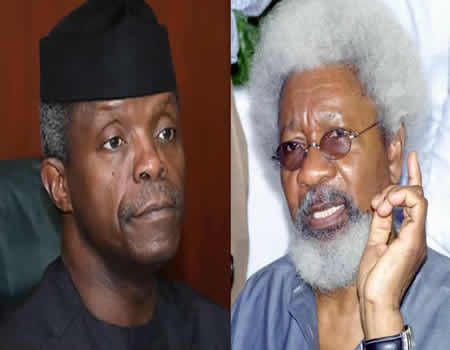
The prestigious Shehu Musa Yar’Adua Centre will on Thursday morning be a beehive of activities as prominent Nigerians including Vice President Prof. Yemi Oshinbajo, Prof. Wole Soyinka, Prof. Ibrahim Gambari, former Senate President Ken Nnamani gather to launch the book, Religion and the Making of Nigeria.
Written by Geoffrey Canada Professor of Africana Studies & History at Bowdoin College, Maine, Prof. ‘Femi Vaughan, the nine-chapter book provides an opportunity for distinguished intellectuals of Nigerian politics and history to lead a discussion on the critical role of religion in the formation of the Nigerian state and society.
Speaking with Nigerian Tribune in Abuja on Wednesday, Vaughan insisted that Nigeria would not be able to solve its incessant conflicts between adherents of Christianity and Islam especially in the middle belt and core north until citizens fully comprehend the nature and causes of the conflict.
According to him, the reason why south west, where the population of Christians and Muslims are almost equal have not been volatile as in most parts of the north was because the two religions arrived only after the people had already marked their identity as Yoruba people.
Contrarily however, Islam arrived much earlier in the north and so, Hausa-Fulani people see themselves first as Muslims before considering their ethnicity.
In addition, the scholar insisted that religion in the country is a constant source of conflict because politicians see in it a potent instrument to garner political and economic advantage.
He expressed hope that the book will engender in its readers the spirit to financially decide to put an end to the conflicts that have retarded national progress and prosperity.
“With complicated relations between Christians and Muslims in the Northern and central regions of the country, Nigeria is one of the world’s major laboratories for the study of religious- based conflict and reconciliation”, he explained.
“I am persuaded that the intersections of these competing religious traditions— Islam, Christianity, and indigenous religions— are decisive in the making of modern Nigeria.
“Starting with a major Muslim reformist movement— the Sokoto Jihad—in con temporary Nigeria’s vast Northern Region, and a Christian evangelical movement, propelled by the influential English missionary organization called the Church Missionary Society (cms), in Atlantic Yoruba communities in southwestern Nigeria during the nineteenth century, I argue that Muslim and Christian structures made up the foundation on which the Nigerian colonial state was grafted in the early twentieth century.
“This perspective underscores how the persistence of Muslim and Christian structures has consistently produced contending— and competing— doctrines, practices, and ideologies to transform Nigeria’s complicated social and political landscape.”
Divided into two parts, the first section analyzes the impact of Islam and Christianity on three major Nigerian regions where the two world religions consistently intersect to shape the evolution of modern Nigeria from the nineteenth century to the twenty-first century; these three intersecting regions are the Hausa- Fulani and Kanuri Muslim North (the region dominated by the Sokoto Caliphate), the traditionally non- Muslim Middle Belt region (a religious and culturally distinct section of Britain’s Northern Nigerian Protectorate in con temporary central and northeastern Nigeria), and the Yoruba Muslim- Christian crossroads in the southwest region of Britain’s Southern Provinces.
The second section provides detailed analyses of how the recurring crisis of sharia (Islamic law) in postcolonial Nigeria essentially reflects the structural imbalance between emirate Northern Nigeria on the one hand, and Nigeria’s Middle Belt and Southern Regions on the other, going back to the amalgamation of Britain’s Northern and Southern colonial provinces in 1914.
Some of the issues raised include the causes and consequences of religious alliances between Nigeria’s ethno- regional political classes and their local constituencies; how might we assess the political roles of Muslim and Christian movements in Nigeria’s deeply divided society; what are the implications of enduring political and social roles of these formidable religious movements for the legitimacy of the Nigerian nation- state?
Others are how have the complicated relations between Christian and Muslim groups shaped governance and development in con temporary Nigerian society; what are the strengths and weaknesses of the local and national conflict- resolution mechanisms used to address Nigeria’s recurring religious crises?
Vaughan expressed hope that the analyses in this book will provide some thoughtful reflection for those interested in the important public policy dimensions of the critical role of Christian- Muslim relations in the governance of Nigeria.
“Overall, this book attempts to address these critical questions through a comprehensive analysis of relations between state and society, and the political struggles between Hausa- Fulani Muslim society and other regions in the country.”
The conclusion brings the issues analyzed in the book together. The persistence of religion- based conflicts in Nigeria underscores an urgent need to devise viable constitutional and political mechanisms to mitigate recurring religious violence in Nigeria’s Northern and Middle Belt communities.
WATCH TOP VIDEOS FROM NIGERIAN TRIBUNE TV
- Relationship Hangout: Public vs Private Proposals – Which Truly Wins in Love?
- “No” Is a Complete Sentence: Why You Should Stop Feeling Guilty
- Relationship Hangout: Friendship Talk 2025 – How to Be a Good Friend & Big Questions on Friendship
- Police Overpower Armed Robbers in Ibadan After Fierce Struggle