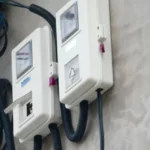
As part of the programmes to eliminate the Nigeria’s seven million metering gap, the Federal Government has said it is targeting the procurement of about 10 million meters under the Presidential Metering Initiative (PMI) over the next five years.
This, the Minister of Power, Chief Adebayo Adelabu, would be implemented with an average of delivering two million meters in a year.
Besides, he explained that another initiative to deliver 3.45 million meters into the electricity sector is the Distribution Sector Recovery Program (DISREP) under the support of the World Bank.
He also listed the Meter Asset Provider (MAP) Scheme, which relies on private companies to provide and install meters; and the Meter Acquisition Fund (MAF), another mechanism to finance meter deployment.
However, based on data from the Nigerian Electricity Regulatory Commission (NERC) from late 2024 to early 2025, the national electricity metering rate in Nigeria has shown slow, incremental progress, leaving a significant portion of customers on estimated billing.
As of December 31, 2024, only about 55 per cent of the 10.1 million active electricity customers were metered, with some reports citing a lower rate of 46.57 per cent (6.29 million out of 13.5 million registered customers).
Early 2025, the national metering rate was reported at 55.01 per cent, with 6.58 million customers metered by August 2025.
Progressing to October 2025, the national electricity metering rate rose to 56.07 per cent with 6.77 million customers metered out of 12.07 million active registered customers.
Despite these gains, millions of customers still remained unmetered, indicating that nearly one in two electricity customers still relies on estimated billing.
Shedding more light on the Federal Government’s efforts in regards to the Presidential Metering Initiative (PMI) , the minister said it was designed to further accelerate meter deployment, strengthen local manufacturing capacity, create jobs, and deepen private-sector participation, with the injection of up to two million meters annually into the electricity sector.
According to him, the initiative was made possible under the purpose-driven leadership President Bola Ahmed Tinubu, through which the Federal Government has successfully mobilized N700 billion in funding from FAAC to implement it.
“Together, these programs reflect a coherent and holistic approach to finally closing Nigeria’s metering gap.
“We are optimistic that in a couple of years to come, every household, every business, every institution, and every industry will be fully metered, so that billing and collections in the power sector will become more transparent, will be very fair, and will be very, very just.
“And it will also improve the readiness of consumers of electricity to pay their bills; that will lead to improved liquidity in the sector. When you have improved liquidity in the sector, the sectoral revenue will be able to pay a higher percentage of the energy costs in the industry, which will eventually lead to improvement in efficiency, improvement in effectiveness of operations, and we’ll be able to achieve the much-awaited stability, reliability, and functionality of electricity supply to our households, businesses,” the minister said.
Speaking at the premises of NEMSA Test Station, Adelabu said that, as part of the continued oversight of critical reforms in Nigeria’s electricity sector to close the longstanding metering gap, the implementation of DISREP remains one of the most consequential reform instruments in the power sector, adding that its metering component is central to restoring transparency, fairness, and financial discipline across the Nigerian Electricity Supply Industry.
The Director – General, Bureau of Public Enterprises (BPE), Mr Ayo Gbeleyi , who was on the entourage of the minister of power to APM Terminal in Apapa, remarked that, in the history of Nigeria, there has never been a time where electricity meters to consumers have been imported or implemented on this scale and size.
“In total, under the various programmes, whether it’s the Distribution Centre Recovery Programme financed by the World Bank or the Presidential Mandate Initiative, we have a combination of almost seven million metres to be deployed in the country. And as the minister said, this is just the first batch of 1,437,500 units that we are implementing.
“We are in the process of awarding the second batch of another 1.55 million metres for consumers.
“So this is phenomenal. This is impactful. So all we are doing is also to call on all stakeholders to work with us collaboratively in a manner that we can fast track the deployment of these meters so that we can breach this metering gap as quickly as possible,” he said.
ALSO READ: Tinubu yet to redeem pledge on power stability — Peter Obi
According to available data, he said that about 6.9 million consumers have not been metered nationwide, adding that Nigeria’s government has sufficient capacity and plan to cover that metering gap as soon as possible.
“This is also good for the consumers.The issue of estimated billing, which has been a nagging problem, will also be eliminated,” he said.
On our part at the Bureau of Public Enterprises, Gbeleyi said the agency is coordinating the loan programme, adding that it also served as a representative of government on all the boards of the electricity distribution companies.
“So, as much as government’s effort is going into this, we are also working assiduously with the distribution companies to ensure seamless handshake and implementation of this programme,” he said.
WATCH TOP VIDEOS FROM NIGERIAN TRIBUNE TV
- Relationship Hangout: Public vs Private Proposals – Which Truly Wins in Love?
- “No” Is a Complete Sentence: Why You Should Stop Feeling Guilty
- Relationship Hangout: Friendship Talk 2025 – How to Be a Good Friend & Big Questions on Friendship
- Police Overpower Armed Robbers in Ibadan After Fierce Struggle