
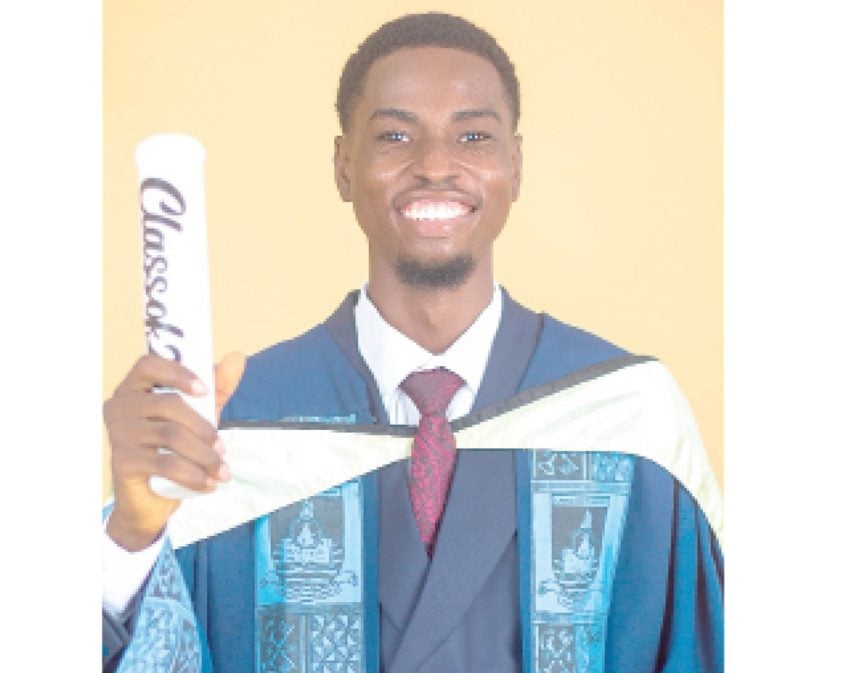
Saheed Sunday graduated from the Department of English, Lagos State University, for the 2025-2026 session, with a First Class. He finished with a Cumulative Grade Point Average (CGPA) of 4.59 on a scale of 5.0. He published two poetry collections before graduating. In this interview by IFEOLUWA ADEYEYE, he speaks about his academic feat, among other things.
What or who influenced you to study English? And why study it at LASU?
The biggest influence behind my studying English Language is Mr Babatunde Sanyaolu, my secondary school English teacher. For the backstory, I did not start as an academically excellent student. In the middle of secondary school, I moved from Lagos to one of the worst places in Ogun State, and the environment changed me completely. I doubted my parents knew this, but I became one of those students who went to school and never reached the classroom. Then, by sheer luck, Mr Sanyaolu came to our class to announce a school debate and asked anybody interested to raise their hand. I raised mine because I wanted to ask him a question, but everyone mistook it for volunteering and started clapping for me. Shame would not let me tell them otherwise.
After the debate, Mr Sanyaolu saw something in me that I could not see in myself. So, he took me under his wing. This was a man everyone loved because of how he taught. He was the only interesting teacher who would even gift students for answering his questions. Being close to him let me watch his way of thinking up close, and I fell in love with it. I went from enjoying his classes to teaching grammar myself in the library, writing poetry, and being sent by the school management to represent us at competitions.
So, yes, English was my first-choice course, because it was the one through which I first found my purpose.
As to why LASU, I have always been the kid who detested burdening his parents with his own responsibilities. So, I was never going to choose an institution that would break their purse. Obafemi Awolowo University and University of Ibadan were my first two choices, but they were not open for admission that year. So, I went with the next option I could afford. Today, I cannot help thinking LASU was a blessing. My story might have turned out differently anywhere else.
Graduating with a First Class and as the best in your department, how would you describe the journey? What did you do differently to achieve these feats?
In 100 level, the only thing that mattered to me was that I was the first person in my family to ever attend a university. But my very first result made me realise that would not automatically translate to academic success, so I had to take my academics more seriously.
Instead of reading over and over again, hoping I had read more than everyone else in my class, I would only read enough to teach what I had read. That was my stand-out point. Teaching not only made me understand what I had read; it also showed me where I was still lacking.
What was your final-year project about and its significance to society?
I developed a grammatical formula that anyone can use to understand the structure and meaning of Nigerian spoken-word poems. It was a project nobody had done before, and the drive for it came from watching people talk about how inaccessible poetry can be. So, I thought, as a poet myself, what could be better than bringing people to the point of understanding poetry, whether or not they are lovers of it.
Do you see English as a lucrative course to study these days? What kind of impact would you like to make with your degree and knowledge of English in your community or Nigeria?
Yes. That aphorism people often dismiss as false, that when you study English you can work anywhere, is absolutely true. It makes you someone everyone needs, and the only reason that would not hold is your own skill level. I started earning as an editor when I was an undergraduate.
As for impact, everything I have done so far through teaching, public speaking, advocacy, and even my project has pointed in one direction. I intend to take language that people have been made to feel locked out of and then hand them the key. So, my ambition is simple. If I can get even a handful of people to the point where expressing their thoughts stops intimidating them and starts arming them, then I am fulfilled.
Did you produce any literary work or engage in any creative project as an English and literature undergraduate student?
Yes. I put out two poetry collections, the first published in Nigeria and the second in Canada. But my biggest flex as a creative was having my book recommended as a compulsory text in my own course and writing an exam on it.
ALSO READ: Nigeria moves to produce armoured vehicles, anti-drone systems locally — DICON-D7G
In what ways do you think literature can make society a better place? And how do you think the government can leverage literature and creatives to foster effective leadership in society?
Literature is an object of society, which is to say it cannot do anything or excel on its own. I do not think it is the function of literature to create a better or a worse society, but it does let us see what each of those two worlds looks like. It is, therefore, left to creatives to paint a vivid picture of the society they want to live in, and to government to make that society exist.
How would you describe your social life on campus? And, were you engaged in any leadership or entrepreneurial endeavours as a student?
I did not exactly have a good social life. The only parties I attended throughout my undergraduate years were dinner parties. But when I had to balance my academics with the numerous leadership roles I held, it was inevitable that something would give. It would have been worse still with an entrepreneurial endeavour added to it.
If you were offered a fully funded scholarship to study in any university in the world, which university would it be, which course would you study, and why study the course?
The University of Cambridge. They are the best in the world for Literature in English, the course I want to do for my master’s.
Many students believe that it is difficult, or even impossible, to combine a rigorous academic life and extracurricular activities and still graduate with a First Class. What advice would you give to this type of student, using your academic achievements as an example?
Balance is difficult and almost unachievable. I was able to excel at both academics and extracurricular activities because I had an ecosystem of like-minded people. This was how it worked. I was friends with the most intellectual people in my department, and we even had a name for ourselves, the Savants of English. We organised tutorials for our coursemates, held some for ourselves, and argued about things far beyond what we had been taught in class. Staying in the top one per cent was easy because almost every discussion we had was geared towards academics. In the same way, being in the LASU Debate Society put me among the best public speakers and poets on campus, which made winning easier, because opportunities were always being shared.
So, if there is one piece of advice I would give anyone struggling right now, it is to keep a circle of people who share your values.
WATCH TOP VIDEOS FROM NIGERIAN TRIBUNE TV
- Relationship Hangout: Public vs Private Proposals – Which Truly Wins in Love?
- “No” Is a Complete Sentence: Why You Should Stop Feeling Guilty
- Relationship Hangout: Friendship Talk 2025 – How to Be a Good Friend & Big Questions on Friendship
- Police Overpower Armed Robbers in Ibadan After Fierce Struggle


