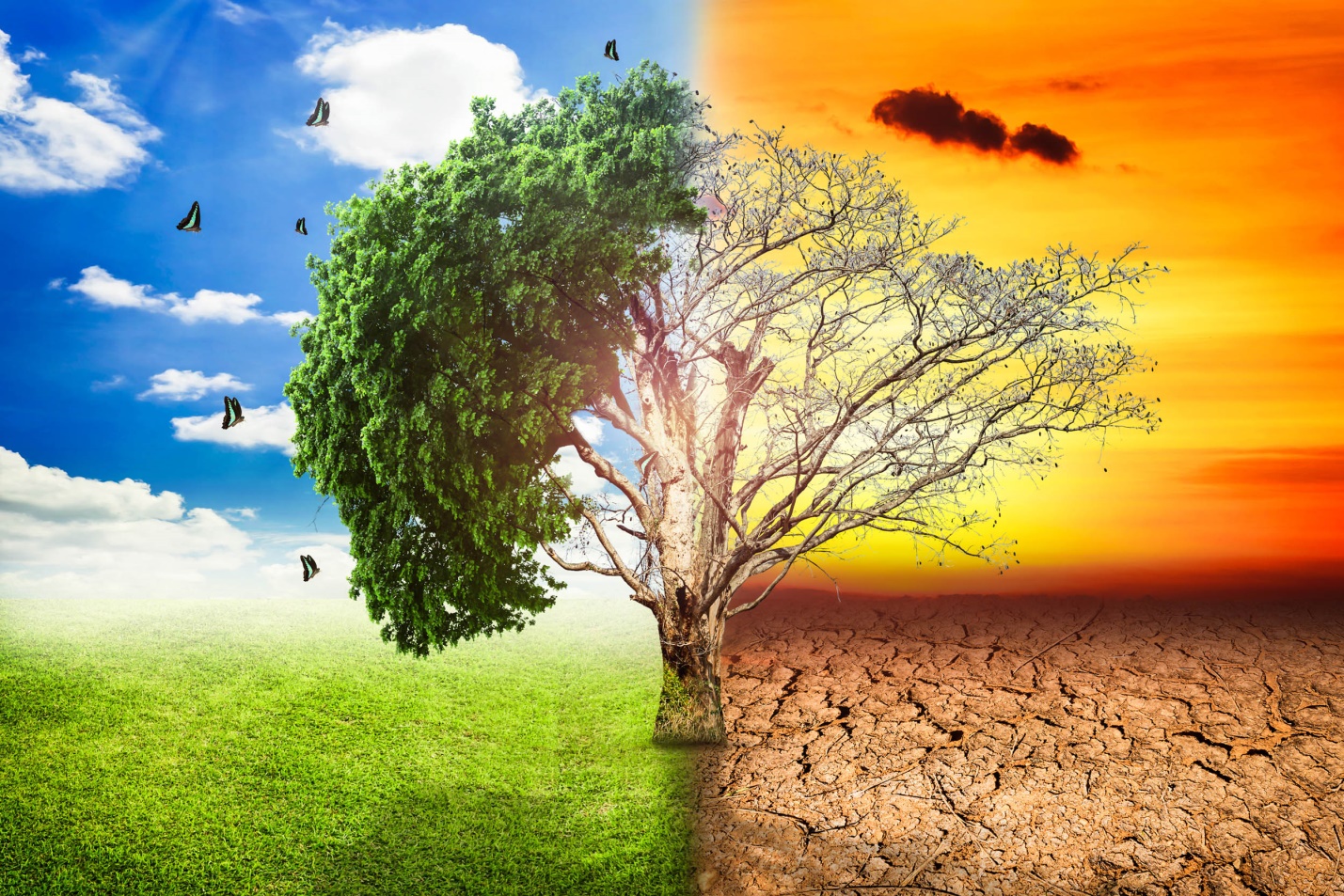
 Climate change is a global issue calling for urgent attention. Writing about the dire effects of climate change in the Nigeria , as an environmental economist and climate change writer, cannot be more important anytime than now, because Nigeria, one of the most vulnerable countries to the harshest impacts of climate change, is feeling the burden of climate change in our everyday lives, whether directly or indirectly.
Climate change is caused both by natural occurrences, and mainly by human actions on the environment. The natural causes of climate change is, as a result of variations in earth’s orbit, variation in ocean circulation, variation in albedo of the continents, as well as variation in solar radiation [Wikipedia]. The human causes are, however, results of deforestation, air pollution, and poor agricultural practices such as bush burning, excess and wrong application of inorganic fertilizer, burning of fossil fuels, urbanisation, industrialisation, inefficient transport system, among others. It is important to note that the United Nations Framework Convention on Climate Change [UNFCCC], uses “Climate change” for human induced change, with the term “Variability” for changes due to natural phenomenon [Intergovernmental Panel on Climate Change, IPCC].
The year 2017 witnessed series of climate-related disasters in Nigeria, ranging from the increased health risk, declining agricultural productivity, biodiversity loss, drying lakes, famine, conflicts or social unrest, poverty, worsening food insecurity situation, heat stress, declining soil capacity for agricultural production, increased natural disaster, extreme weather events, among others.
One of the major country-specific effects of climate change in Nigeria is declining agricultural productivity, which is due to the irregular, unpredictable farming calendar. The usual April-October rainy season and the October-March dry season is no longer a constant as it has been for some decades now. Farmers now plant in the midst of great uncertainties, thus resulting in untold losses, for their investment waste away from lack of rainfall at the right time.
Consequently, this result in decline in productivity, and the income of Nigerian farmers, as well as a likely fall in the agriculture share of GDP, which stands at 29.15% of Q3-2017 GDP figure [NBS] and employment.
The Agricultural Promotion Policy [APP], of the current federal government, reviewed the Agricultural Transformation Agenda [ATA] policy of the Jonathan government, and found that we still have gaps in demand and supply of key crops [FMARD Policy & Strategy Document, APP 2016-2020, 9]. But with declining agricultural productivity, due to climate change, the gaps are set to widen even further.
Another [indirect] effect of climate change is the issue of clashes between herdsmen and farmers, which is a serious and prevailing social problem in Nigeria. Due to the problem of rainfall variability, caused by climate change, herdsmen in the core North, now push down South more frequently, in order to feed their cattle on farmers’ cultivation. This has mutated over time in the destruction of investments and efforts, while also attacking outspoken farmers, a situation for which hundreds of lives have been brutally lost in Benue, Taraba, Nasarawa, Ogun and several other states, a stat corroborated by the National Emergency Management Agency (NEMA).
Decades ago, pastures were arguably available at reasonable level in both the North and South of Nigeria, and these clashes were almost non-existent. Evidence is seen from the changing nature of the nation’s ecological zones. Hence, we see serious clashes result, because these nomadic herdsmen want to satisfactorily feed their cattle, often at the expense of farmers’ cultivation. This issue needs urgent unbiased action in Nigeria now. The support of the international community at this point will be valued, as the Nigerian government has not been able to give satisfactory, non-ethnical and proactive solutions, while lives are wasting away.
There is also an increasing rate of natural disasters and extreme weather events. Northern Nigeria is becoming more of a drought-prone area, with an advancing desert, already encroaching southward, thus making the few cultivable lands of the north, almost uncultivable. Flooding is no small issue in Nigeria, with hundreds of thousands of people, agribusiness and property lost in 2017, in Benue State, Kano, Lagos and other states [according to NEMA]. It is now a robust mechanism for numerous diseases to breed, especially vector-borne diseases like Malaria [WHO puts Nigeria as the nation with the highest Malaria casualties worldwide]. And because of drought, children, especially in the North, now stand at risk of malnutrition.
According to United Nations Children’s Fund (UNICEF), Nigeria currently has the highest number of malnourished children, who are under the age of five. The erosion of low-lying coastal and non-coastal regions of Nigeria is also disaster, which is also causing buildings to collapse, with attendant loss of lives, while also raising construction cost as its implication.
Of important concern also are the drying lakes in Nigeria, with the drying Lake Chad, which is at the junction of Chad, Cameroon, Nigeria and Niger as a valid reference point. Andrew Bamford, a British investigative journalist, on 14th April, 2006, reported that the lake is now less than 500 square miles of water due to global warming. The consequences of the drying of these lakes include loss of means of livelihood of citizens that borders these lakes, who depend on it for farming, fishing, drinking and animal husbandry, as well as unrest and forced migration which places burden on the new location they are relocating to.
Another very important effect of climate change in Nigeria is the declining soil carrying capacity and heat related problems on humans, crops and livestock. Due to deforestation, trees which should serve as cover for soil against the harsh sunshine, are felled indiscriminately, thereby, exposing soils and reducing soils productive capacity, and thus, creating problems for agriculture in Nigeria. Heat-related incidents are on the rise, as well as heat stress (hyperthermia) on both crops and livestock, because of increasing greenhouse gas emissions, leading to high losses in crop and livestock production.
Climate change has cost Nigeria an increasing loss of biodiversity, from which several problems have emerged, such as the destruction of marine ecosystem, loss of nature’s balance, as well as destruction of freshwater resources. This situation currently poses problems for man, as he cannot live in isolation, but in interdependence with his environment. Failure to protect the environment is like a death penalty, hence, we must, as a centre of focus, ensure that the protection of the Nigerian ecosystem is not undermined.
As the way forward, it is important to realize that we have to combat climate change at all levels, by both mitigating against and adapting to its consequent effects on our nation. To do this, we must invest in many mitigation and adaptation projects. Many of the already existing projects, such as the resuscitation of the drying Lake Chad, the Ogoni clean-up project and the Great Green Tree Wall project in eleven northern states et, among others, should be completed without delay.
For the declining agricultural productivity due to extreme weather events, farmers should be encouraged to plant drought-resistant varieties and rear high yielding, resilient livestock breeds.
Good architectural design of houses that ensures quality ventilation should be developed, to help people deal with heat waves and stress from climate change. The use of carbon sinks mechanisms for absorbing CO2 is needed in Nigeria to tackle climate change and its consequent effects, especially on a nation like Nigeria with large forest of about 69930 sq. km [World Bank, 2015].
All arms of government should ensure policies that support the use of more clean, renewable energy, rather than the heavy investments in coal-based energy, which has not helped the economy, as inconsistent power supply still persists across the country, with several businesses paralysed.
Government and relevant stakeholders should extensively fund research in climate change in tertiary institutions and research institutes across the nation. Efficient database management system on climate change occurrence and related events should be developed, in order to ensure effective and timely response to climate change incidents in Nigeria.
On the herdsmen crisis, due to their nomadic nature, grazing can be said to have no place in 21st century Nigeria. An idea that is already in existence, but has not been largely considered, is the hydroponics fodder, with ready, rich fresh grass-feed for our cattle, pioneered by BIC FARMS Concepts, and located in Ikeja, Lagos State. More funds and support should be provided to this organisation and agricultural research institute to bring this idea to limelight. If we must solve this crisis once and for all, we must ensure our cattle are raised in ranches like it is in developed climes. Rearing cattle in ranches is even more beneficial and healthy for everyone and the cattle. The ranch strategy will provide jobs for youths, revenue for government and equally ensure security of lives of property.
To conclude, that our frontline farmers, women, children, aged people are at the receiving end of climate change effects is incontestable. We cannot continue to suffer this way. Climate change is real and if these issues are not addressed now, a gloomy future awaits Nigeria. Our government should rise up, show strong leadership and political will that sends a message to our counterpart nations; that we are ready to tackle climate change and related issues on all fronts in Nigeria. Every one of us should also be responsible for our environment, and only then can we have the peace that comes with such actions and attitude.
Olufemi, a climate tracker writer and Agricultural & Resource Economics graduate of The Federal University of Technology Akure, wrote in via [email protected]
WATCH TOP VIDEOS FROM NIGERIAN TRIBUNE TV
- Relationship Hangout: Public vs Private Proposals – Which Truly Wins in Love?
- “No” Is a Complete Sentence: Why You Should Stop Feeling Guilty
- Relationship Hangout: Friendship Talk 2025 – How to Be a Good Friend & Big Questions on Friendship
- Police Overpower Armed Robbers in Ibadan After Fierce Struggle