
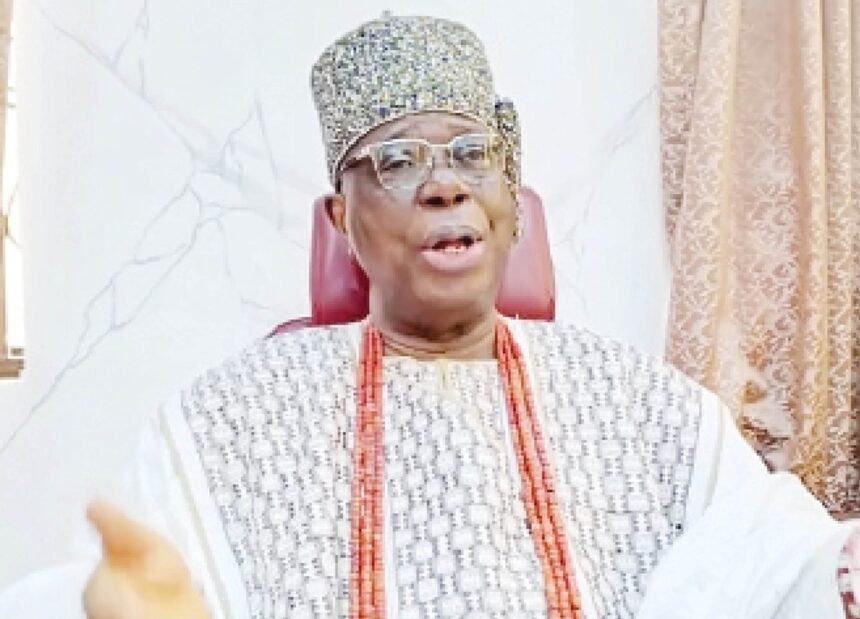
•‘Oyebanji is leading Ekiti in line with the blueprint prepared by the founding fathers’
Ahead of his 80th birthday and 35th coronation ceremonies this weekend, the Ewi of Ado-Ekiti, Oba (Dr) Rufus Adeyemo Adejugbe Aladesanmi III, in this interview by ‘YOMI AYELESO, speaks on his experience of service and legacy on the throne, the traditional institution, the progress of Ado-Ekiti and Ekiti State under Governor Biodun Oyebanji, among other issues.
Looking at the journey in the last 80 years and 35 years on the throne, how do you feel and what have you been able to achieve for the community?
Well, first of all, I give glory to God Almighty for sparing my life and granting me the grace to be alive today. Let me say that 35 years is not a day. The period consists of three and a half decades. When I got to this place 35 years ago, all the infrastructures in the palace required urgent attention. The late Ewi Anirare was here for over 40 years and he did very well. The first storey building in this palace was started during his reign, and the last effort on that project was on the 28th of August, 1948. The building was so magnificent that schoolchildren then trooped to the palace every day for two weeks to dance, eat, and go home — that was how happy the people were. But afterwards, people went on a kind of sabbatical.
By the time I came in, the structure had become dilapidated because it was made of mud, and cracks were everywhere. The other building initiated during the reign of my predecessor, Oba George Adelabu, was uncompleted. From the gatehouse, everywhere looked neglected, and I kept asking myself: “How will I survive this?” I placed everything before God.
Fifty years ago, before I became king, I never saw myself as the Ewi of Ado-Ekiti. When it became obvious and my name came up, I prayed that if it was God’s wish, it should happen so that His name would be glorified; but if it would become a source of regret, then it should not happen. When I eventually came, I put everything before God. From the gatehouse today, you can see the hand of God everywhere.
I started by asking an architect from the Federal Polytechnic, the late Oluwadiya, who was then Director of Works, to help prepare drawings for what should be put in place in the palace. At a time, we had about seven drawings. The man asked, “Kabiyesi, where is the money to execute all these?” I told him not to worry. To God be the glory, we picked the projects one after the other, and God has been faithful. From the gatehouse to other sections, the palace has witnessed tremendous transformation.
Beyond the palace transformation, what other significant improvements has this ancient town recorded since you became the traditional ruler, and what would you consider your legacy?
Well, there was peace, because the town was highly polarised when I ascended the throne; it was heavily divided into two factions because of the chieftaincy problem. One faction, Omo mi la muun mi, supported Prince Adegoke; the other, Erinle Ado agbe mi, supported the then Ewi, Oba George Adelabu. Reconciliation appeared impossible.
One day, leaders of Erinle Ado agbe mi came to me and urged me to use my authority against the other group. They complained that the Omo mi la muun mi group met every Sunday, disturbing the peace of the town, singing and physically attacking anyone identified as Erinle Ado agbe mi. They wanted me to use the police to suppress them.
I laughed and told them: “As the Ewi of Ado-Ekiti, all these people are my subjects. If I use the police to oppress them, it means I am not capable of being the Ewi. I should be their leader.” I assured them that one day the matter would become history.
Today, we thank God, the town is united and speaks with one voice. There is unity of purpose. We take advantage of the Udiroko Festival, which is our only unifying festival, marking the day our forefathers settled here under the Iroko tree. Every year, we celebrate it. So, the legacy is that Oba Rufus Adeyemo Adejugbe came at a turbulent time, and God used me to restore unity and peace. By the time I leave, Ado-Ekiti will remain united and progressive by the grace of God.
The traditional institution is very demanding. How have you balanced your role as monarch, father, husband and grandfather?
Well, I would say I am very lucky. By God’s mercy, I have a wife who is a mother to the entire family, the Eyesorun of Ado-Ekiti, Eyesorun Margaret Abosede Adejugbe. She is a woman who can do anything for the family. If I am not around and something requiring millions of naira needs to be done, she will handle and complete it before I return.
I recall one time I was in Abuja during the reign of the late Ooni of Ife, Oba Okunade Sijuade. Whenever he travelled, more than 10 or 15 traditional rulers accompanied him. One day he said, “Ewi, we are going to eat lunch at your palace today.” I called the Eyesorun immediately and told her to prepare for about 100 guests. This was before the era of easy money transfers. She went as far as Igbokoda in Ondo State to get fresh fish and prepared all kinds of meals.
When we arrived, Ooni sampled every dish, fried rice, jollof, soups, testing the quality. After he finished, he and all the Kabiyesis were satisfied. He then asked someone: “What job was the Ewi doing before he became king? To organise a meal like this for 100 people without notice?” He was amazed.
This was possible because of the Eyesorun’s organisational ability. I also thank God for the other Oloris and the entire Ewi-in-Council. For 35 years, there has been no major rift. Ado-Ekiti people are supportive and blessed. I enjoy the grace of God.
Almost 30 years since the creation of Ekiti State, no Ado-Ekiti indigene has become governor. Is this a cause you would be willing to champion?
I am not a politician. I remember our visit to General Abacha in Lagos during the agitation for state creation. He told us: “You are traditional rulers. You are different from politicians. You cannot be governor or commissioner.”
Just as in Akure, Ondo State was created in 1976 and no Akure son has been governor, I know Ado-Ekiti’s turn will come. What matters most is peace and development. The average Nigerian cares less about where the leader is from, but whether he can put food on the table. Of course, it is good for an Ado-Ekiti person to be governor, but not by force. One day, it will happen.
Are you comfortable with the level of development in Ado-Ekiti compared with other state capitals, especially in the South West?
Well, “comfortable” is relative. Maybe we are not there yet, but we are better. When I came in, Ado-Ekiti was a local government headquarters with only a Divisional Police Office. Today, we have a full Police Command and about six DPOs. The number of secondary schools has increased more than tenfold, including private schools. At that time, the only higher institutions were the University of Ado-Ekiti (now EKSU) and the Federal Polytechnic. Today, we have EKSU, Afe Babalola University (ABUAD), Crown Polytechnic and others. Economically, we are still struggling, but Rome was not built in a day. We have reasons to thank God.
What challenges have you encountered in the last 35 years on the throne, and how did you overcome them?
The initial disunity ended because God intervened. Another challenge came when the Vice-Chancellor of UNAD, Prof. Bodunrin, and the Registrar, Deji Adegbite, approached me over accreditation problems. Many courses lacked facilities. They challenged me to contribute.
I asked for their list and chose the Faculty of Law because three sets of students were unable to graduate due to lack of accreditation. They assumed I would give them money to add to whatever they had. Instead, I said Ado people would build the Faculty of Law.
They said it must be ready in six months. I said they should not worry. During Udiroko Festival, I presented the challenge to Ado people. We formed a committee with Aare Afe Babalola, SAN, as chairman. Within six months, the structure was completed and accreditation started that year. Today, only God knows how many lawyers the faculty has produced.
How did the struggle for the creation of Ekiti State begin, and what role did you play in making Ado-Ekiti the capital?
I was about six months on the throne in 1991 when Commissioner Babatunde led a delegation to me. They were meeting at Chief Deji Fasuan’s house and needed royal support. I accepted. Perhaps God brought me to the throne for that purpose. I joined the struggle, which lasted six years.
One Sunday, during Bishop Akinbola’s Silver Jubilee celebration, I asked the bishop how he planned to host the Kabiyesis after the service. He had no plan, so I offered to host them. Over 100 traditional rulers came. Instead of merrymaking, they used the gathering to lament that Nigeria had recently created six states and Ekiti, which was qualified, was left out.
They demanded we begin agitation immediately. We began meeting every two weeks. I cancelled my trip to Lagos and accepted to chair the committee of royal fathers. Leaders of thought merged with us. There was no part of Nigeria we did not visit. It was a harrowing six-year struggle. Eventually, Ekiti State was created, and Ado-Ekiti became the capital.
Many in Ado-Ekiti are concerned about non-indigenes acquiring property in ancestral areas. Do you see this as a problem?
The Nigerian Constitution allows citizens to own property anywhere. We cannot legally stop anyone from buying property in Ado-Ekiti.
However, I always warn my people to think carefully before selling ancestral homes. They must consider their children, who will one day want a place to call their father’s house. People see a lump sum, maybe N100 million, and rush to sell. But after sharing the money among family members, each person may end up with less than N200,000. Soon, the money is gone and they move to virgin lands, while the buyer enjoys the city centre. It is a challenge, yes, but constitutionally, buyers have the right.
Looking back 29 years after creation, have the dreams that inspired the movement for Ekiti State been fulfilled?
Honestly, no. Those who struggled for the state did not emerge as governors in the early years. We had a blueprint. General Abacha told us there would be no take-off grant; we said we were ready. I wrote to the pioneer Military Administrator, Colonel Mohammed Inuwa Bawa, and even proposed commissioner nominees. But some inherited officials misinformed him, saying the Ewi wanted to hijack the administration. That created a divide.
But today, Governor Biodun Oyebanji, who was our secretary during the struggle, understands the blueprint. He is reaching out to past governors, calling for unity, even engaging the opposition. Today, you can hardly speak of opposition because he has united everyone. That spirit of unity was the foundation of our struggle.
Has the Oyebanji administration lived up to expectations in the last three years, based on the blueprint?
As I said, Oyebanji is like the mother of the baby; he knows exactly where the shoe pinches. That is why he has performed better than all previous governors put together. He was part of us, part of the struggle and he understudied past administrations. Without hesitation, I consider him the best among them.
The traditional institution in Yoruba land faces scrutiny due to the conduct of some traditional rulers. What is your take, especially regarding ascension processes?
I know what I passed through during my ascension. There are rites you must perform before becoming an Oba. If you truly desire the throne, you must submit yourself to the process. It is that process that moulds you and teaches what to do and what not to do. No religion forbids performing the traditional rites required to become an Oba. You may be Christian or Muslim, but your conduct as king should reflect dignity and influence others positively. However, I do not support the cancellation of traditional processes for ascension. As I have said, we are all human with individual differences, but the fact remains that there is a process you must undergo before you become an Oba.
WATCH TOP VIDEOS FROM NIGERIAN TRIBUNE TV
- Relationship Hangout: Public vs Private Proposals – Which Truly Wins in Love?
- “No” Is a Complete Sentence: Why You Should Stop Feeling Guilty
- Relationship Hangout: Friendship Talk 2025 – How to Be a Good Friend & Big Questions on Friendship
- Police Overpower Armed Robbers in Ibadan After Fierce Struggle


