
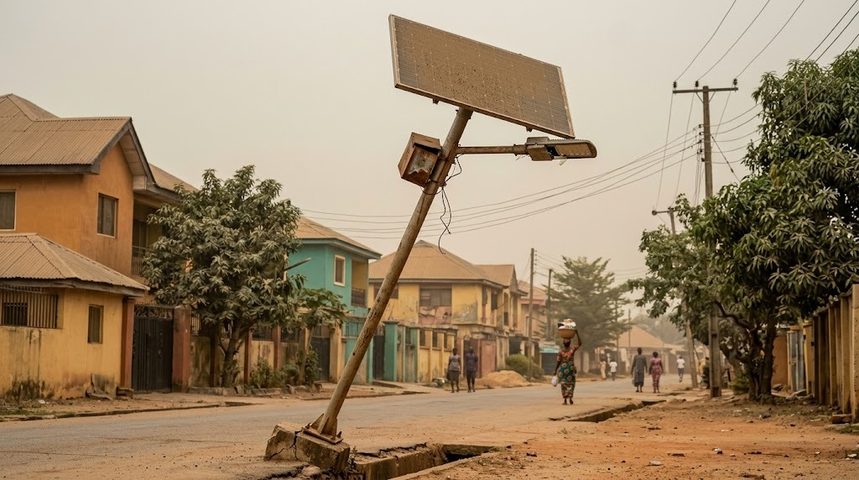
Many suburban communities in Nigeria welcome solar streetlights with excitement. Residents look forward to well-lit streets, better security, and nighttime business activity. However, that joy often turns to disappointment after barely six months when the lights go completely dark.
According to research published in the Nigerian Journal of Technology (NIJOTECH), a significant number of standalone solar streetlights installed across developing communities experience early operational failure due to poor component selection and inadequate system monitoring.
In this article, Tribune Online examines the five major technical and environmental factors responsible for these rapid failures and what can be done to keep solar streetlights shining bright.
Low-quality batteries and deep over-discharge
The battery serves as the heart of any solar lighting system because it stores energy collected during the day to power the LED bulb at night.
Contractors sometimes install cheap lead-acid batteries or low-grade lithium cells to cut installation costs.
These inferior batteries cannot withstand daily deep discharge cycles. Over six months of continuous night usage, their capacity drops drastically until they can no longer hold enough charge to power the light through the night.
Dust, harmattan soot, and neglected cleaning
Solar panels require clean surface glass to convert sunlight into direct electrical current efficiently.
In suburban areas with unpaved roads and construction sites, heavy dust and seasonal Harmattan haze quickly coat the glass panels.
Heavy dust and soot accumulation on solar panels can reduce total power generation by up to 40 percent. This drop prevents the battery from fully charging, causing early system shutdown every night.
ALSO READ: 5 ways HR departments use 360-degree feedback to justify planned layoffs
Substandard charge controllers and poor wiring
The charge controller acts as the brain of the solar streetlight by regulating current flow from the panel to the battery and controlling light activation at dusk.
Substandard controllers lack protection against voltage surges and extreme outdoor temperatures. Poor wiring connections made during rush installations often loosen due to wind vibration or corrode from rainwater ingress.
When moisture gets into unsealed joints, it causes short circuits that destroy the controller within months.
Wrong panel orientation and shading from trees
A solar panel must receive direct, unobstructed sunlight for at least six hours daily to generate sufficient power.
During installation, technicians sometimes mount panels flat or position them toward trees and tall buildings without considering seasonal sun angles. Over time, growing tree branches cast shadows across the panel surface. Even partial shading across a few cells drastically reduces overall panel voltage and prevents full daily charging.
Total lack of routine community maintenance
Solar streetlights are not “install and forget” devices; they require periodic checks to maintain performance.
Many local government authorities and community associations fail to set up maintenance schedules or assign trained personnel to inspect the installations.
Simple maintenance steps such as wiping panel surfaces every three months, trimming overgrown branches, and tightening loose structural bolts are routinely ignored.
Without basic upkeep, small manageable faults quickly escalate into permanent system breakdowns before six months elapse.
WATCH TOP VIDEOS FROM NIGERIAN TRIBUNE TV
- Relationship Hangout: Public vs Private Proposals – Which Truly Wins in Love?
- “No” Is a Complete Sentence: Why You Should Stop Feeling Guilty
- Relationship Hangout: Friendship Talk 2025 – How to Be a Good Friend & Big Questions on Friendship
- Police Overpower Armed Robbers in Ibadan After Fierce Struggle


