Esteemed historian, Prof. Toyin Falola, has warned that ethnic and religious politics remain the greatest threats to Nigeria’s unity and democratic progress.
Delivering a powerful address at the Prof. Ayo Olukotun Memorial Lecture on Tuesday, March 18, 2025, at Adeline Hall, Lead City University, Ibadan, Prof. Toyin Falola sharply criticized the persistent grip of ethnic and religious allegiances on Nigerian politics. He warned that these sectarian divisions continue to erode national governance, weaken democratic institutions, and fuel ongoing political instability.
Falola, while speaking on the theme Ayo Olukotun and the Nigerian Nation, asserted that ethnic and religious loyalties have overshadowed national discourse, replacing merit-based leadership and policy-driven governance with identity politics. He maintained that these deep-seated divisions have inflicted significant damage on the nation, ultimately “relegating the nation to a state of disunity.”
Falola pointed to the 2019 presidential election as a key example of how tribal and religious sentiment dictate political choices, even when candidates share similar backgrounds. Despite the two leading candidates being from the same region and religious background, the election remained divisive, reinforcing deep-seated fears and mistrust among different ethnic and religious groups.
“Why is there so much apprehension and foreboding when the presidential race is mainly between two politicians of northern extraction, who belong to the same religion?” he asked. He lamented that rather than uniting the electorate, such elections only expose the fragility of Nigeria’s national cohesion.
Beyond elections, Falola criticized the tendency of ethnic and religious considerations to influence key political appointments. He argued that this practice has weakened governance, promoted mediocrity, and discouraged meritocracy, as leaders prioritize sectional loyalty over competence and national interest.
He observed that ethnic and religious biases have eroded the very foundations of democracy, turning public office into a battleground for personal and sectional gain rather than a space for service and national development.
Falola did not shy away from addressing the role of religion in Nigerian politics, emphasizing that rather than being a moral force for accountability and good governance, religion has become a political tool in the hands of power-seeking elites.
“Instead of serving as a bulwark for the anti-corruption crusade, religion has been hijacked by political gladiators who act out of cynical self-interest, not caring for the larger good,” he stated. He warned that as long as public office remains ‘an arena of obscene wealth acquisition,’ religious and ethnic divisions will persist, preventing Nigeria from achieving true national unity.
He further criticized how politicians exploit religious sentiments to distract the public from governance failures. Instead of focusing on pressing national issues such as economic growth, security, and infrastructure, leaders “perfect the game of ethnic and religious manipulation, using it to secure votes and evade accountability.”
To break free from the grip of ethnic and religious politics, Falola stressed the urgent need for national reorientation and political maturity. He called for governance based on competence rather than sectional affiliation, arguing that Nigeria’s future depends on moving beyond identity politics toward issue-based leadership.
“We cannot keep sacrificing national progress on the altar of sectional sentiment,” he warned. “A nation so hopelessly divided such as Nigeria is today, cannot make much progress without revisiting the terms of our unity in diversity.”
According to him, strengthening national institutions is key to ensuring that democracy is protected from the dangers of ethnic and religious manipulation. He urged civil society, intellectuals, and the media to push for a new political culture that prioritizes policy-driven debates over sentimental politics.
He further argued that civic engagement must go beyond voting along ethnic or religious lines, emphasizing that Nigerians must begin to demand policies that address the country’s core challenges rather than supporting leaders based on regional or religious affiliations.
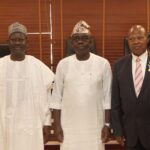
The Prof. Ayo Olukotun Memorial Lecture drew an esteemed audience of scholars, political figures, and intellectuals. Presiding over the event was Dr. Olorunnimbe Mamora, former senator of the Federal Republic of Nigeria, who provided insightful reflections on the theme. Prof. Kabiru Adeyemo, Vice Chancellor of Lead City University, served as the chief host, reinforcing the institution’s commitment to fostering national discourse. Also in attendance were Dr. Dyebola Ayeni, Registrar of Lead City University, and Dr. Igho Fayomi, Chair of the Organizing Committee, both of whom played key roles in organizing the landmark event.
Falola challenged leaders and citizens alike to embrace a new vision for governance—one based on competence, integrity, and a commitment to national progress, just as he remarked that “We must choose the path of unity over division, competence over sentiment, and governance over tribalism. Nigeria will not move forward until we dismantle the structures that fuel disunity and put national interest above sectional loyalty.”
ALSO READ TOP STORIES FROM NIGERIAN TRIBUNE
WATCH TOP VIDEOS FROM NIGERIAN TRIBUNE TV
- Relationship Hangout: Public vs Private Proposals – Which Truly Wins in Love?
- “No” Is a Complete Sentence: Why You Should Stop Feeling Guilty
- Relationship Hangout: Friendship Talk 2025 – How to Be a Good Friend & Big Questions on Friendship
- Police Overpower Armed Robbers in Ibadan After Fierce Struggle